AQA · GCSE · Combined Science
Course version: 8464 · Version from Sept 2018
Fractional distillation and petrochemicals: The vast array of natural and synthetic carbon compounds occur due to the ability of carbon atoms to form families of similar compounds.
Carbon has four electrons in its outer shell, so each carbon atom can form four covalent bonds.
- 3 key terms
Study notes
From the checked teaching notes for this specification point.
The idea
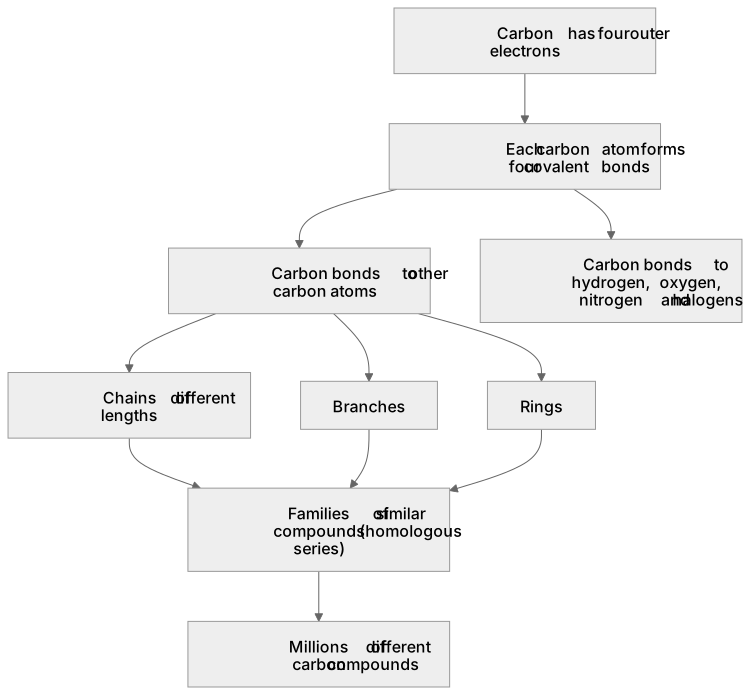
Carbon has four electrons in its outer shell, so each carbon atom can form four covalent bonds. This lets carbon atoms bond to one another in chains, branches and rings, and also bond to hydrogen, oxygen, nitrogen and halogens. Because the same small set of bonding patterns repeats, carbon compounds fall into families called homologous series, such as alkanes (CₙH₂ₙ₊₂), alkenes (CₙH₂ₙ), alcohols (CₙH₂ₙ₊₁OH) and carboxylic acids (CₙH₂ₙ₊₁COOH). Natural compounds come from living things, for example the hydrocarbons in crude oil and the carbohydrates in plants; synthetic compounds are made by humans, for example plastics such as poly(ethene) and medicines such as aspirin. Millions of different compounds are possible because the chain length, branching and functional group can all vary.
What earns the marks
- Carbon atoms each form four covalent bonds, which allows carbon to bond to other carbon atoms and to elements such as hydrogen, oxygen, nitrogen and chlorine.
- Carbon atoms can join into chains of different lengths, and the chains may be straight, branched or arranged in rings.
- A homologous series is a family of compounds with the same general formula and similar chemical properties, in which each member differs from the next by a CH₂ unit.
- Natural carbon compounds are obtained from living organisms or geological sources, for example hydrocarbons in crude oil and carbohydrates in plants.
- Synthetic carbon compounds are manufactured by humans, for example poly(ethene) from ethene and aspirin from salicylic acid.
- The variety of possible chain lengths, branching patterns and functional groups explains why so many different carbon compounds exist.
Common mistakes and how to put them right
Thinking carbon forms only one bond.
Put it right: Carbon has four outer electrons, so it forms four covalent bonds, as in methane CH₄.
Confusing natural with synthetic.
Put it right: Natural compounds are produced by living things or found in nature, whereas synthetic compounds are made by humans, even if they copy a natural substance.
Assuming a homologous series contains identical compounds.
Put it right: Members share a general formula and similar reactions but have different numbers of carbon atoms, so their physical properties change gradually.
Exam tips
- When asked why carbon forms so many compounds, link the answer to carbon's four covalent bonds and its ability to form chains, branches and rings.
- Give one named natural example and one named synthetic example, and state clearly which is which.
- If a general formula is given, check it against a named member, for example C₃H₈ fits CₙH₂ₙ₊₂ for an alkane.
Try the lesson
The start of the Fractional distillation and petrochemicals: The vast array of natural and synthetic carbon compounds occur due to the ability of carbon atoms to form families of similar compounds. lesson, made from checked teaching notes for this specification point.
Have a go first
There is a vast array of natural and synthetic carbon compounds. What property of carbon atoms allows so many different compounds to exist?
Listen
Carbon has four electrons in its outer shell, so each carbon atom can form four covalent bonds. This lets carbon atoms bond to one another in chains, branches and rings, and also bond to hydrogen, oxygen, nitrogen and halogens. Because the same small set of bonding patterns repeats, carbon compounds fall into families called homologous series, such as alkanes (CₙH₂ₙ₊₂), alkenes (CₙH₂ₙ), alcohols (CₙH₂ₙ₊₁OH) and carboxylic acids (CₙH₂ₙ₊₁COOH). Natural compounds come from living things, for example the hydrocarbons in crude oil and the carbohydrates in plants; synthetic compounds are made by humans, for example plastics such as poly(ethene) and medicines such as aspirin. Millions of different compounds are possible because the chain length, branching and functional group can all vary. A strong answer earns marks for these points. Carbon atoms each form four covalent bonds, which allows carbon to bond to other carbon atoms and to elements such as hydrogen, oxygen, nitrogen and chlorine. Carbon atoms can join into chains of different lengths, and the chains may be straight, branched or arranged in rings. A homologous series is a family of compounds with the same general formula and similar chemical properties, in which each member differs from the next by a CH₂ unit. Natural carbon compounds are obtained from living organisms or geological sources, for example hydrocarbons in crude oil and carbohydrates in plants. Exam tip: When asked why carbon forms so many compounds, link the answer to carbon's four covalent bonds and its ability to form chains, branches and rings.
See it
Key words
Say what each word means before you turn the card.
Homologous series
Try answering aloud or in your head before turning the card.
Natural carbon compounds
Try answering aloud or in your head before turning the card.
Synthetic carbon compounds
Try answering aloud or in your head before turning the card.
See every definition
- Homologous series
- A family of compounds with the same general formula and similar chemical properties, in which each member differs from the next by a CH₂ unit.
- Natural carbon compounds
- Compounds obtained from living organisms or geological sources, for example hydrocarbons in crude oil and carbohydrates in plants.
- Synthetic carbon compounds
- Compounds manufactured by humans, for example poly(ethene) from ethene and aspirin from salicylic acid.
Label the diagram
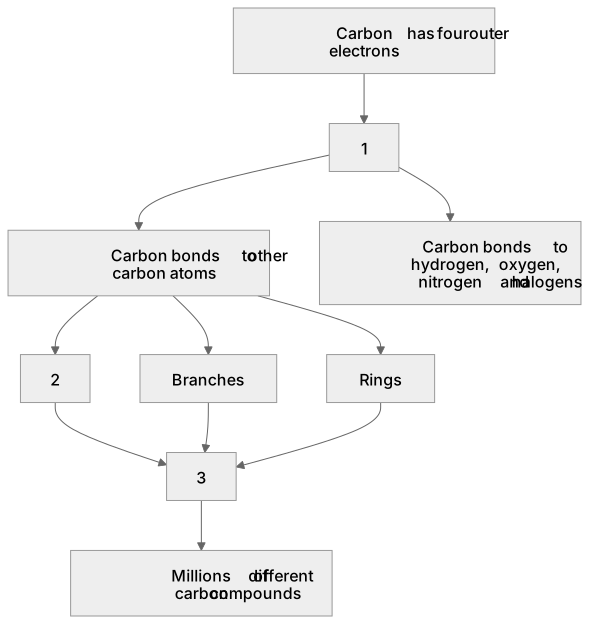
Some boxes have lost their names. Pick the right name for each number.
1Box 1
2Box 2
3Box 3
There is more to this lesson
The full lesson goes on to check your understanding and help you earn the marks. Create a free account to carry on, with your progress saved.
A week of Premium from your first lesson · Then the free plan continues · No card, no charge
Test your understanding of Fractional distillation and petrochemicals: The vast array of natural and synthetic carbon compounds occur due to the ability of carbon atoms to form families of similar compounds.
Active recall beats re-reading. Take an instant quiz now to test what you’ve learned and lock it into long-term memory.
A week of Premium from your first lesson · Then the free plan continues · No card, no charge