AQA · GCSE · Combined Science
Course version: 8464 · Version from Sept 2018
Life cycle assessment: disposal at the end of its useful life, including transport and distribution at each stage.
A life cycle assessment (LCA) covers every stage of a product's existence, and this statement focuses on two parts: disposal at the end of its useful life, and the transport and distribution that…
- 3 key terms
Study notes
From the checked teaching notes for this specification point.
The idea
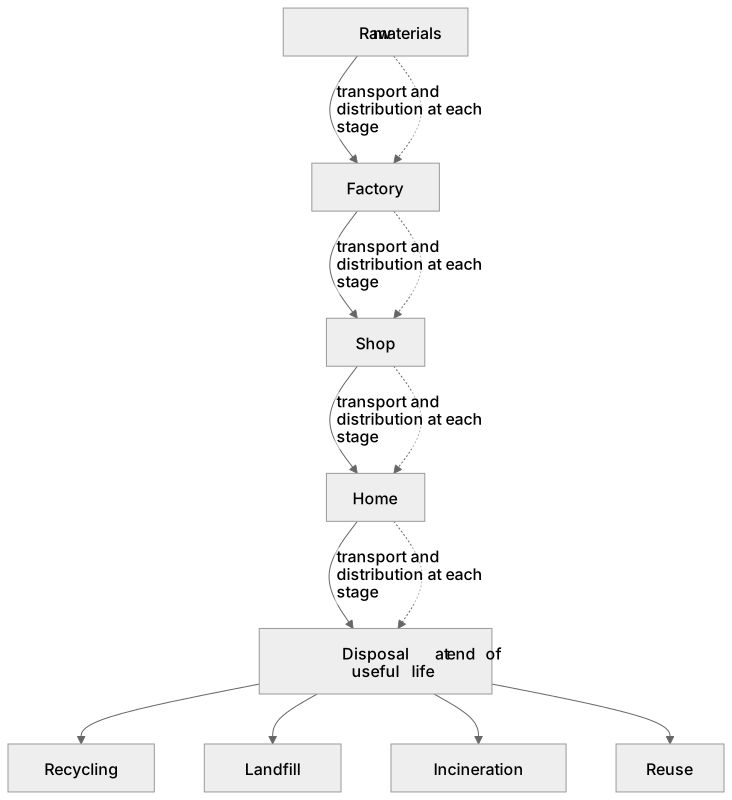
A life cycle assessment (LCA) covers every stage of a product's existence, and this statement focuses on two parts: disposal at the end of its useful life, and the transport and distribution that occurs at each stage. Disposal means deciding what happens when a product no longer works or is no longer wanted: it may be recycled, sent to landfill, incinerated or reused, and each route has different environmental costs. Transport and distribution must be counted at every stage, because moving raw materials to a factory, finished goods to shops and waste to a disposal site all burn fuel and release emissions.
For example: A glass bottle made, filled, delivered and later recycled involves several journeys, and each one adds to its overall impact.
What earns the marks
- Describes disposal options at end of life, such as recycling, landfill, incineration or reuse.
- Explains that different disposal routes have different environmental impacts, for example landfill versus recycling.
- States that transport and distribution occur at each stage of the life cycle, not only at the end.
- Gives examples of transport stages, such as raw materials to factory, product to shop and waste to disposal site.
- Explains that transporting materials and products uses fuel and produces emissions.
- Links transport and disposal together as parts of a complete LCA rather than separate afterthoughts.
Common mistakes and how to put them right
Thinking disposal only means throwing items in the bin.
Put it right by naming recycling, reuse and incineration as alternatives with different impacts.
Forgetting transport between stages and counting only delivery to the customer.
Put it right by listing journeys at every stage, including waste collection.
Assuming recycling has no environmental cost.
Put it right by noting collection and reprocessing still need transport and energy.
Exam tips
- When describing disposal, give at least two routes and say how their impacts differ.
- Mention transport at more than one stage to show you understand it applies throughout the life cycle.
- Use a short chain such as raw material to factory to shop to home to disposal site to structure your answer.
Try the lesson
The start of the Life cycle assessment: disposal at the end of its useful life, including transport and distribution at each stage. lesson, made from checked teaching notes for this specification point.
Have a go first
A life cycle assessment of a plastic bottle includes the stage where the bottle is thrown away after use. What is this stage called?
Listen
A life cycle assessment (LCA) covers every stage of a product's existence, and this statement focuses on two parts: disposal at the end of its useful life, and the transport and distribution that occurs at each stage. Disposal means deciding what happens when a product no longer works or is no longer wanted: it may be recycled, sent to landfill, incinerated or reused, and each route has different environmental costs. Transport and distribution must be counted at every stage, because moving raw materials to a factory, finished goods to shops and waste to a disposal site all burn fuel and release emissions. For example, a glass bottle made, filled, delivered and later recycled involves several journeys, and each one adds to its overall impact. A strong answer earns marks for these points. Describes disposal options at end of life, such as recycling, landfill, incineration or reuse. Explains that different disposal routes have different environmental impacts, for example landfill versus recycling. States that transport and distribution occur at each stage of the life cycle, not only at the end. Gives examples of transport stages, such as raw materials to factory, product to shop and waste to disposal site. A common slip: Thinking disposal only means throwing items in the bin. Instead, naming recycling, reuse and incineration as alternatives with different impacts. Exam tip: When describing disposal, give at least two routes and say how their impacts differ.
See it
Key words
Say what each word means before you turn the card.
Disposal
Try answering aloud or in your head before turning the card.
Transport and distribution
Try answering aloud or in your head before turning the card.
Environmental costs
Try answering aloud or in your head before turning the card.
See every definition
- Disposal
- Deciding what happens when a product no longer works or is no longer wanted, such as recycling, landfill, incineration or reuse.
- Transport and distribution
- Moving raw materials to a factory, finished goods to shops and waste to a disposal site, which must be counted at every stage.
- Environmental costs
- The different impacts each disposal route has, and the fuel burned and emissions released when materials and products are moved.
Label the diagram
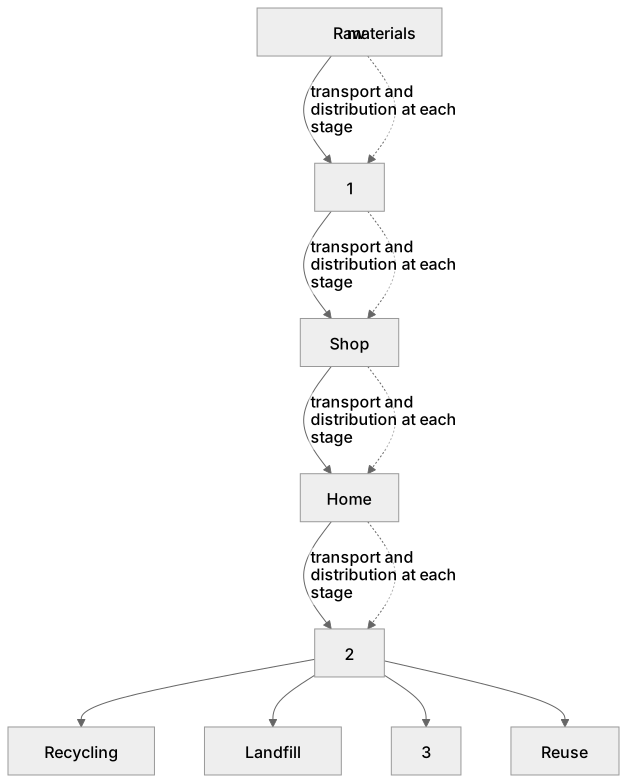
Some boxes have lost their names. Pick the right name for each number.
1Box 1
2Box 2
3Box 3
There is more to this lesson
The full lesson goes on to check your understanding and help you earn the marks. Create a free account to carry on, with your progress saved.
A week of Premium from your first lesson · Then the free plan continues · No card, no charge
Test your understanding of Life cycle assessment: disposal at the end of its useful life, including transport and distribution at each stage.
Active recall beats re-reading. Take an instant quiz now to test what you’ve learned and lock it into long-term memory.
A week of Premium from your first lesson · Then the free plan continues · No card, no charge