AQA · GCSE · Combined Science
Course version: 8464 · Version from Sept 2018
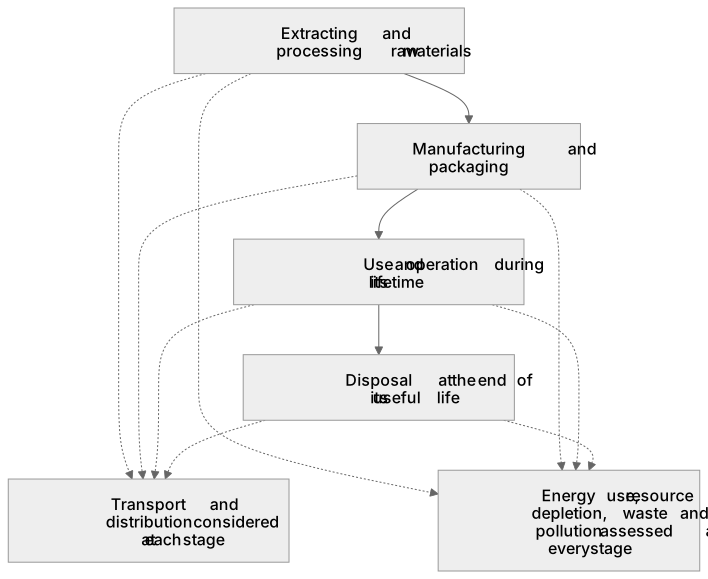
Life cycle assessment: Life cycle assessments (LCAs) are carried out to assess the environmental impact of products in each of these stages:
A life cycle assessment (LCA) evaluates a product's environmental impact across four main stages: extracting and processing raw materials, manufacturing and packaging, use and operation during its…
- 4 key terms
Study notes
From the checked teaching notes for this specification point.
The idea
A life cycle assessment (LCA) evaluates a product's environmental impact across four main stages: extracting and processing raw materials, manufacturing and packaging, use and operation during its lifetime, and disposal at the end of its useful life. Transport and distribution are considered at each of these stages. At every stage, energy use, resource depletion, waste, and pollution are assessed. For example, a plastic bottle requires crude oil extraction, whereas a glass bottle requires high-temperature melting but can be reused. LCAs are not simply about which material is 'best': the conclusion depends on the data and assumptions used. A fair comparison uses the same functional unit and states the boundaries of the assessment.
What earns the marks
- Names the stages: extracting and processing raw materials, manufacturing and packaging, use and operation, and disposal.
- Explains that transport and distribution are included at each stage of the life cycle.
- Assesses each stage for environmental impacts such as energy use, resource depletion, waste, and pollution.
- Applies the stages to a named product, such as a plastic or glass bottle, to show understanding.
- Recognises that the outcome depends on the data, assumptions, and boundaries used in the assessment.
Common mistakes and how to put them right
Omitting processing and packaging.
Put it right: Ensure you state 'extracting and processing raw materials' and 'manufacturing and packaging'.
Treating transport as a single separate stage.
Put it right: Transport and distribution must be considered at each stage of the life cycle.
Treating an LCA as only about disposal or recycling.
Put it right: All stages must be considered, from raw materials to end of life.
Exam tips
- Structure your answer around the specific stages listed in the specification so no part is omitted.
- Remember to explicitly mention transport and distribution as a factor across all stages.
- Use a named product and give a specific example at each stage, such as crude oil extraction for plastic.
Try the lesson
The start of the Life cycle assessment: Life cycle assessments (LCAs) are carried out to assess the environmental impact of products in each of these stages: lesson, made from checked teaching notes for this specification point.
Have a go first
Which of these is a stage of a life cycle assessment (LCA)?
Listen
A life cycle assessment (LCA) evaluates a product's environmental impact across four main stages: extracting and processing raw materials, manufacturing and packaging, use and operation during its lifetime, and disposal at the end of its useful life. Transport and distribution are considered at each of these stages. At every stage, energy use, resource depletion, waste, and pollution are assessed. For example, a plastic bottle requires crude oil extraction, whereas a glass bottle requires high-temperature melting but can be reused. LCAs are not simply about which material is 'best': the conclusion depends on the data and assumptions used. A fair comparison uses the same functional unit and states the boundaries of the assessment. A strong answer earns marks for these points. Names the stages: extracting and processing raw materials, manufacturing and packaging, use and operation, and disposal. Explains that transport and distribution are included at each stage of the life cycle. Assesses each stage for environmental impacts such as energy use, resource depletion, waste, and pollution. Applies the stages to a named product, such as a plastic or glass bottle, to show understanding. A common slip: Omitting processing and packaging. Instead, ensure you state 'extracting and processing raw materials' and 'manufacturing and packaging'. Exam tip: Structure your answer around the specific stages listed in the specification so no part is omitted.
See it
Key words
Say what each word means before you turn the card.
Life cycle assessment
Try answering aloud or in your head before turning the card.
Environmental impact
Try answering aloud or in your head before turning the card.
Raw materials and manufacturing
Try answering aloud or in your head before turning the card.
Disposal and transport
Try answering aloud or in your head before turning the card.
See every definition
- Life cycle assessment
- Carried out to assess the environmental impact of products in each of the stages, from raw materials to end of life.
- Environmental impact
- Assessed at every stage through energy use, resource depletion, waste and pollution.
- Raw materials and manufacturing
- The stages of extracting and processing raw materials, and manufacturing and packaging.
- Disposal and transport
- Disposal at the end of a product's useful life, with transport and distribution considered at each stage.
Label the diagram
Some boxes have lost their names. Pick the right name for each number.
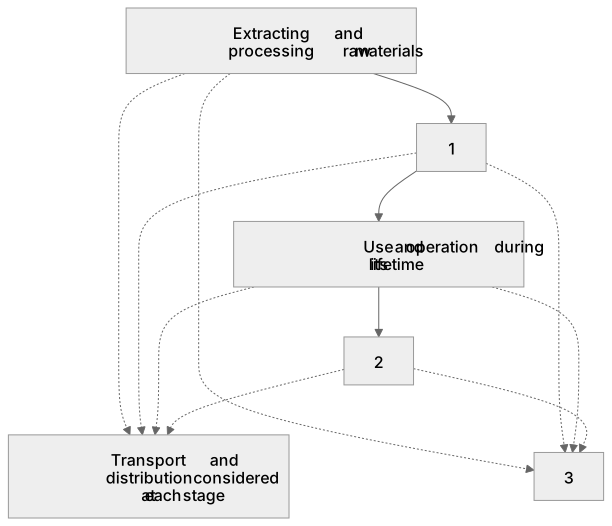
1Box 1
2Box 2
3Box 3
There is more to this lesson
The full lesson goes on to check your understanding and help you earn the marks. Create a free account to carry on, with your progress saved.
A week of Premium from your first lesson · Then the free plan continues · No card, no charge
Test your understanding of Life cycle assessment: Life cycle assessments (LCAs) are carried out to assess the environmental impact of products in each of these stages:
Active recall beats re-reading. Take an instant quiz now to test what you’ve learned and lock it into long-term memory.
A week of Premium from your first lesson · Then the free plan continues · No card, no charge