AQA · GCSE · Combined Science
Course version: 8464 · Version from Sept 2018
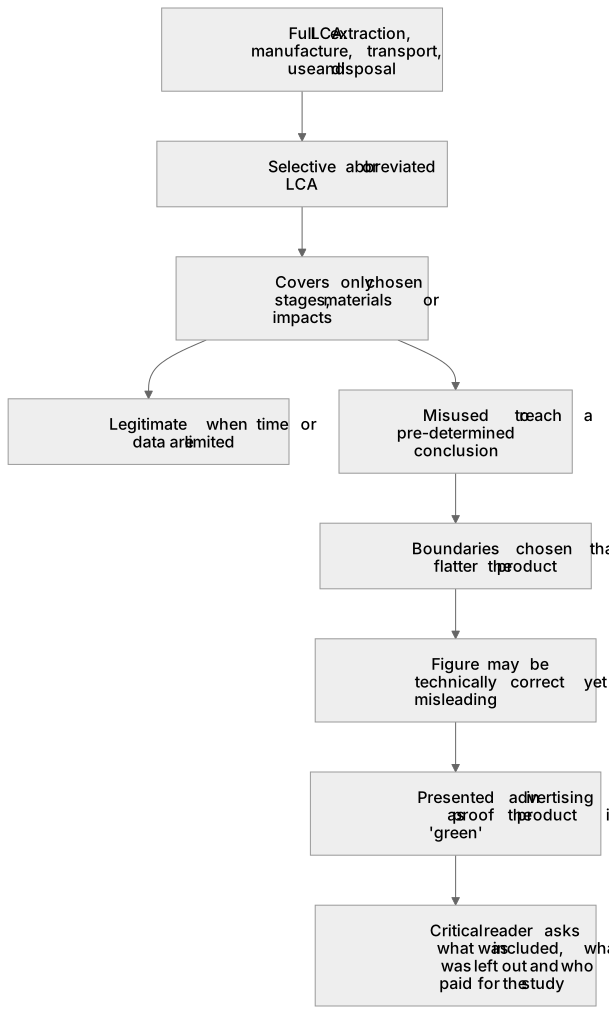
Life cycle assessment: Selective or abbreviated LCAs can be devised to evaluate a product but these can be misused to reach pre-determined conclusions, eg in support of claims for advertising purposes.
A full life cycle assessment examines extraction, manufacture, transport, use and disposal, which takes time and data.
- 4 key terms
Study notes
From the checked teaching notes for this specification point.
The idea
A full life cycle assessment examines extraction, manufacture, transport, use and disposal, which takes time and data. A company may instead carry out a selective or abbreviated LCA: it studies only chosen stages, chosen materials or chosen impacts. This can be legitimate when time or data are limited, and it can still evaluate a product usefully. The danger is misuse. If a firm wants a pre-determined conclusion, it can choose boundaries that flatter its product, for example comparing only the use phase of a reusable bag while ignoring the energy used to make it, or reporting carbon dioxide but omitting water pollution. The resulting figure may be technically correct yet misleading. Advertisers can then present it as proof that a product is 'green'. A critical reader asks what was included, what was left out and who paid for the study.
What earns the marks
- Defines a selective or abbreviated LCA as one that covers only some stages, materials or impact categories.
- Explains a legitimate reason for abbreviating, such as limited time, cost or missing data.
- Explains how choice of boundaries or impact categories can steer an LCA towards a pre-determined conclusion.
- Gives a specific example, such as comparing only the use phase of two products while ignoring manufacture or disposal.
- Explains how such a result can support advertising claims that present the product as environmentally friendly.
- Suggests a check, such as asking which stages and impacts were included and who commissioned the study.
Common mistakes and how to put them right
Saying an abbreviated LCA is always wrong.
Put it right by stating it can be a valid evaluation when its limits are made clear.
Confusing a selective LCA with a dishonest one.
Put it right by separating the method from the misuse of the method.
Assuming a published figure must be complete.
Put it right by checking which stages and impacts the figure actually covers.
Exam tips
- Name the stage or impact that has been omitted when you criticise an example.
- Use the phrase 'pre-determined conclusion' to show you understand the intention behind the misuse.
- Balance your answer by giving one fair use and one unfair use of an abbreviated LCA.
Try the lesson
The start of the Life cycle assessment: Selective or abbreviated LCAs can be devised to evaluate a product but these can be misused to reach pre-determined conclusions, eg in support of claims for advertising purposes. lesson, made from checked teaching notes for this specification point.
Have a go first
A company wants to advertise a new drinks bottle as environmentally friendly. Which statement best describes how a selective life cycle assessment could be used by that company?
Listen
A full life cycle assessment examines extraction, manufacture, transport, use and disposal, which takes time and data. A company may instead carry out a selective or abbreviated LCA: it studies only chosen stages, chosen materials or chosen impacts. This can be legitimate when time or data are limited, and it can still evaluate a product usefully. The danger is misuse. If a firm wants a pre-determined conclusion, it can choose boundaries that flatter its product, for example comparing only the use phase of a reusable bag while ignoring the energy used to make it, or reporting carbon dioxide but omitting water pollution. The resulting figure may be technically correct yet misleading. Advertisers can then present it as proof that a product is 'green'. A critical reader asks what was included, what was left out and who paid for the study. A strong answer earns marks for these points. Defines a selective or abbreviated LCA as one that covers only some stages, materials or impact categories. Explains a legitimate reason for abbreviating, such as limited time, cost or missing data. Explains how choice of boundaries or impact categories can steer an LCA towards a pre-determined conclusion. Gives a specific example, such as comparing only the use phase of two products while ignoring manufacture or disposal. A common slip: Saying an abbreviated LCA is always wrong. Instead, stating it can be a valid evaluation when its limits are made clear. Exam tip: Name the stage or impact that has been omitted when you criticise an example.
See it
Key words
Say what each word means before you turn the card.
Selective and abbreviated LCA
Try answering aloud or in your head before turning the card.
Bias and pre-determined conclusions
Try answering aloud or in your head before turning the card.
Advertising and green claims
Try answering aloud or in your head before turning the card.
Critical evaluation of evidence
Try answering aloud or in your head before turning the card.
See every definition
- Selective and abbreviated LCA
- A study that covers only some stages, materials or impact categories rather than a full life cycle assessment.
- Bias and pre-determined conclusions
- Choosing boundaries that flatter a product so the study reaches a conclusion decided in advance.
- Advertising and green claims
- Presenting a technically correct but misleading figure as proof that a product is 'green'.
- Critical evaluation of evidence
- Asking what was included, what was left out and who paid for the study.
Label the diagram
Some boxes have lost their names. Pick the right name for each number.
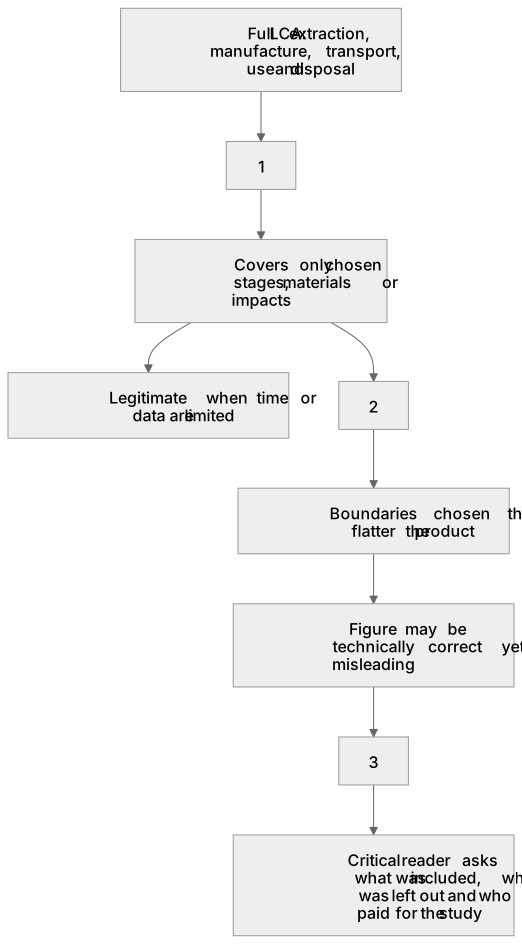
1Box 1
2Box 2
3Box 3
There is more to this lesson
The full lesson goes on to check your understanding and help you earn the marks. Create a free account to carry on, with your progress saved.
A week of Premium from your first lesson · Then the free plan continues · No card, no charge
Test your understanding of Life cycle assessment: Selective or abbreviated LCAs can be devised to evaluate a product but these can be misused to reach pre-determined conclusions, eg in support of claims for advertising purposes.
Active recall beats re-reading. Take an instant quiz now to test what you’ve learned and lock it into long-term memory.
A week of Premium from your first lesson · Then the free plan continues · No card, no charge