AQA · GCSE · Combined Science
Course version: 8464 · Version from Sept 2018
Neutralisation of acids and salt production: Acids are neutralised by alkalis (eg soluble metal hydroxides) and bases (eg insoluble metal hydroxides and metal oxides) to produce salts and water, and by metal carbonates to produce salts, water and carbon dioxide.
Neutralisation occurs when an acid reacts with a base, removing acidic and basic character.
- 4 key terms
Study notes
From the checked teaching notes for this specification point.
The idea
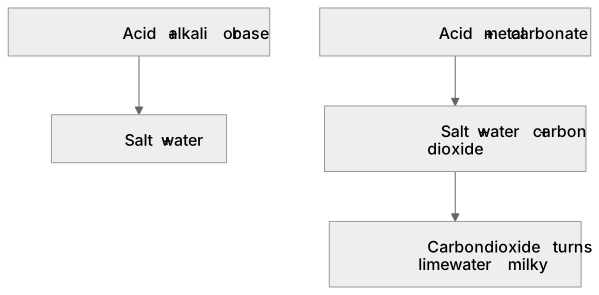
Neutralisation occurs when an acid reacts with a base, removing acidic and basic character. Alkalis are soluble bases, typically soluble metal hydroxides such as sodium hydroxide, NaOH(aq). Insoluble bases include metal oxides such as copper(II) oxide, CuO(s), and insoluble metal hydroxides such as iron(III) hydroxide, Fe(OH)₃(s). Both react with acids to form a salt and water only: acid + base → salt + water. For example, hydrochloric acid with sodium hydroxide gives sodium chloride and water: HCl(aq) + NaOH(aq) → NaCl(aq) + H₂O(l). Metal carbonates, such as calcium carbonate, CaCO₃(s), also neutralise acids but produce carbon dioxide as well: acid + metal carbonate → salt + water + carbon dioxide. For example, 2HCl(aq) + CaCO₃(s) → CaCl₂(aq) + H₂O(l) + CO₂(g). The carbon dioxide is observed as effervescence and turns limewater milky.
What earns the marks
- Acid + alkali or base → salt + water; this is neutralisation and no gas is produced in these reactions.
- Alkalis are soluble metal hydroxides, for example NaOH(aq) and KOH(aq); bases include insoluble metal hydroxides and metal oxides such as CuO(s) and Fe(OH)₃(s).
- Acid + metal carbonate → salt + water + carbon dioxide; the gas is identified by bubbling through limewater, which turns milky or cloudy.
- Word equations and balanced symbol equations must use correct formulae, including state symbols where required, for example HCl(aq) + NaOH(aq) → NaCl(aq) + H₂O(l).
- The salt name is built from the metal or ammonium ion from the base or carbonate and the acid anion: chloride from hydrochloric acid, nitrate from nitric acid, sulfate from sulfuric acid.
- Neutralisation can be followed by pH change towards pH 7, and in practical work an indicator or pH meter can show when the acid has been neutralised.
Common mistakes and how to put them right
Writing that acid + alkali produces carbon dioxide.
Put it right by stating that carbon dioxide is produced only when a metal carbonate reacts with an acid.
Confusing soluble and insoluble hydroxides.
Put it right by defining alkalis as soluble metal hydroxides and noting that insoluble metal hydroxides are bases but not alkalis.
Omitting water from the products of acid + metal carbonate.
Put it right by writing the full word equation acid + metal carbonate → salt + water + carbon dioxide.
Using incorrect salt formulae such as CaCl instead of CaCl₂.
Put it right by balancing charges, since Ca²⁺ needs two Cl⁻ ions.
Exam tips
- Underline the acid and the base or carbonate in the question, then name the salt from the metal or ammonium ion and the acid anion before writing the equation.
- When a gas is produced, state the test and the positive result, for example carbon dioxide turns limewater milky.
- Balance symbol equations by checking each element in turn, and include state symbols if the question asks for them.
- For required practical work, describe adding the solid base or carbonate gradually to the acid until it is in excess, then filtering to remove excess solid.
Try the lesson
The start of the Neutralisation of acids and salt production: Acids are neutralised by alkalis (eg soluble metal hydroxides) and bases (eg insoluble metal hydroxides and metal oxides) to produce salts and water, and by metal carbonates to produce salts, water and carbon dioxide. lesson, made from checked teaching notes for this specification point.
Have a go first
Which gas is produced when a metal carbonate reacts with an acid?
Listen
Neutralisation occurs when an acid reacts with a base, removing acidic and basic character. Alkalis are soluble bases, typically soluble metal hydroxides such as sodium hydroxide, NaOH(aq). Insoluble bases include metal oxides such as copper(II) oxide, CuO(s), and insoluble metal hydroxides such as iron(III) hydroxide, Fe(OH)₃(s). Both react with acids to form a salt and water only: acid + base → salt + water. For example, hydrochloric acid with sodium hydroxide gives sodium chloride and water: HCl(aq) + NaOH(aq) → NaCl(aq) + H₂O(l). Metal carbonates, such as calcium carbonate, CaCO₃(s), also neutralise acids but produce carbon dioxide as well: acid + metal carbonate → salt + water + carbon dioxide. For example, 2HCl(aq) + CaCO₃(s) → CaCl₂(aq) + H₂O(l) + CO₂(g). The carbon dioxide is observed as effervescence and turns limewater milky. A strong answer earns marks for these points. Acid + alkali or base → salt + water; this is neutralisation and no gas is produced in these reactions. Alkalis are soluble metal hydroxides, for example NaOH(aq) and KOH(aq); bases include insoluble metal hydroxides and metal oxides such as CuO(s) and Fe(OH)₃(s). Acid + metal carbonate → salt + water + carbon dioxide; the gas is identified by bubbling through limewater, which turns milky or cloudy. Word equations and balanced symbol equations must use correct formulae, including state symbols where required, for example HCl(aq) + NaOH(aq) → NaCl(aq) + H₂O(l). A common slip: Writing that acid + alkali produces carbon dioxide. Instead, stating that carbon dioxide is produced only when a metal carbonate reacts with an acid. Exam tip: Underline the acid and the base or carbonate in the question, then name the salt from the metal or ammonium ion and the acid anion before writing the equation.
See it
Key words
Say what each word means before you turn the card.
Neutralisation reactions
Try answering aloud or in your head before turning the card.
Acids, bases and alkalis
Try answering aloud or in your head before turning the card.
Salt production
Try answering aloud or in your head before turning the card.
Gas tests and observations
Try answering aloud or in your head before turning the card.
See every definition
- Neutralisation reactions
- Reactions in which acids are neutralised by alkalis and bases to produce salts and water, or by metal carbonates to produce salts, water and carbon dioxide.
- Acids, bases and alkalis
- Alkalis are soluble metal hydroxides, while bases include insoluble metal hydroxides and metal oxides, and both react with acids to form a salt and water only.
- Salt production
- A salt and water are formed when an acid reacts with an alkali or base, and a salt, water and carbon dioxide are formed with a metal carbonate.
- Gas tests and observations
- Carbon dioxide produced when a metal carbonate neutralises an acid is observed as effervescence and turns limewater milky.
Label the diagram
Some boxes have lost their names. Pick the right name for each number.
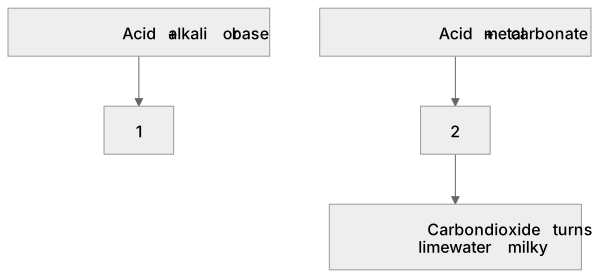
1Box 1
2Box 2
There is more to this lesson
The full lesson goes on to check your understanding and help you earn the marks. Create a free account to carry on, with your progress saved.
A week of Premium from your first lesson · Then the free plan continues · No card, no charge
Test your understanding of Neutralisation of acids and salt production: Acids are neutralised by alkalis (eg soluble metal hydroxides) and bases (eg insoluble metal hydroxides and metal oxides) to produce salts and water, and by metal carbonates to produce salts, water and carbon dioxide.
Active recall beats re-reading. Take an instant quiz now to test what you’ve learned and lock it into long-term memory.
A week of Premium from your first lesson · Then the free plan continues · No card, no charge