AQA · GCSE · Combined Science
Course version: 8464 · Version from Sept 2018
Neutralisation of acids and salt production: predict products from given reactants
Predicting products means working out what is formed when named reactants are neutralised.
- 4 key terms
Study notes
From the checked teaching notes for this specification point.
The idea
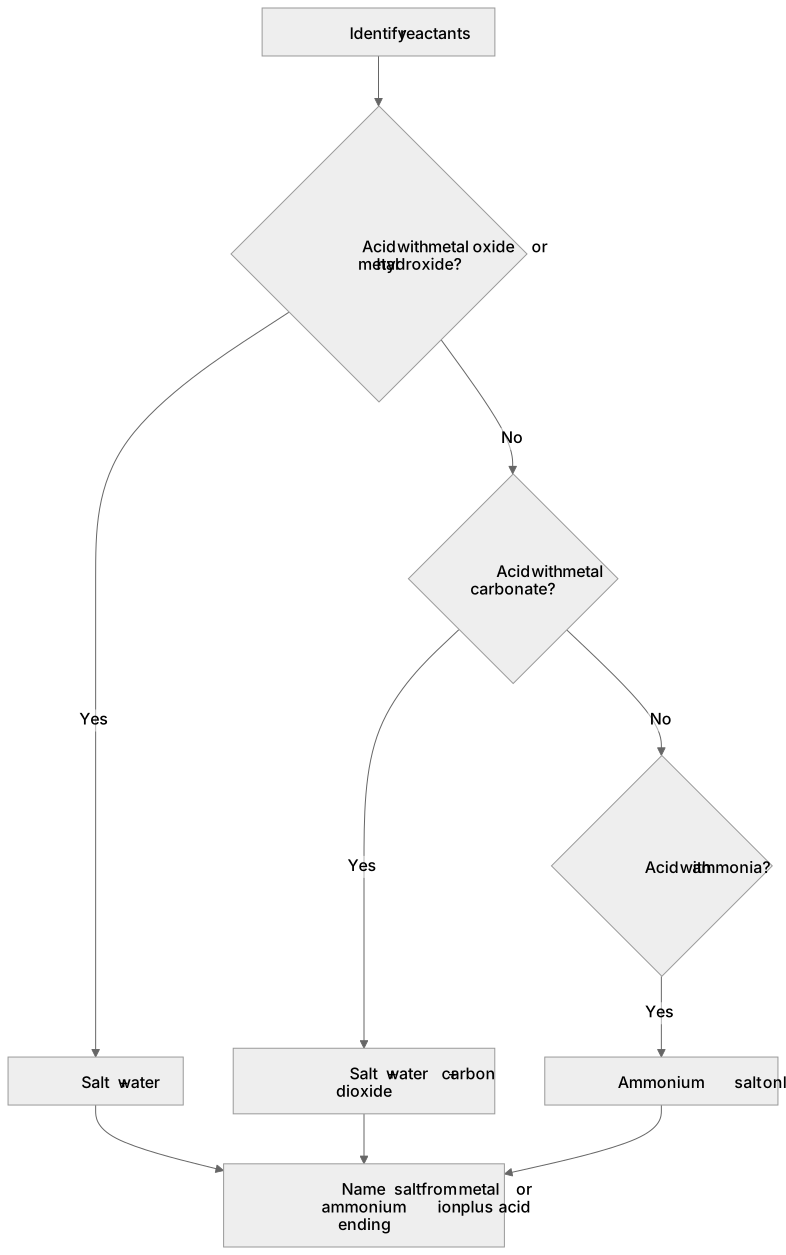
Predicting products means working out what is formed when named reactants are neutralised. First decide whether the reactants are an acid and a base or alkali. Acids include hydrochloric, sulfuric and nitric acid. Bases include metal oxides, metal hydroxides, metal carbonates and ammonia. An acid with a metal hydroxide or metal oxide gives a salt and water. An acid with a metal carbonate also gives carbon dioxide, seen as fizzing. An acid with ammonia gives only an ammonium salt. The salt name comes from the metal or ammonium ion plus the acid ending: chloride from hydrochloric acid, sulfate from sulfuric acid, and nitrate from nitric acid.
For example: Nitric acid with calcium carbonate gives calcium nitrate, water and carbon dioxide.
What earns the marks
- Classify each reactant as an acid or a base, alkali or carbonate before predicting products.
- Apply the pattern acid + metal hydroxide or metal oxide → salt + water.
- Apply the pattern acid + metal carbonate → salt + water + carbon dioxide.
- Apply the pattern acid + ammonia → ammonium salt.
- Derive the salt name from the metal or ammonium ion and the acid, for example sulfate from sulfuric acid and sodium from sodium hydroxide.
- Write the products as a word equation and, where asked, as a balanced symbol equation with correct formulae and state symbols.
Common mistakes and how to put them right
Predicting carbon dioxide for every neutralisation.
Put it right: Carbon dioxide is produced only when the base is a metal carbonate or hydrogencarbonate.
Mixing up acid endings, for example writing 'sulfuric' salt names such as sodium sulfuric.
Put it right: Use the salt ending, so sodium sulfate.
Assuming ammonia reacting with an acid produces water.
Put it right: Ammonia reacts with an acid to produce only an ammonium salt, with no water formed.
Exam tips
- Write the general pattern for the reaction type in the margin before naming the specific products.
- Check the metal or ammonium ion in the base, because this fixes the first part of the salt name.
- For carbonate reactions, include the gas test observation, such as bubbling or limewater turning milky, if the question asks for evidence.
Try the lesson
The start of the Neutralisation of acids and salt production: predict products from given reactants lesson, made from checked teaching notes for this specification point.
Have a go first
Hydrochloric acid reacts with sodium hydroxide in a neutralisation reaction. Which salt is produced?
Listen
Predicting products means working out what is formed when named reactants are neutralised. First decide whether the reactants are an acid and a base or alkali. Acids include hydrochloric, sulfuric and nitric acid. Bases include metal oxides, metal hydroxides, metal carbonates and ammonia. An acid with a metal hydroxide or metal oxide gives a salt and water. An acid with a metal carbonate also gives carbon dioxide, seen as fizzing. An acid with ammonia gives only an ammonium salt. The salt name comes from the metal or ammonium ion plus the acid ending: chloride from hydrochloric acid, sulfate from sulfuric acid, and nitrate from nitric acid. For example, nitric acid with calcium carbonate gives calcium nitrate, water and carbon dioxide. A strong answer earns marks for these points. Classify each reactant as an acid or a base, alkali or carbonate before predicting products. Apply the pattern acid + metal hydroxide or metal oxide → salt + water. Apply the pattern acid + metal carbonate → salt + water + carbon dioxide. Apply the pattern acid + ammonia → ammonium salt. A common slip: Predicting carbon dioxide for every neutralisation. Instead, carbon dioxide is produced only when the base is a metal carbonate or hydrogencarbonate. Exam tip: Write the general pattern for the reaction type in the margin before naming the specific products.
See it
Key words
Say what each word means before you turn the card.
Reactant classification
Try answering aloud or in your head before turning the card.
Product prediction patterns
Try answering aloud or in your head before turning the card.
Salt nomenclature
Try answering aloud or in your head before turning the card.
Balanced equations and state symbols
Try answering aloud or in your head before turning the card.
See every definition
- Reactant classification
- Deciding whether the named reactants are an acid and a base or alkali before predicting products.
- Product prediction patterns
- Applying the pattern for the reaction type, such as acid with metal carbonate giving salt, water and carbon dioxide.
- Salt nomenclature
- Deriving the salt name from the metal or ammonium ion plus the acid ending, such as chloride from hydrochloric acid.
- Balanced equations and state symbols
- Writing the products as a word equation and, where asked, as a balanced symbol equation with correct formulae and state symbols.
There is more to this lesson
The full lesson goes on to check your understanding and help you earn the marks. Create a free account to carry on, with your progress saved.
A week of Premium from your first lesson · Then the free plan continues · No card, no charge
Test your understanding of Neutralisation of acids and salt production: predict products from given reactants
Active recall beats re-reading. Take an instant quiz now to test what you’ve learned and lock it into long-term memory.
A week of Premium from your first lesson · Then the free plan continues · No card, no charge