AQA · GCSE · Combined Science
Course version: 8464 · Version from Sept 2018
Neutralisation of acids and salt production: use the formulae of common ions to deduce the formulae of salts.
A salt is an ionic compound formed when the hydrogen of an acid is replaced by a metal or ammonium ion.
Study notes
From the checked teaching notes for this specification point.
The idea
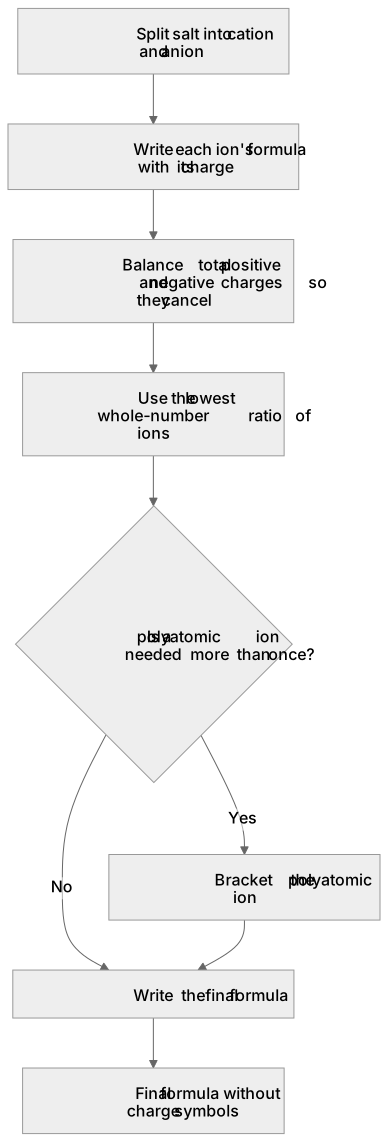
A salt is an ionic compound formed when the hydrogen of an acid is replaced by a metal or ammonium ion. To deduce a salt formula, split it into its cation and anion, write each ion's formula with its charge, then balance the total positive and negative charges so they cancel. For example, sodium ions Na⁺ and sulfate ions SO₄²⁻ need two Na⁺ for each SO₄²⁻, giving Na₂SO₄. Aluminium Al³⁺ with chloride Cl⁻ needs three Cl⁻, giving AlCl₃. Where a polyatomic ion is needed more than once, bracket it: calcium hydroxide is Ca(OH)₂. Charges are not shown in the final formula; they are only a working step. This skill underpins writing balanced equations for neutralisation and predicting products of acid reactions.
What earns the marks
- Identify the cation and anion present in the named salt, using the metal or ammonium ion as the cation and the acid-derived ion as the anion.
- State the charge on each common ion correctly, for example Na⁺, Mg²⁺, Al³⁺, Cl⁻, O²⁻, OH⁻, NO₃⁻, SO₄²⁻, CO₃²⁻.
- Apply the rule that total positive charge must equal total negative charge in the final neutral formula.
- Use the lowest whole-number ratio of ions, so magnesium chloride is MgCl₂ rather than Mg₂Cl₄.
- Place polyatomic ions in brackets when more than one is required, as in Ca(OH)₂ and Al₂(SO₄)₃.
- Write the final formula without charge symbols, since the compound itself is electrically neutral.
Common mistakes and how to put them right
Writing the charges into the final formula, such as Na⁺Cl⁻ instead of NaCl.
Put it right: Charges are a balancing step only; the finished salt formula shows no charge symbols.
Swapping the ion ratio, for example writing MgCl instead of MgCl₂.
Put it right: Check that 1 × 2⁺ balances 2 × 1⁻, so two chloride ions are needed.
Forgetting brackets around a repeated polyatomic ion, writing CaOH₂ instead of Ca(OH)₂.
Put it right: Bracket the whole ion before adding the subscript when more than one unit is needed.
Using the acid's hydrogen count as the metal count without checking charge, for example assuming H₂SO₄ always gives a 2⁺ metal sulfate.
Put it right: Balance charges from the ions themselves, not from the acid's formula.
Exam tips
- Write the two ion formulae with their charges side by side before combining them; this makes the balancing step visible and easy to check.
- Cross-check by multiplying the subscript by the ion charge for each ion and confirming the two totals are equal in size.
- If a question gives an unfamiliar salt name, break it into the familiar cation and anion parts rather than trying to recall the whole formula.
- Show the bracketed form for hydroxide, nitrate, sulfate and carbonate salts whenever the subscript is greater than one.
Try the lesson
The start of the Neutralisation of acids and salt production: use the formulae of common ions to deduce the formulae of salts. lesson, made from checked teaching notes for this specification point.
Have a go first
Sodium ions have the formula Na⁺ and chloride ions have the formula Cl⁻. What is the formula of the salt sodium chloride?
Listen
A salt is an ionic compound formed when the hydrogen of an acid is replaced by a metal or ammonium ion. To deduce a salt formula, split it into its cation and anion, write each ion's formula with its charge, then balance the total positive and negative charges so they cancel. For example, sodium ions Na⁺ and sulfate ions SO₄²⁻ need two Na⁺ for each SO₄²⁻, giving Na₂SO₄. Aluminium Al³⁺ with chloride Cl⁻ needs three Cl⁻, giving AlCl₃. Where a polyatomic ion is needed more than once, bracket it: calcium hydroxide is Ca(OH)₂. Charges are not shown in the final formula; they are only a working step. This skill underpins writing balanced equations for neutralisation and predicting products of acid reactions. A strong answer earns marks for these points. Identify the cation and anion present in the named salt, using the metal or ammonium ion as the cation and the acid-derived ion as the anion. State the charge on each common ion correctly, for example Na⁺, Mg²⁺, Al³⁺, Cl⁻, O²⁻, OH⁻, NO₃⁻, SO₄²⁻, CO₃²⁻. Apply the rule that total positive charge must equal total negative charge in the final neutral formula. Use the lowest whole-number ratio of ions, so magnesium chloride is MgCl₂ rather than Mg₂Cl₄. A common slip: Writing the charges into the final formula, such as Na⁺Cl⁻ instead of NaCl. Instead, charges are a balancing step only; the finished salt formula shows no charge symbols. Exam tip: Write the two ion formulae with their charges side by side before combining them; this makes the balancing step visible and easy to check.
See it
There is more to this lesson
The full lesson goes on to check your understanding and help you earn the marks. Create a free account to carry on, with your progress saved.
A week of Premium from your first lesson · Then the free plan continues · No card, no charge
Test your understanding of Neutralisation of acids and salt production: use the formulae of common ions to deduce the formulae of salts.
Active recall beats re-reading. Take an instant quiz now to test what you’ve learned and lock it into long-term memory.
A week of Premium from your first lesson · Then the free plan continues · No card, no charge