AQA · GCSE · Combined Science
Course version: 8464 · Version from Sept 2018
Oxidation and reduction in terms of electrons (HT only): identify in a given reaction, symbol equation or half equation which species are oxidised and which are reduced.
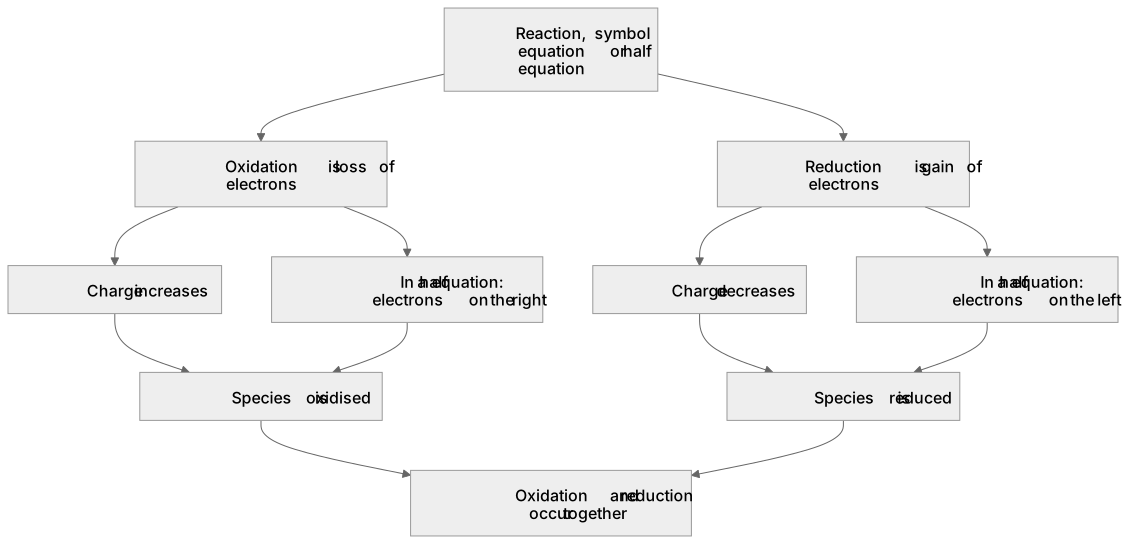
In terms of electrons (Higher Tier only), oxidation is loss of electrons and reduction is gain of electrons.
- 3 key terms
Study notes
From the checked teaching notes for this specification point.
The idea
In terms of electrons (Higher Tier only), oxidation is loss of electrons and reduction is gain of electrons. To identify which species is oxidised or reduced, track electron loss and gain using ionic charges or half equations. In a full symbol equation, split it into half equations: the species whose charge increases is oxidised; the species whose charge decreases is reduced. For example, in Zn + Cu²⁺ → Zn²⁺ + Cu, zinc goes from 0 to 2⁺ (loses electrons, oxidised) and copper goes from 2⁺ to 0 (gains electrons, reduced). In a half equation, electrons on the right mean oxidation; electrons on the left mean reduction. Always balance atoms and charge, and remember that oxidation and reduction occur together.
What earns the marks
- State that oxidation is loss of electrons and reduction is gain of electrons, using the mnemonic OIL RIG if helpful.
- In a symbol equation, check the charges of elements on both sides and identify the species whose charge increases (oxidised) and decreases (reduced).
- In a half equation, locate the electrons: if they appear as products on the right, the reactant is oxidised; if they appear as reactants on the left, the reactant is reduced.
- Check that the number of electrons lost equals the number gained in the overall reaction, and that both oxidation and reduction are identified.
- For a named species, state clearly whether it is oxidised or reduced, referring to electron transfer rather than oxygen or hydrogen.
Common mistakes and how to put them right
Confusing oxidation and reduction.
Put it right: OIL RIG (Oxidation Is Loss, Reduction Is Gain) and check electron position in half equations.
Assuming oxygen must be present for oxidation.
Put it right: In electron-transfer terms, oxidation can occur without oxygen, such as Na → Na⁺ + e⁻.
Ignoring charge changes in a full equation.
Put it right: Determine the charges of ions on both sides before deciding which species is oxidised or reduced.
Exam tips
- Underline the species and write its charge above each symbol before and after the reaction to make the change clear.
- For half equations, draw a quick arrow from the electron term to show whether electrons are lost or gained.
Try the lesson
The start of the Oxidation and reduction in terms of electrons (HT only): identify in a given reaction, symbol equation or half equation which species are oxidised and which are reduced. lesson, made from checked teaching notes for this specification point.
Have a go first
In the half equation Zn → Zn²⁺ + 2e⁻, which species is oxidised?
Listen
In terms of electrons (Higher Tier only), oxidation is loss of electrons and reduction is gain of electrons. To identify which species is oxidised or reduced, track electron loss and gain using ionic charges or half equations. In a full symbol equation, split it into half equations: the species whose charge increases is oxidised; the species whose charge decreases is reduced. For example, in Zn + Cu²⁺ → Zn²⁺ + Cu, zinc goes from 0 to 2⁺ (loses electrons, oxidised) and copper goes from 2⁺ to 0 (gains electrons, reduced). In a half equation, electrons on the right mean oxidation; electrons on the left mean reduction. Always balance atoms and charge, and remember that oxidation and reduction occur together. A strong answer earns marks for these points. State that oxidation is loss of electrons and reduction is gain of electrons, using the mnemonic OIL RIG if helpful. In a symbol equation, check the charges of elements on both sides and identify the species whose charge increases (oxidised) and decreases (reduced). In a half equation, locate the electrons: if they appear as products on the right, the reactant is oxidised; if they appear as reactants on the left, the reactant is reduced. Check that the number of electrons lost equals the number gained in the overall reaction, and that both oxidation and reduction are identified. Exam tip: Underline the species and write its charge above each symbol before and after the reaction to make the change clear.
See it
Key words
Say what each word means before you turn the card.
Oxidation
Try answering aloud or in your head before turning the card.
Reduction
Try answering aloud or in your head before turning the card.
Half equation
Try answering aloud or in your head before turning the card.
See every definition
- Oxidation
- Loss of electrons, which can be remembered using the mnemonic OIL RIG.
- Reduction
- Gain of electrons, which can be remembered using the mnemonic OIL RIG.
- Half equation
- A representation of electron loss and gain in which electrons on the right mean oxidation and electrons on the left mean reduction.
Label the diagram
Some boxes have lost their names. Pick the right name for each number.
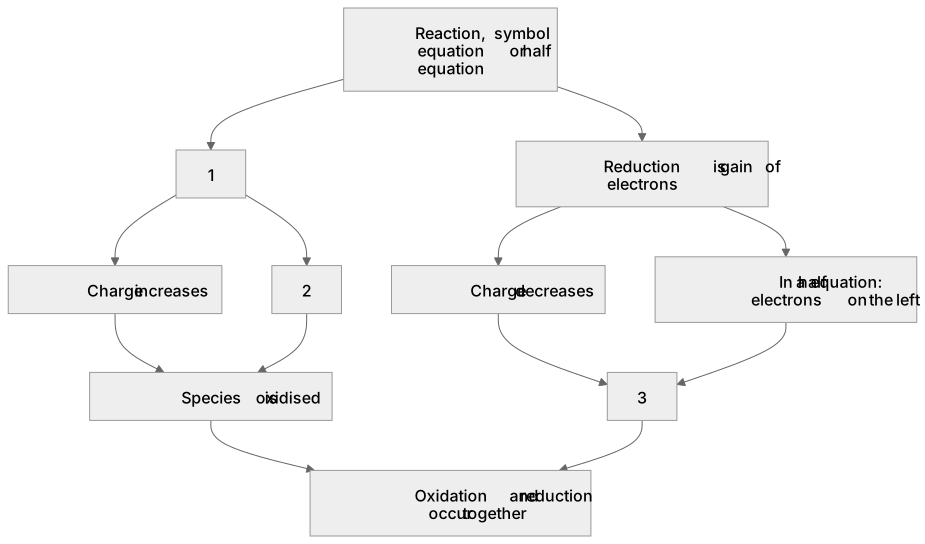
1Box 1
2Box 2
3Box 3
There is more to this lesson
The full lesson goes on to check your understanding and help you earn the marks. Create a free account to carry on, with your progress saved.
A week of Premium from your first lesson · Then the free plan continues · No card, no charge
Test your understanding of Oxidation and reduction in terms of electrons (HT only): identify in a given reaction, symbol equation or half equation which species are oxidised and which are reduced.
Active recall beats re-reading. Take an instant quiz now to test what you’ve learned and lock it into long-term memory.
A week of Premium from your first lesson · Then the free plan continues · No card, no charge