AQA · GCSE · Combined Science
Course version: 8464 · Version from Sept 2018
Potable water: distinguish between potable water and pure water
Potable water is water that is safe to drink: it has acceptable levels of dissolved substances and microbes, but it is not necessarily pure in the chemical sense.
- 2 key terms
Study notes
From the checked teaching notes for this specification point.
The idea
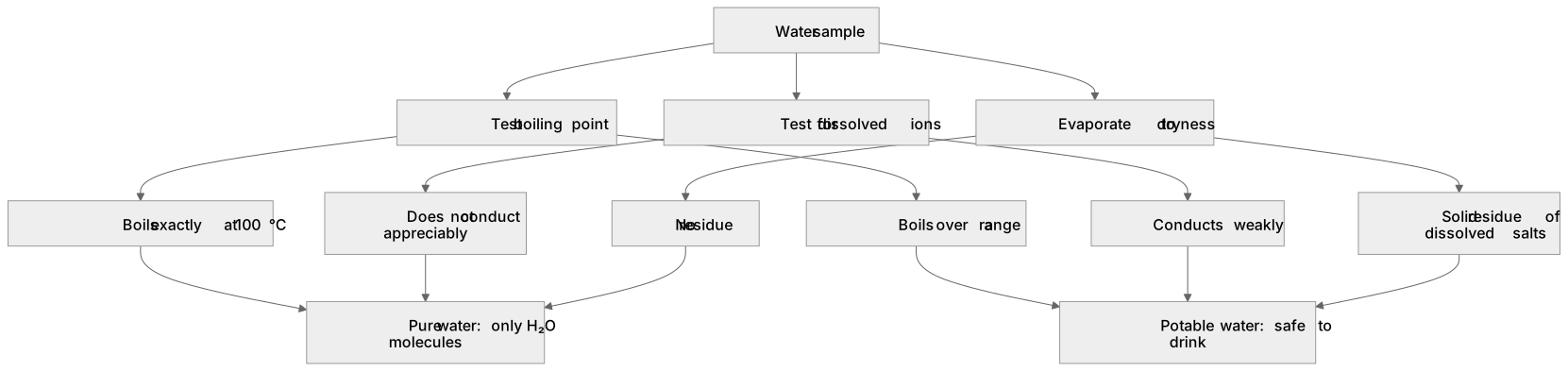
Potable water is water that is safe to drink: it has acceptable levels of dissolved substances and microbes, but it is not necessarily pure in the chemical sense. Pure water, in chemistry, contains only H₂O molecules and nothing else, so it has a fixed boiling point of 100 °C at standard pressure and no dissolved ions. Potable water may contain dissolved salts, such as sodium chloride, and traces of other minerals, so its boiling point can differ slightly from 100 °C and it conducts electricity weakly. For example, distilled water is pure, while tap water is potable but contains chloride ions, calcium ions and dissolved gases. To distinguish them, test boiling point or test for dissolved ions; a sample that boils exactly at 100 °C and leaves no residue on evaporation is pure, whereas a sample that leaves a residue or boils over a range is potable but impure.
What earns the marks
- Potable water is defined as water that is safe to drink, with acceptable levels of dissolved substances and microorganisms, rather than water containing only H₂O molecules.
- Pure water is defined chemically as containing only H₂O molecules, with no dissolved ions or other substances present.
- A suitable distinction is that pure water has a fixed boiling point of 100 °C at standard pressure, while potable water may boil over a range because dissolved substances raise the boiling point.
- Another distinction is that pure water does not conduct electricity appreciably, whereas potable water conducts weakly because it contains dissolved ions.
- Evaporation can distinguish the samples: pure water leaves no residue, while potable water leaves a solid residue of dissolved salts.
- A named example, such as distilled water as pure and tap water as potable, can support the distinction.
Common mistakes and how to put them right
Stating that potable water is pure water.
Put it right: Potable water is safe to drink but still contains dissolved substances and microbes, so it is not chemically pure.
Claiming that potable water contains no ions at all.
Put it right: Potable water contains dissolved ions such as Na⁺, Cl⁻ and Ca²⁺ at acceptable concentrations.
Saying that pure water is the same as filtered water.
Put it right: Filtration removes insoluble particles but does not remove dissolved ions, so filtered water may still be impure.
Exam tips
- Use the phrase 'safe to drink' when defining potable water, and 'only H₂O molecules' when defining pure water.
- Give a practical test, such as boiling point measurement or evaporation to dryness, rather than only a verbal definition.
- Link the presence of dissolved ions to both electrical conductivity and boiling point elevation to show understanding.
Try the lesson
The start of the Potable water: distinguish between potable water and pure water lesson, made from checked teaching notes for this specification point.
Have a go first
Which statement correctly describes potable water?
Listen
Potable water is water that is safe to drink: it has acceptable levels of dissolved substances and microbes, but it is not necessarily pure in the chemical sense. Pure water, in chemistry, contains only H₂O molecules and nothing else, so it has a fixed boiling point of 100 °C at standard pressure and no dissolved ions. Potable water may contain dissolved salts, such as sodium chloride, and traces of other minerals, so its boiling point can differ slightly from 100 °C and it conducts electricity weakly. For example, distilled water is pure, while tap water is potable but contains chloride ions, calcium ions and dissolved gases. To distinguish them, test boiling point or test for dissolved ions; a sample that boils exactly at 100 °C and leaves no residue on evaporation is pure, whereas a sample that leaves a residue or boils over a range is potable but impure. A strong answer earns marks for these points. Potable water is defined as water that is safe to drink, with acceptable levels of dissolved substances and microorganisms, rather than water containing only H₂O molecules. Pure water is defined chemically as containing only H₂O molecules, with no dissolved ions or other substances present. A suitable distinction is that pure water has a fixed boiling point of 100 °C at standard pressure, while potable water may boil over a range because dissolved substances raise the boiling point. Another distinction is that pure water does not conduct electricity appreciably, whereas potable water conducts weakly because it contains dissolved ions. A common slip: stating that potable water is pure water. Instead, potable water is safe to drink but still contains dissolved substances and microbes, so it is not chemically pure. Exam tip: Use the phrase 'safe to drink' when defining potable water, and 'only H₂O molecules' when defining pure water.
See it
Key words
Say what each word means before you turn the card.
Potable water
Try answering aloud or in your head before turning the card.
Pure water
Try answering aloud or in your head before turning the card.
See every definition
- Potable water
- Water that is safe to drink, with acceptable levels of dissolved substances and microbes, but not necessarily pure in the chemical sense.
- Pure water
- Water that contains only H₂O molecules and nothing else, so it has a fixed boiling point of 100 °C at standard pressure and no dissolved ions.
Label the diagram
Some boxes have lost their names. Pick the right name for each number.
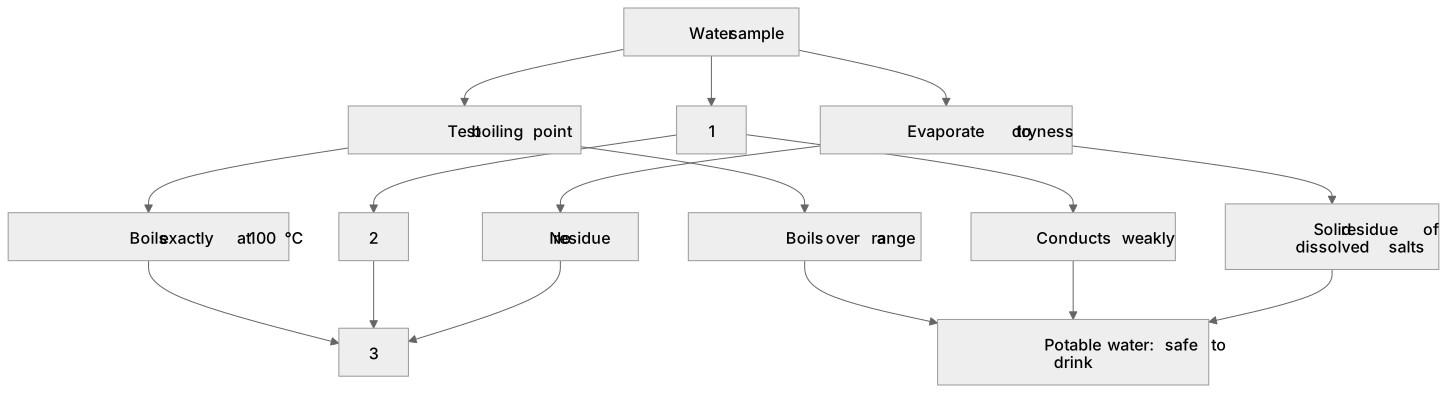
1Box 1
2Box 2
3Box 3
There is more to this lesson
The full lesson goes on to check your understanding and help you earn the marks. Create a free account to carry on, with your progress saved.
A week of Premium from your first lesson · Then the free plan continues · No card, no charge
Test your understanding of Potable water: distinguish between potable water and pure water
Active recall beats re-reading. Take an instant quiz now to test what you’ve learned and lock it into long-term memory.
A week of Premium from your first lesson · Then the free plan continues · No card, no charge