AQA · GCSE · Combined Science
Course version: 8464 · Version from Sept 2018
Potable water: If supplies of fresh water are limited, desalination of salty water or sea water may be required. Desalination can be done by distillation or by processes that use membranes such as reverse osmosis. These processes require large amounts of energy.
Fresh water is scarce in some regions, so salty water or sea water must be treated to make it potable.
- 4 key terms
Study notes
From the checked teaching notes for this specification point.
The idea
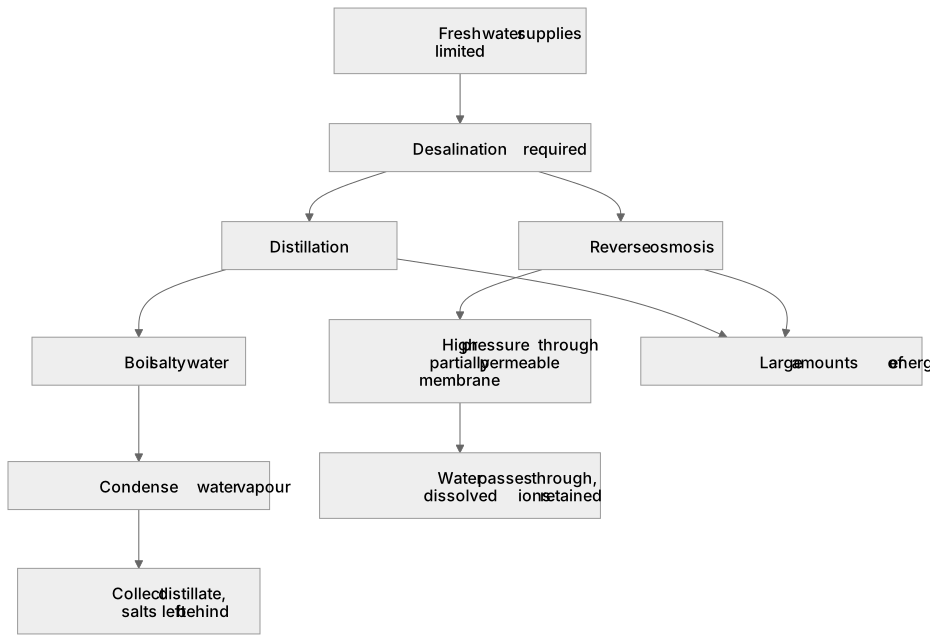
Fresh water is scarce in some regions, so salty water or sea water must be treated to make it potable. Desalination removes dissolved salts. Distillation heats the salty water until it boils, condenses the steam and collects the distillate, leaving salts behind. Reverse osmosis forces salty water at high pressure through a partially permeable membrane that retains dissolved ions while water molecules pass through. Both methods demand large amounts of energy: distillation mainly for heating and cooling, reverse osmosis mainly for pumping water at high pressure. Energy use makes desalination expensive and can release carbon dioxide if the electricity comes from burning fossil fuels.
For example: A coastal town with little rainfall may rely on a reverse osmosis plant, whereas a small-scale distillation unit can be used where a reliable heat source exists.
What earns the marks
- Desalination is needed when fresh water supplies are limited and salty water or sea water must be made potable.
- Distillation involves boiling salty water, condensing the water vapour and collecting the liquid distillate, which leaves dissolved salts behind.
- Reverse osmosis uses a partially permeable membrane and high pressure so water passes through while dissolved ions are retained.
- Comparing methods: distillation uses energy mainly for heating and cooling, while reverse osmosis uses energy mainly for pumping water at high pressure.
- The product of desalination is water with a much lower concentration of dissolved salts, suitable for drinking after appropriate treatment.
Common mistakes and how to put them right
Thinking that distillation simply filters out salt.
Put it right by explaining that the water changes to vapour and then condenses, leaving dissolved salts in the original container.
Believing that reverse osmosis works by boiling water.
Put it right by stating that it uses pressure and a partially permeable membrane, not a change of state.
Assuming desalination is cheap because sea water is abundant.
Put it right by linking both processes to large energy demands and therefore high cost.
Exam tips
- Name the two processes clearly and state the key principle of each: boiling and condensing for distillation, pressure and a partially permeable membrane for reverse osmosis.
- When asked why desalination is not always used, refer to the large energy requirement and the resulting cost or environmental impact.
- Use comparative language such as 'whereas' or 'in contrast' when contrasting distillation with reverse osmosis, and keep the comparison focused on the separation mechanism and energy use.
Try the lesson
The start of the Potable water: If supplies of fresh water are limited, desalination of salty water or sea water may be required. Desalination can be done by distillation or by processes that use membranes such as reverse osmosis. These processes require large amounts of energy. lesson, made from checked teaching notes for this specification point.
Have a go first
Which two methods can be used to desalinate salty water or sea water?
Listen
Fresh water is scarce in some regions, so salty water or sea water must be treated to make it potable. Desalination removes dissolved salts. Distillation heats the salty water until it boils, condenses the steam and collects the distillate, leaving salts behind. Reverse osmosis forces salty water at high pressure through a partially permeable membrane that retains dissolved ions while water molecules pass through. Both methods demand large amounts of energy: distillation mainly for heating and cooling, reverse osmosis mainly for pumping water at high pressure. Energy use makes desalination expensive and can release carbon dioxide if the electricity comes from burning fossil fuels. For example, a coastal town with little rainfall may rely on a reverse osmosis plant, whereas a small-scale distillation unit can be used where a reliable heat source exists. A strong answer earns marks for these points. Desalination is needed when fresh water supplies are limited and salty water or sea water must be made potable. Distillation involves boiling salty water, condensing the water vapour and collecting the liquid distillate, which leaves dissolved salts behind. Reverse osmosis uses a partially permeable membrane and high pressure so water passes through while dissolved ions are retained. Comparing methods: distillation uses energy mainly for heating and cooling, while reverse osmosis uses energy mainly for pumping water at high pressure. A common slip: Thinking that distillation simply filters out salt. Instead, explaining that the water changes to vapour and then condenses, leaving dissolved salts in the original container. Exam tip: Name the two processes clearly and state the key principle of each: boiling and condensing for distillation, pressure and a partially permeable membrane for reverse osmosis.
See it
Key words
Say what each word means before you turn the card.
Desalination
Try answering aloud or in your head before turning the card.
Distillation
Try answering aloud or in your head before turning the card.
Reverse osmosis
Try answering aloud or in your head before turning the card.
Energy demand
Try answering aloud or in your head before turning the card.
See every definition
- Desalination
- Removes dissolved salts from salty water or sea water when supplies of fresh water are limited.
- Distillation
- Heats the salty water until it boils, condenses the steam and collects the distillate, leaving salts behind.
- Reverse osmosis
- Forces salty water at high pressure through a partially permeable membrane that retains dissolved ions while water molecules pass through.
- Energy demand
- Both methods require large amounts of energy, making desalination expensive and potentially environmentally demanding.
Label the diagram
Some boxes have lost their names. Pick the right name for each number.
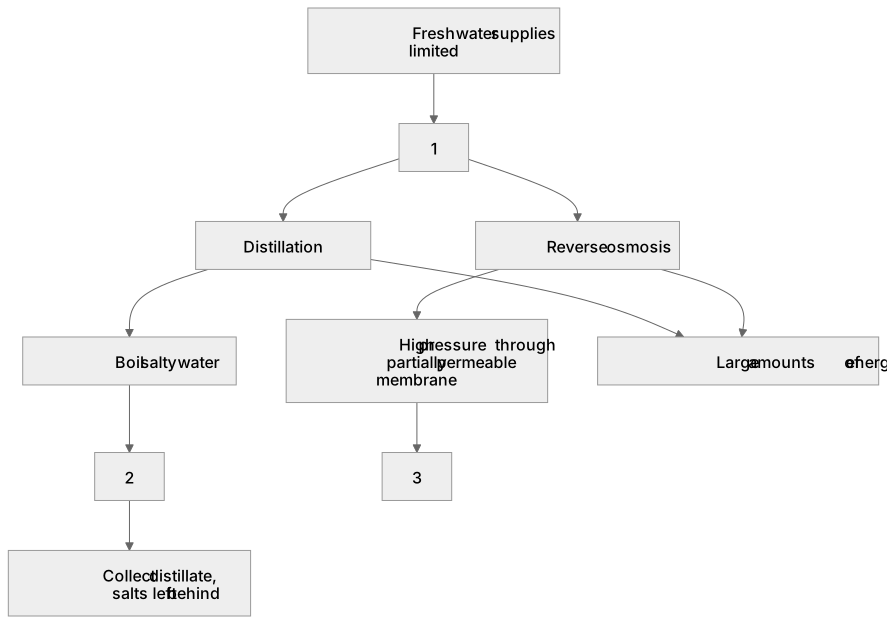
1Box 1
2Box 2
3Box 3
There is more to this lesson
The full lesson goes on to check your understanding and help you earn the marks. Create a free account to carry on, with your progress saved.
A week of Premium from your first lesson · Then the free plan continues · No card, no charge
Test your understanding of Potable water: If supplies of fresh water are limited, desalination of salty water or sea water may be required. Desalination can be done by distillation or by processes that use membranes such as reverse osmosis. These processes require large amounts of energy.
Active recall beats re-reading. Take an instant quiz now to test what you’ve learned and lock it into long-term memory.
A week of Premium from your first lesson · Then the free plan continues · No card, no charge