AQA · GCSE · Combined Science
Course version: 8464 · Version from Sept 2018
Properties of hydrocarbons: flammability.
Flammability is a chemical property describing how readily a hydrocarbon fuel burns in oxygen.
- 4 key terms
Study notes
From the checked teaching notes for this specification point.
The idea
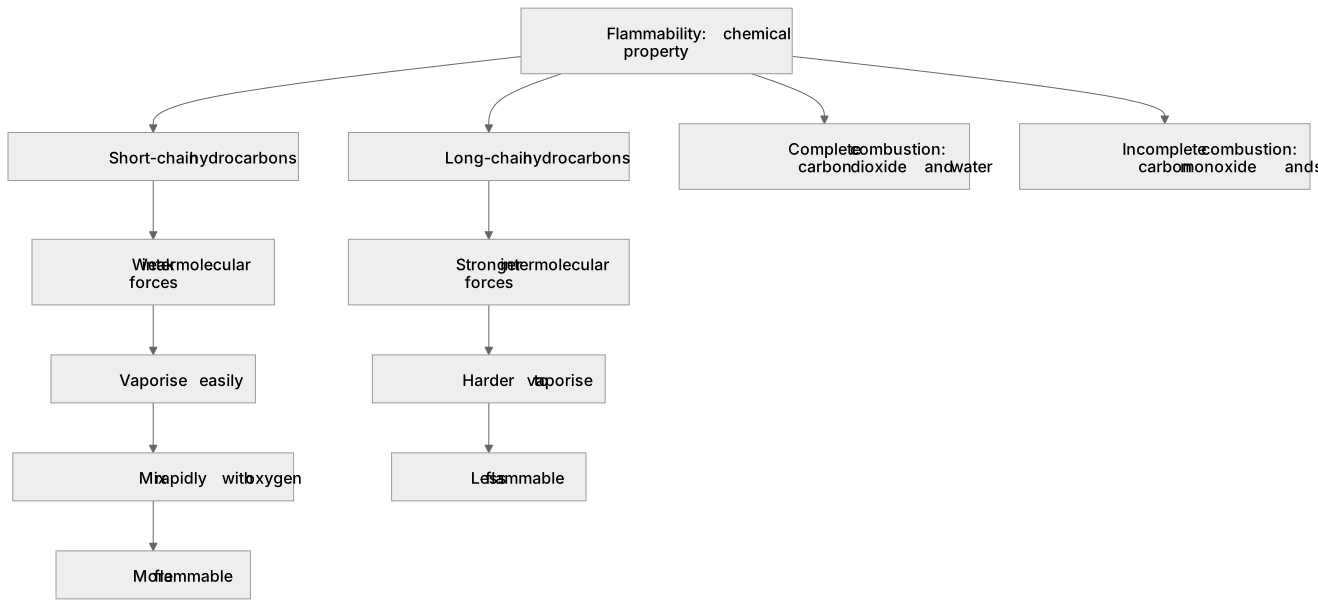
Flammability is a chemical property describing how readily a hydrocarbon fuel burns in oxygen. In GCSE Combined Science, you relate flammability to molecular size and intermolecular forces. Short-chain hydrocarbons such as methane, CH₄, and propane, C₃H₈, are highly flammable gases because they have weak intermolecular forces, so they vaporise easily and mix rapidly with oxygen. Longer-chain hydrocarbons such as decane, C₁₀H₂₂, are less flammable liquids because stronger intermolecular forces make them harder to vaporise. Flammability is assessed by comparing how easily fuels ignite and burn, and by linking this to their uses as fuels. Complete combustion produces carbon dioxide and water; incomplete combustion produces carbon monoxide and soot.
What earns the marks
- Flammability is a chemical property: it describes how easily a substance burns in oxygen, not how it looks or melts.
- Hydrocarbons are flammable because they react exothermically with oxygen in combustion, releasing energy as heat and light.
- Short-chain hydrocarbons are more flammable than long-chain hydrocarbons because they have weaker intermolecular forces and lower boiling points, so they vaporise and mix with oxygen more readily.
- Complete combustion of a hydrocarbon produces carbon dioxide and water; incomplete combustion produces carbon monoxide and/or carbon (soot).
Common mistakes and how to put them right
Stating that flammability is a physical property.
Put it right: Flammability is a chemical property because burning produces new substances.
Claiming that long-chain hydrocarbons are more flammable because they contain more carbon.
Put it right: Longer chains have stronger intermolecular forces, so they are less volatile and generally less flammable.
Writing that combustion always produces carbon dioxide and water.
Put it right: Incomplete combustion can also produce carbon monoxide and soot, especially when oxygen supply is limited.
Exam tips
- When asked to compare flammability, link it to chain length, intermolecular forces and boiling point rather than just saying 'smaller is more flammable'.
- Use the correct products for complete and incomplete combustion; if a question mentions a yellow smoky flame or limited air, think carbon monoxide and soot.
- Apply flammability to real fuels: explain why methane is used in domestic gas and why longer-chain hydrocarbons are used as diesel or lubricants.
Try the lesson
The start of the Properties of hydrocarbons: flammability. lesson, made from checked teaching notes for this specification point.
Have a go first
Which property describes how easily a hydrocarbon fuel catches fire and burns in air?
Listen
Flammability is a chemical property describing how readily a hydrocarbon fuel burns in oxygen. In GCSE Combined Science, you relate flammability to molecular size and intermolecular forces. Short-chain hydrocarbons such as methane, CH₄, and propane, C₃H₈, are highly flammable gases because they have weak intermolecular forces, so they vaporise easily and mix rapidly with oxygen. Longer-chain hydrocarbons such as decane, C₁₀H₂₂, are less flammable liquids because stronger intermolecular forces make them harder to vaporise. Flammability is assessed by comparing how easily fuels ignite and burn, and by linking this to their uses as fuels. Complete combustion produces carbon dioxide and water; incomplete combustion produces carbon monoxide and soot. A strong answer earns marks for these points. Flammability is a chemical property: it describes how easily a substance burns in oxygen, not how it looks or melts. Hydrocarbons are flammable because they react exothermically with oxygen in combustion, releasing energy as heat and light. Short-chain hydrocarbons are more flammable than long-chain hydrocarbons because they have weaker intermolecular forces and lower boiling points, so they vaporise and mix with oxygen more readily. Complete combustion of a hydrocarbon produces carbon dioxide and water; incomplete combustion produces carbon monoxide and/or carbon (soot). A common slip: stating that flammability is a physical property. Instead, flammability is a chemical property because burning produces new substances. Exam tip: When asked to compare flammability, link it to chain length, intermolecular forces and boiling point rather than just saying 'smaller is more flammable'.
See it
Key words
Say what each word means before you turn the card.
Flammability
Try answering aloud or in your head before turning the card.
Complete combustion
Try answering aloud or in your head before turning the card.
Incomplete combustion
Try answering aloud or in your head before turning the card.
Intermolecular forces
Try answering aloud or in your head before turning the card.
See every definition
- Flammability
- A chemical property describing how readily a hydrocarbon fuel burns in oxygen.
- Complete combustion
- Combustion that produces carbon dioxide and water.
- Incomplete combustion
- Combustion that produces carbon monoxide and soot.
- Intermolecular forces
- Forces that, when weak, let short-chain hydrocarbons vaporise easily and mix rapidly with oxygen, and when stronger make longer-chain hydrocarbons harder to vaporise.
Label the diagram
Some boxes have lost their names. Pick the right name for each number.
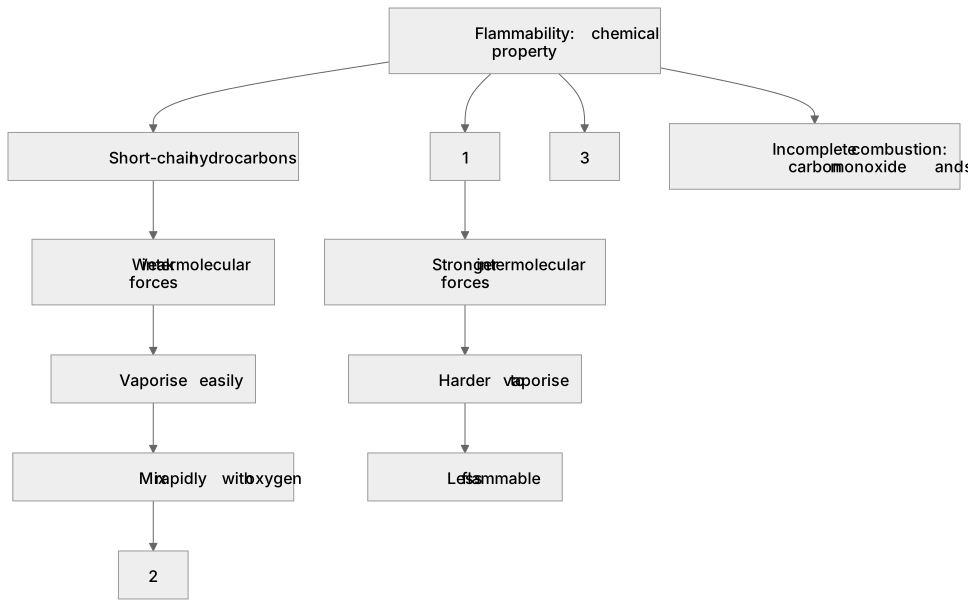
1Box 1
2Box 2
3Box 3
There is more to this lesson
The full lesson goes on to check your understanding and help you earn the marks. Create a free account to carry on, with your progress saved.
A week of Premium from your first lesson · Then the free plan continues · No card, no charge
Test your understanding of Properties of hydrocarbons: flammability.
Active recall beats re-reading. Take an instant quiz now to test what you’ve learned and lock it into long-term memory.
A week of Premium from your first lesson · Then the free plan continues · No card, no charge