AQA · GCSE · Combined Science
Course version: 8464 · Version from Sept 2018
Properties of hydrocarbons: Some properties of hydrocarbons depend on the size of their molecules, including boiling point, viscosity and flammability. These properties influence how hydrocarbons are used as fuels.
This statement explains that the physical and chemical behaviour of hydrocarbons is linked to molecule size.
- 4 key terms
Study notes
From the checked teaching notes for this specification point.
The idea
This statement explains that the physical and chemical behaviour of hydrocarbons is linked to molecule size. As the number of carbon atoms in a hydrocarbon chain increases, the molecules become larger and heavier. This changes three key properties: boiling point increases, viscosity increases and flammability decreases. These trends arise because larger molecules have stronger intermolecular forces between them, so more energy is needed to separate them and they flow less easily. The properties then determine how a hydrocarbon is used. For example, short-chain hydrocarbons such as methane and propane have low boiling points and are highly flammable, making them useful as gases for heating and cooking. Longer-chain hydrocarbons are more viscous and less flammable, so they are used as lubricants or as fuels where a slower, steadier burn is needed.
What earns the marks
- State that as hydrocarbon molecules get larger, boiling point increases.
- Explain that larger molecules have stronger intermolecular forces, so more energy is needed to overcome them.
- Describe that viscosity increases as molecule size increases, meaning larger hydrocarbons flow less easily.
- Explain that flammability decreases as molecule size increases, so larger hydrocarbons are harder to ignite.
- Link these properties to uses: small molecules as fuels for burning, larger molecules as lubricants or for slower-burning fuels.
- Use the trends to predict the behaviour of an unfamiliar hydrocarbon when its size is given.
Common mistakes and how to put them right
Saying that boiling point decreases as molecule size increases.
Put it right: Boiling point increases because larger molecules have stronger intermolecular forces.
Confusing viscosity with density.
Put it right: Viscosity is resistance to flow, not mass per unit volume.
Thinking all hydrocarbons are equally flammable.
Put it right: Flammability decreases as molecule size increases.
Assuming larger hydrocarbons are always better fuels.
Put it right: Larger hydrocarbons are less flammable and may be used as lubricants instead.
Exam tips
- When explaining a trend, always refer to the size of the molecule and the strength of intermolecular forces.
- Use comparative language such as 'higher', 'lower', 'more viscous' and 'less flammable' to make your answers precise.
- If asked to suggest a use, match the property to the job: highly flammable for easy burning, viscous for lubrication.
- Practise drawing or interpreting a graph of boiling point against number of carbon atoms to reinforce the trend.
Try the lesson
The start of the Properties of hydrocarbons: Some properties of hydrocarbons depend on the size of their molecules, including boiling point, viscosity and flammability. These properties influence how hydrocarbons are used as fuels. lesson, made from checked teaching notes for this specification point.
Have a go first
As the molecules of a hydrocarbon fuel get larger, what happens to its boiling point?
Listen
This statement explains that the physical and chemical behaviour of hydrocarbons is linked to molecule size. As the number of carbon atoms in a hydrocarbon chain increases, the molecules become larger and heavier. This changes three key properties: boiling point increases, viscosity increases and flammability decreases. These trends arise because larger molecules have stronger intermolecular forces between them, so more energy is needed to separate them and they flow less easily. The properties then determine how a hydrocarbon is used. For example, short-chain hydrocarbons such as methane and propane have low boiling points and are highly flammable, making them useful as gases for heating and cooking. Longer-chain hydrocarbons are more viscous and less flammable, so they are used as lubricants or as fuels where a slower, steadier burn is needed. A strong answer earns marks for these points. State that as hydrocarbon molecules get larger, boiling point increases. Explain that larger molecules have stronger intermolecular forces, so more energy is needed to overcome them. Describe that viscosity increases as molecule size increases, meaning larger hydrocarbons flow less easily. Explain that flammability decreases as molecule size increases, so larger hydrocarbons are harder to ignite. A common slip: saying that boiling point decreases as molecule size increases. Instead, boiling point increases because larger molecules have stronger intermolecular forces. Exam tip: When explaining a trend, always refer to the size of the molecule and the strength of intermolecular forces.
See it
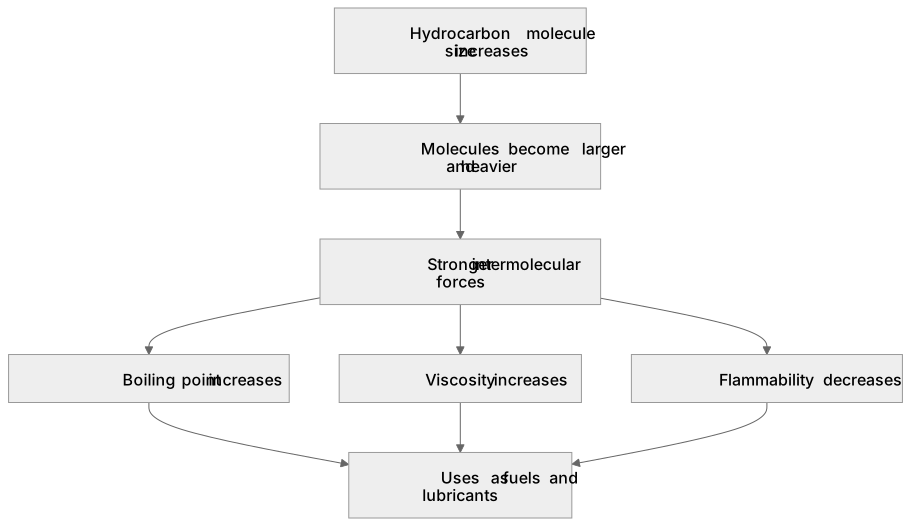
Key words
Say what each word means before you turn the card.
boiling point
Try answering aloud or in your head before turning the card.
viscosity
Try answering aloud or in your head before turning the card.
flammability
Try answering aloud or in your head before turning the card.
intermolecular forces
Try answering aloud or in your head before turning the card.
See every definition
- boiling point
- As hydrocarbon molecules get larger, this increases because larger molecules have stronger intermolecular forces, so more energy is needed to overcome them.
- viscosity
- Resistance to flow, which increases as molecule size increases, meaning larger hydrocarbons flow less easily.
- flammability
- How easily a hydrocarbon ignites, which decreases as molecule size increases, so larger hydrocarbons are harder to ignite.
- intermolecular forces
- Forces between molecules that are stronger in larger molecules, so more energy is needed to separate them.
Label the diagram
Some boxes have lost their names. Pick the right name for each number.
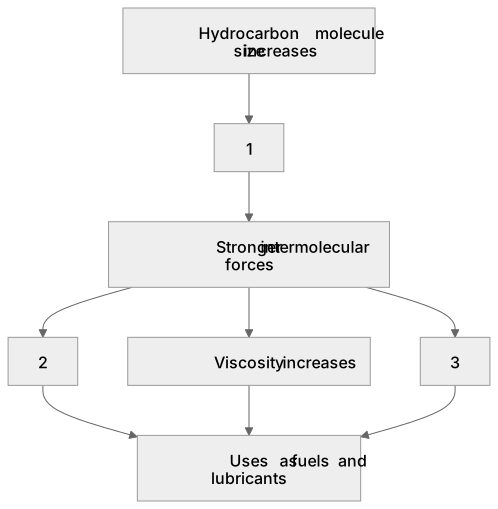
1Box 1
2Box 2
3Box 3
There is more to this lesson
The full lesson goes on to check your understanding and help you earn the marks. Create a free account to carry on, with your progress saved.
A week of Premium from your first lesson · Then the free plan continues · No card, no charge
Test your understanding of Properties of hydrocarbons: Some properties of hydrocarbons depend on the size of their molecules, including boiling point, viscosity and flammability. These properties influence how hydrocarbons are used as fuels.
Active recall beats re-reading. Take an instant quiz now to test what you’ve learned and lock it into long-term memory.
A week of Premium from your first lesson · Then the free plan continues · No card, no charge