AQA · GCSE · Combined Science
Course version: 8464 · Version from Sept 2018
Properties of hydrocarbons: Students should be able to write balanced equations for the complete combustion of hydrocarbons with a given formula.
Complete combustion of a hydrocarbon occurs when it burns in a plentiful supply of oxygen, producing carbon dioxide and water only.
- 2 key terms
Study notes
From the checked teaching notes for this specification point.
The idea
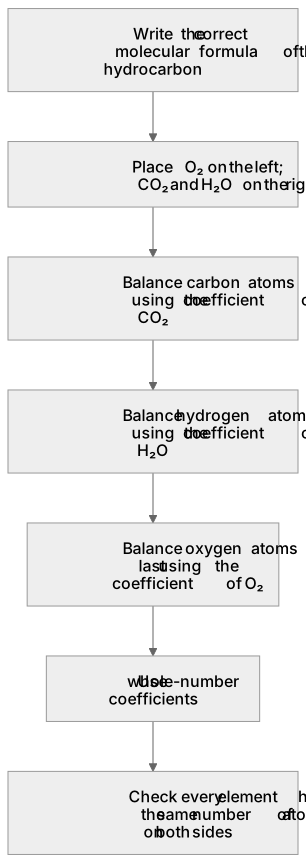
Complete combustion of a hydrocarbon occurs when it burns in a plentiful supply of oxygen, producing carbon dioxide and water only. To write a balanced equation, first write the correct molecular formula of the hydrocarbon, then place O₂ on the left and CO₂ and H₂O on the right. Balance carbon atoms first, then hydrogen atoms, and finally oxygen atoms, using whole-number coefficients. For example, methane CH₄ burns as CH₄ + 2O₂ → CO₂ + 2H₂O. For ethane C₂H₆, balance to 2C₂H₆ + 7O₂ → 4CO₂ + 6H₂O. Check that every element has the same number of atoms on both sides. State symbols may be added if required, but the essential skill is correct formulae and whole-number balancing.
What earns the marks
- Correctly identify the products of complete combustion as carbon dioxide and water.
- Write the correct molecular formula for the given hydrocarbon, including any double bonds implied by the formula.
- Balance carbon atoms by adjusting the coefficient of CO₂ to match the number of carbon atoms in the hydrocarbon.
- Balance hydrogen atoms by adjusting the coefficient of H₂O to match half the number of hydrogen atoms in the hydrocarbon.
- Balance oxygen atoms last by adjusting the coefficient of O₂, using a whole number or an even-numbered coefficient where necessary.
Common mistakes and how to put them right
Writing water as OH or hydrogen peroxide instead of H₂O.
Put it right by using H₂O for the combustion product.
Balancing oxygen before carbon and hydrogen, which often leads to fractions.
Put it right by balancing C, then H, then O.
Forgetting to multiply the oxygen count in CO₂ and H₂O when choosing the O₂ coefficient.
Put it right by counting all oxygen atoms on the product side before setting the O₂ coefficient.
Exam tips
- Write the unbalanced word or formula equation first, then balance systematically rather than guessing coefficients.
- Show your balancing steps clearly so that a correct final equation is not lost through an arithmetic slip.
Try the lesson
The start of the Properties of hydrocarbons: Students should be able to write balanced equations for the complete combustion of hydrocarbons with a given formula. lesson, made from checked teaching notes for this specification point.
Have a go first
Methane burns completely in oxygen. Which balanced equation shows the complete combustion of methane?
Listen
Complete combustion of a hydrocarbon occurs when it burns in a plentiful supply of oxygen, producing carbon dioxide and water only. To write a balanced equation, first write the correct molecular formula of the hydrocarbon, then place O₂ on the left and CO₂ and H₂O on the right. Balance carbon atoms first, then hydrogen atoms, and finally oxygen atoms, using whole-number coefficients. For example, methane CH₄ burns as CH₄ + 2O₂ → CO₂ + 2H₂O. For ethane C₂H₆, balance to 2C₂H₆ + 7O₂ → 4CO₂ + 6H₂O. Check that every element has the same number of atoms on both sides. State symbols may be added if required, but the essential skill is correct formulae and whole-number balancing. A strong answer earns marks for these points. Correctly identify the products of complete combustion as carbon dioxide and water. Write the correct molecular formula for the given hydrocarbon, including any double bonds implied by the formula. Balance carbon atoms by adjusting the coefficient of CO₂ to match the number of carbon atoms in the hydrocarbon. Balance hydrogen atoms by adjusting the coefficient of H₂O to match half the number of hydrogen atoms in the hydrocarbon. A common slip: Writing water as OH or hydrogen peroxide instead of H₂O. Instead, using H₂O for the combustion product. Exam tip: Write the unbalanced word or formula equation first, then balance systematically rather than guessing coefficients.
See it
Put it in order
Put these steps in the order they happen.
- 1. Place O₂ on the left; CO₂ and H₂O on the right
- 2. Balance carbon atoms using the coefficient of CO₂
- 3. Balance hydrogen atoms using the coefficient of H₂O
- 4. Balance oxygen atoms last using the coefficient of O₂
- 5. Use whole-number coefficients
- 6. Check every element has the same number of atoms on both sides
- 7. Write the correct molecular formula of the hydrocarbon
Key words
Say what each word means before you turn the card.
Complete combustion
Try answering aloud or in your head before turning the card.
Balancing chemical equations
Try answering aloud or in your head before turning the card.
See every definition
- Complete combustion
- Burning a hydrocarbon in a plentiful supply of oxygen, producing carbon dioxide and water only.
- Balancing chemical equations
- Adjusting whole-number coefficients so that every element has the same number of atoms on both sides.
Label the diagram
Some boxes have lost their names. Pick the right name for each number.
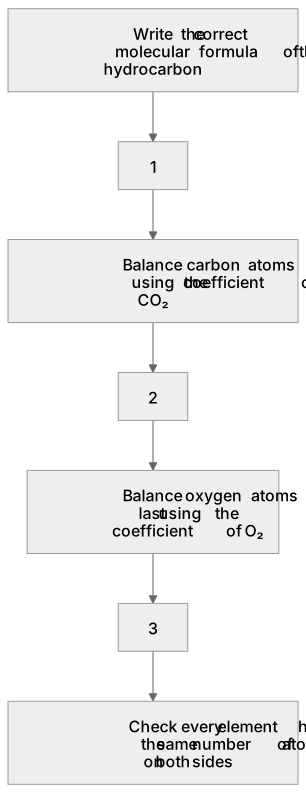
1Box 1
2Box 2
3Box 3
There is more to this lesson
The full lesson goes on to check your understanding and help you earn the marks. Create a free account to carry on, with your progress saved.
A week of Premium from your first lesson · Then the free plan continues · No card, no charge
Test your understanding of Properties of hydrocarbons: Students should be able to write balanced equations for the complete combustion of hydrocarbons with a given formula.
Active recall beats re-reading. Take an instant quiz now to test what you’ve learned and lock it into long-term memory.
A week of Premium from your first lesson · Then the free plan continues · No card, no charge