AQA · GCSE · Combined Science
Course version: 8464 · Version from Sept 2018
Properties of hydrocarbons: viscosity
Viscosity describes how easily a liquid hydrocarbon flows.
Study notes
From the checked teaching notes for this specification point.
The idea
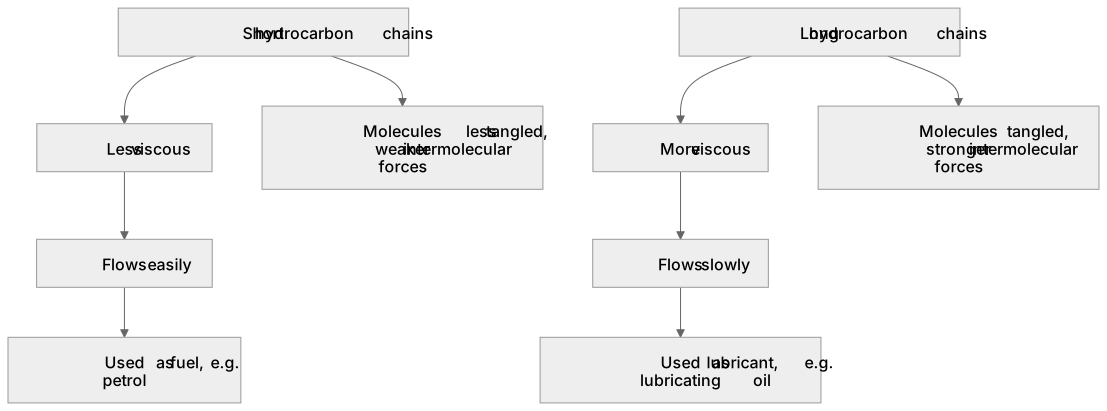
Viscosity describes how easily a liquid hydrocarbon flows. A viscous liquid is thick and flows slowly because its molecules are long and become tangled, so they resist sliding over one another. In a homologous series, viscosity increases as chain length increases: methane and propane are gases, petrol contains shorter chains and flows easily, while diesel and lubricating oil contain longer chains and are more viscous.
For example: Petrol is used as fuel because it flows easily, whereas lubricating oil is used where a thick, slow-flowing liquid is needed.
What earns the marks
- Viscosity is a measure of how easily a liquid flows; higher viscosity means slower flow.
- As the number of carbon atoms in the hydrocarbon chain increases, viscosity increases.
- Longer hydrocarbon molecules become tangled and have stronger intermolecular forces, so they resist flowing past one another.
- Shorter hydrocarbons are less viscous and flow more easily, which is why petrol is more runny than diesel or lubricating oil.
- Viscosity is a physical property that helps determine the use of a fraction, such as fuel or lubricant.
- The trend can be observed by comparing how quickly equal volumes of different fractions flow through the same tube or opening.
Common mistakes and how to put them right
Saying viscosity increases because molecules are heavier.
Put it right: Viscosity increases mainly because longer molecules become tangled and have stronger intermolecular forces, not simply because they are heavier.
Confusing viscosity with boiling point.
Put it right: Viscosity describes resistance to flow, while boiling point describes the temperature of a change of state.
Stating that viscous liquids are denser.
Put it right: Viscosity and density are different properties; a liquid can be viscous without being unusually dense.
Exam tips
- Define viscosity clearly before describing the trend, so your answer has a secure starting point.
- Compare named fractions such as petrol, diesel and lubricating oil to make the trend concrete.
- Explain viscosity using molecular size, tangling and intermolecular forces rather than using the word thick alone.
- When linking viscosity to use, state the required property, such as easy flow for a fuel or slow flow for a lubricant.
Try the lesson
The start of the Properties of hydrocarbons: viscosity lesson, made from checked teaching notes for this specification point.
Have a go first
Which word describes how easily a liquid hydrocarbon flows?
Listen
Viscosity describes how easily a liquid hydrocarbon flows. A viscous liquid is thick and flows slowly because its molecules are long and become tangled, so they resist sliding over one another. In a homologous series, viscosity increases as chain length increases: methane and propane are gases, petrol contains shorter chains and flows easily, while diesel and lubricating oil contain longer chains and are more viscous. For example, petrol is used as fuel because it flows easily, whereas lubricating oil is used where a thick, slow-flowing liquid is needed. A strong answer earns marks for these points. Viscosity is a measure of how easily a liquid flows; higher viscosity means slower flow. As the number of carbon atoms in the hydrocarbon chain increases, viscosity increases. Longer hydrocarbon molecules become tangled and have stronger intermolecular forces, so they resist flowing past one another. Shorter hydrocarbons are less viscous and flow more easily, which is why petrol is more runny than diesel or lubricating oil. A common slip: saying viscosity increases because molecules are heavier. Instead, viscosity increases mainly because longer molecules become tangled and have stronger intermolecular forces, not simply because they are heavier. Exam tip: Define viscosity clearly before describing the trend, so your answer has a secure starting point.
See it
Label the diagram
Some boxes have lost their names. Pick the right name for each number.
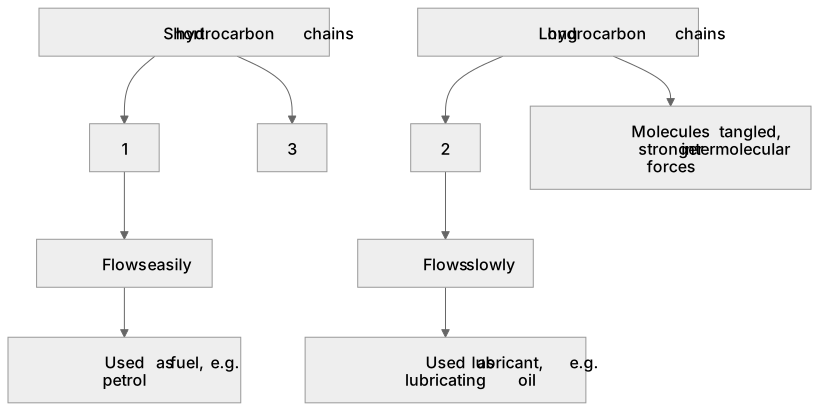
1Box 1
2Box 2
3Box 3
There is more to this lesson
The full lesson goes on to check your understanding and help you earn the marks. Create a free account to carry on, with your progress saved.
A week of Premium from your first lesson · Then the free plan continues · No card, no charge
Test your understanding of Properties of hydrocarbons: viscosity
Active recall beats re-reading. Take an instant quiz now to test what you’ve learned and lock it into long-term memory.
A week of Premium from your first lesson · Then the free plan continues · No card, no charge