AQA · GCSE · Combined Science
Course version: 8464 · Version from Sept 2018
Pure substances: In chemistry, a pure substance is a single element or compound, not mixed with any other substance.
In everyday language, 'pure' often means clean or natural, but in chemistry it has a precise meaning: a pure substance consists of only one element or one compound, with nothing else mixed in.
- 4 key terms
Study notes
From the checked teaching notes for this specification point.
The idea
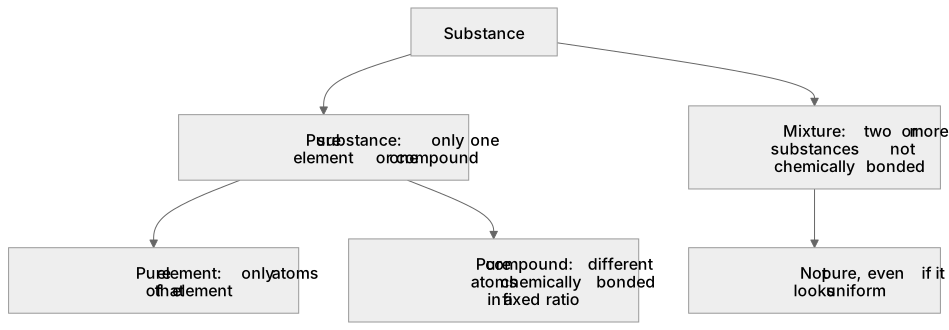
In everyday language, 'pure' often means clean or natural, but in chemistry it has a precise meaning: a pure substance consists of only one element or one compound, with nothing else mixed in. A pure element contains only atoms of that element, such as a block of copper or a sample of oxygen. A pure compound contains only one compound, such as distilled water (H₂O) or pure sodium chloride. Importantly, a pure substance can contain more than one type of atom, provided those atoms are chemically bonded in a fixed ratio as a single compound. If two or more different elements or compounds are present but not chemically bonded together, the sample is a mixture, even if it looks uniform, such as salty water or air.
What earns the marks
- States that a pure substance contains only one element or only one compound.
- Recognises that a pure compound may contain different types of atom chemically bonded together, for example H₂O or CO₂.
- Distinguishes a pure substance from a mixture, where two or more substances are present but not chemically combined.
- Applies the definition to unfamiliar examples, such as classifying pure iron as an element and pure ethanol as a compound.
- Explains that a mixture can contain a pure element or compound alongside other substances, so the mixture itself is not pure.
Common mistakes and how to put them right
Thinking 'pure' means clean, safe or natural.
Put it right: In chemistry it means only one element or compound is present.
Believing a pure substance must contain only one type of atom.
Put it right: A pure compound contains different atoms bonded in a fixed ratio.
Classifying air or salty water as pure because they look clear.
Put it right: They are mixtures of two or more substances.
Exam tips
- Read the question carefully to see whether it asks about a pure element, a pure compound or a mixture before answering.
- When justifying purity, name the single substance present and state that no other substance is mixed with it.
- Use particle diagrams or formulae to support your answer, for example showing H₂O as one compound rather than a mixture of hydrogen and oxygen.
Try the lesson
The start of the Pure substances: In chemistry, a pure substance is a single element or compound, not mixed with any other substance. lesson, made from checked teaching notes for this specification point.
Have a go first
How is a pure substance defined in chemistry?
Listen
In everyday language, 'pure' often means clean or natural, but in chemistry it has a precise meaning: a pure substance consists of only one element or one compound, with nothing else mixed in. A pure element contains only atoms of that element, such as a block of copper or a sample of oxygen. A pure compound contains only one compound, such as distilled water (H₂O) or pure sodium chloride. Importantly, a pure substance can contain more than one type of atom, provided those atoms are chemically bonded in a fixed ratio as a single compound. If two or more different elements or compounds are present but not chemically bonded together, the sample is a mixture, even if it looks uniform, such as salty water or air. A strong answer earns marks for these points. States that a pure substance contains only one element or only one compound. Recognises that a pure compound may contain different types of atom chemically bonded together, for example H₂O or CO₂. Distinguishes a pure substance from a mixture, where two or more substances are present but not chemically combined. Applies the definition to unfamiliar examples, such as classifying pure iron as an element and pure ethanol as a compound. A common slip: Thinking 'pure' means clean, safe or natural. Instead, in chemistry it means only one element or compound is present. Exam tip: Read the question carefully to see whether it asks about a pure element, a pure compound or a mixture before answering.
See it
Key words
Say what each word means before you turn the card.
Pure substance
Try answering aloud or in your head before turning the card.
Mixture
Try answering aloud or in your head before turning the card.
Pure compound
Try answering aloud or in your head before turning the card.
Pure element
Try answering aloud or in your head before turning the card.
See every definition
- Pure substance
- A single element or compound, not mixed with any other substance.
- Mixture
- Two or more different elements or compounds present but not chemically bonded together, even if it looks uniform.
- Pure compound
- Contains only one compound, and may contain different types of atom chemically bonded together in a fixed ratio.
- Pure element
- Contains only atoms of that element.
Label the diagram
Some boxes have lost their names. Pick the right name for each number.
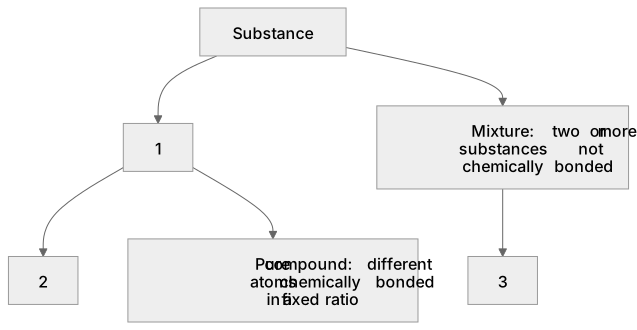
1Box 1
2Box 2
3Box 3
There is more to this lesson
The full lesson goes on to check your understanding and help you earn the marks. Create a free account to carry on, with your progress saved.
A week of Premium from your first lesson · Then the free plan continues · No card, no charge
Test your understanding of Pure substances: In chemistry, a pure substance is a single element or compound, not mixed with any other substance.
Active recall beats re-reading. Take an instant quiz now to test what you’ve learned and lock it into long-term memory.
A week of Premium from your first lesson · Then the free plan continues · No card, no charge