AQA · GCSE · Combined Science
Course version: 8464 · Version from Sept 2018
Pure substances: In everyday language, a pure substance can mean a substance that has had nothing added to it, so it is unadulterated and in its natural state, eg pure milk.
In everyday language, 'pure' describes something with nothing added, unadulterated and in its natural state, such as pure milk or pure orange juice.
- 3 key terms
Study notes
From the checked teaching notes for this specification point.
The idea
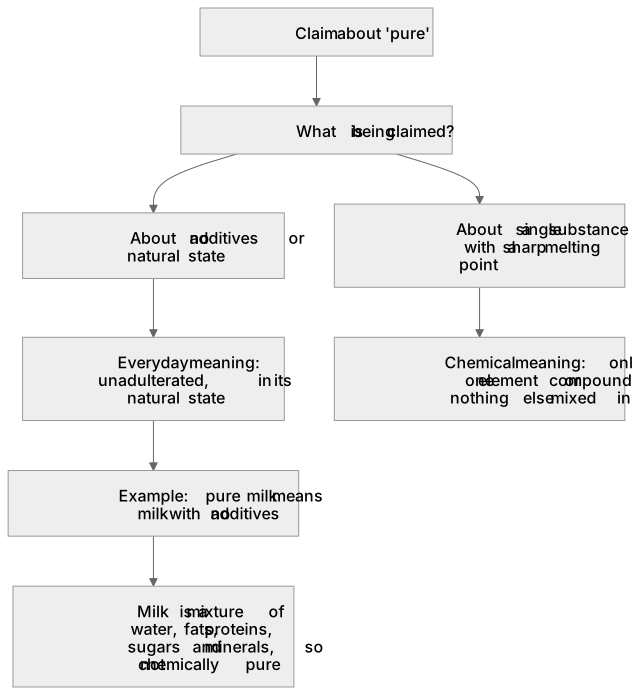
In everyday language, 'pure' describes something with nothing added, unadulterated and in its natural state, such as pure milk or pure orange juice. This everyday meaning is about absence of additives, not chemical composition. Chemists use 'pure' differently: a pure substance contains only one element or compound, with no other substances mixed in. So pure milk is not chemically pure because it is a mixture of water, fats, proteins, sugars and minerals. A bottle labelled 'pure water' may still contain dissolved ions, making it a mixture in chemical terms. To decide which meaning applies, ask what is being claimed: if the claim is about no additives or natural state, it is the everyday meaning; if it is about a single substance with a sharp melting point, it is the chemical meaning.
What earns the marks
- Everyday meaning: a substance that has had nothing added to it, so it is unadulterated and in its natural state.
- Example: pure milk means milk with no additives, not a single chemical substance.
- Chemical meaning: a pure substance contains only one element or compound, with no other substances mixed in.
- Pure milk is a mixture of water, fats, proteins, sugars and minerals, so it is not chemically pure.
- The context of the claim determines which meaning of 'pure' is intended.
Common mistakes and how to put them right
Assuming 'pure' always means chemically pure.
Put it right: In everyday language it can mean unadulterated or natural, as with pure milk.
Thinking pure milk is a single substance.
Put it right: Milk is a mixture of water, fats, proteins, sugars and minerals.
Treating the two meanings as interchangeable.
Put it right: Identify whether the claim is about additives or about chemical composition.
Exam tips
- Read the context of the word 'pure' before deciding which meaning is intended.
- Use the milk example to show you understand the everyday meaning is about no additives.
- Contrast everyday and chemical meanings explicitly in your answer to show understanding.
Try the lesson
The start of the Pure substances: In everyday language, a pure substance can mean a substance that has had nothing added to it, so it is unadulterated and in its natural state, eg pure milk. lesson, made from checked teaching notes for this specification point.
Have a go first
A bottle of orange juice is labelled 'pure orange juice'. In everyday language, what does the word 'pure' mean here?
Listen
In everyday language, 'pure' describes something with nothing added, unadulterated and in its natural state, such as pure milk or pure orange juice. This everyday meaning is about absence of additives, not chemical composition. Chemists use 'pure' differently: a pure substance contains only one element or compound, with no other substances mixed in. So pure milk is not chemically pure because it is a mixture of water, fats, proteins, sugars and minerals. A bottle labelled 'pure water' may still contain dissolved ions, making it a mixture in chemical terms. To decide which meaning applies, ask what is being claimed: if the claim is about no additives or natural state, it is the everyday meaning; if it is about a single substance with a sharp melting point, it is the chemical meaning. A strong answer earns marks for these points. Everyday meaning: a substance that has had nothing added to it, so it is unadulterated and in its natural state. Example: pure milk means milk with no additives, not a single chemical substance. Chemical meaning: a pure substance contains only one element or compound, with no other substances mixed in. Pure milk is a mixture of water, fats, proteins, sugars and minerals, so it is not chemically pure. A common slip: Assuming 'pure' always means chemically pure. Instead, in everyday language it can mean unadulterated or natural, as with pure milk. Exam tip: Read the context of the word 'pure' before deciding which meaning is intended.
See it
Key words
Say what each word means before you turn the card.
Everyday versus chemical meaning of pure
Try answering aloud or in your head before turning the card.
Unadulterated and natural state
Try answering aloud or in your head before turning the card.
Mixtures versus single substances
Try answering aloud or in your head before turning the card.
See every definition
- Everyday versus chemical meaning of pure
- In everyday language a pure substance has had nothing added to it, while chemists use pure to mean only one element or compound with no other substances mixed in.
- Unadulterated and natural state
- A substance that has had nothing added to it, so it is unadulterated and in its natural state.
- Mixtures versus single substances
- A pure substance contains only one element or compound, with no other substances mixed in, whereas pure milk is a mixture of water, fats, proteins, sugars and minerals.
Label the diagram
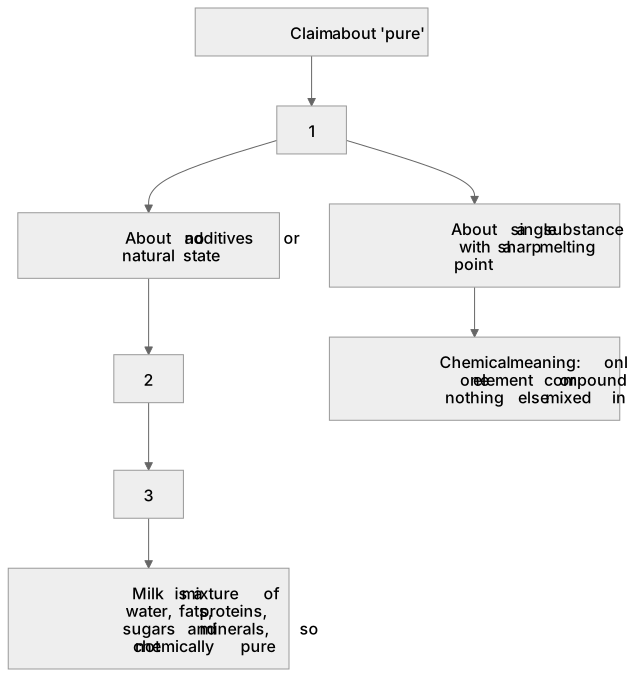
Some boxes have lost their names. Pick the right name for each number.
1Box 1
2Box 2
3Box 3
There is more to this lesson
The full lesson goes on to check your understanding and help you earn the marks. Create a free account to carry on, with your progress saved.
A week of Premium from your first lesson · Then the free plan continues · No card, no charge
Test your understanding of Pure substances: In everyday language, a pure substance can mean a substance that has had nothing added to it, so it is unadulterated and in its natural state, eg pure milk.
Active recall beats re-reading. Take an instant quiz now to test what you’ve learned and lock it into long-term memory.
A week of Premium from your first lesson · Then the free plan continues · No card, no charge