AQA · GCSE · Combined Science
Course version: 8464 · Version from Sept 2018
Reaction profiles: Chemical reactions can occur only when reacting particles collide with each other and with sufficient energy. The minimum amount of energy that particles must have to react is called the activation energy.
Particles must collide to react, but most collisions do not lead to reaction.
Study notes
From the checked teaching notes for this specification point.
The idea
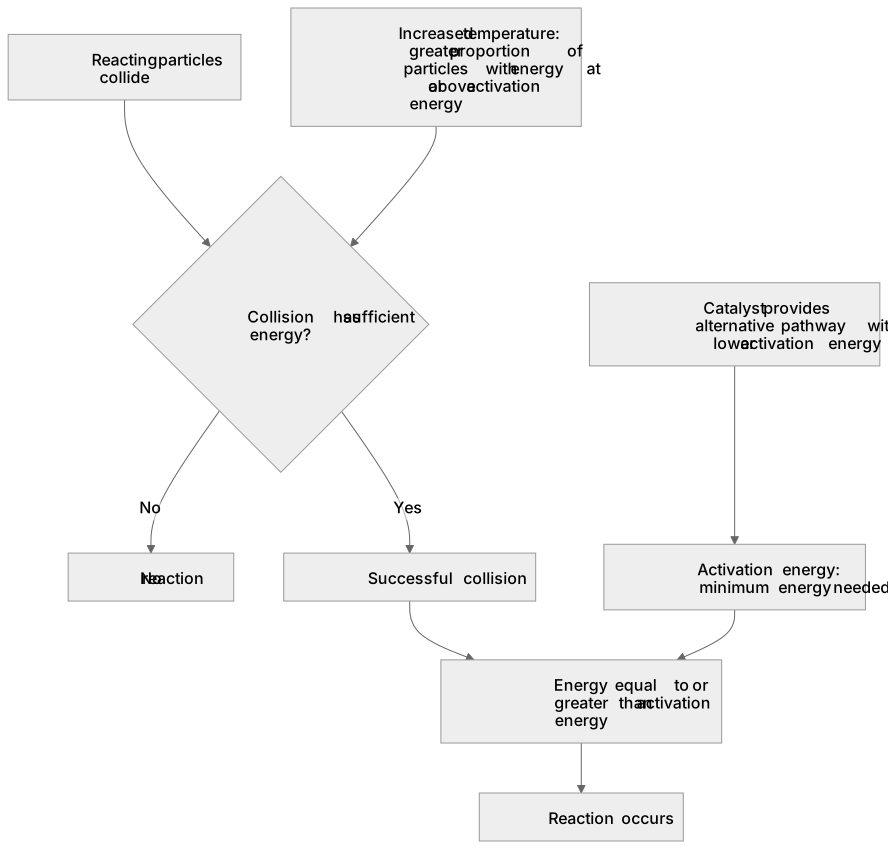
Particles must collide to react, but most collisions do not lead to reaction. A successful collision requires energy equal to or greater than the activation energy. Activation energy is the minimum energy needed for reacting particles to overcome the energy barrier and form products. On a reaction profile, it is the energy difference between the reactants and the peak of the curve. Increasing temperature increases the proportion of particles with energy ≥ activation energy, so reaction rate increases. Catalysts provide an alternative pathway with lower activation energy. This concept explains why reactions have a threshold and why not every collision is effective.
What earns the marks
- States that reacting particles must collide with each other.
- Explains that collisions must have sufficient energy to be successful.
- Defines activation energy as the minimum energy required for a reaction to occur.
- Identifies activation energy on a reaction profile as the energy difference between reactants and the peak of the curve.
- Links increased temperature to a greater proportion of particles having energy greater than or equal to the activation energy.
- Explains that catalysts lower activation energy by providing an alternative reaction pathway.
Common mistakes and how to put them right
Saying any collision causes a reaction.
Put it right: Only collisions with energy greater than or equal to the activation energy are successful.
Confusing activation energy with overall energy change.
Put it right: Activation energy is the energy barrier from reactants to the peak; overall energy change is from reactants to products.
Thinking a catalyst increases the energy of particles.
Put it right: A catalyst lowers the activation energy by providing an alternative pathway.
Assuming exothermic reactions do not have an activation energy.
Put it right: All reactions require an initial input of activation energy to start breaking bonds.
Exam tips
- Use the phrase 'minimum energy' when defining activation energy.
- On a reaction profile, label the activation energy as the vertical distance from reactants to the highest point of the curve.
- When explaining rate increases with temperature, refer to the proportion of particles with energy greater than or equal to the activation energy.
- For catalyst questions, state that the activation energy is lowered, not that the particles gain energy.
Try the lesson
The start of the Reaction profiles: Chemical reactions can occur only when reacting particles collide with each other and with sufficient energy. The minimum amount of energy that particles must have to react is called the activation energy. lesson, made from checked teaching notes for this specification point.
Have a go first
What name is given to the minimum amount of energy that reacting particles must have in order to react when they collide?
Listen
Particles must collide to react, but most collisions do not lead to reaction. A successful collision requires energy equal to or greater than the activation energy. Activation energy is the minimum energy needed for reacting particles to overcome the energy barrier and form products. On a reaction profile, it is the energy difference between the reactants and the peak of the curve. Increasing temperature increases the proportion of particles with energy ≥ activation energy, so reaction rate increases. Catalysts provide an alternative pathway with lower activation energy. This concept explains why reactions have a threshold and why not every collision is effective. A strong answer earns marks for these points. States that reacting particles must collide with each other. Explains that collisions must have sufficient energy to be successful. Defines activation energy as the minimum energy required for a reaction to occur. Identifies activation energy on a reaction profile as the energy difference between reactants and the peak of the curve. A common slip: saying any collision causes a reaction. Instead, only collisions with energy greater than or equal to the activation energy are successful. Exam tip: Use the phrase 'minimum energy' when defining activation energy.
See it
There is more to this lesson
The full lesson goes on to check your understanding and help you earn the marks. Create a free account to carry on, with your progress saved.
A week of Premium from your first lesson · Then the free plan continues · No card, no charge
Test your understanding of Reaction profiles: Chemical reactions can occur only when reacting particles collide with each other and with sufficient energy. The minimum amount of energy that particles must have to react is called the activation energy.
Active recall beats re-reading. Take an instant quiz now to test what you’ve learned and lock it into long-term memory.
A week of Premium from your first lesson · Then the free plan continues · No card, no charge