AQA · GCSE · Combined Science
Course version: 8464 · Version from Sept 2018
Reactions of acids with metals: explain in terms of gain or loss of electrons, that these are redox reactions
For Higher Tier, candidates must explain metal-acid reactions as redox processes using electron transfer.
- 3 key terms
Study notes
From the checked teaching notes for this specification point.
The idea
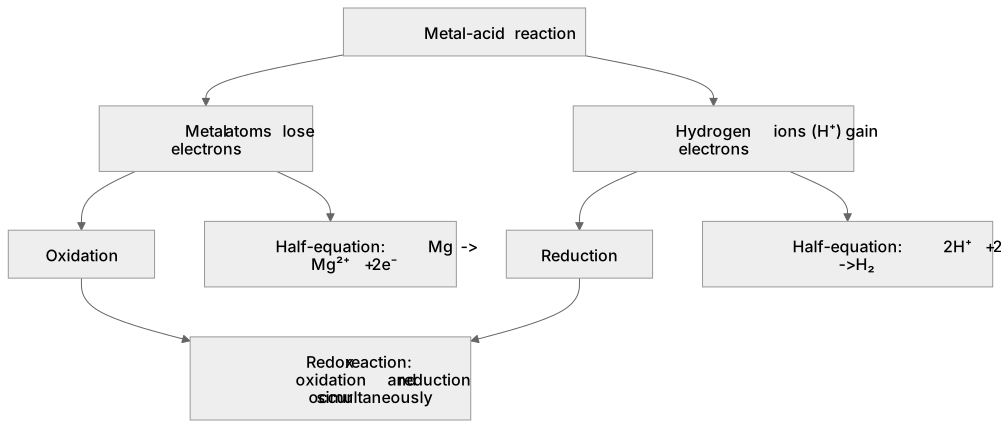
For Higher Tier, candidates must explain metal-acid reactions as redox processes using electron transfer. A redox reaction occurs when oxidation (loss of electrons) and reduction (gain of electrons) happen simultaneously. For example, when magnesium reacts with hydrochloric acid, magnesium atoms lose two electrons to form Mg²⁺ ions (oxidation). Simultaneously, two H⁺ ions from the acid each gain one electron to form a hydrogen molecule, H₂ (reduction). Half-equations clearly show this transfer.
What earns the marks
- Define oxidation strictly as the loss of electrons by a chemical species.
- Define reduction strictly as the gain of electrons by a chemical species.
- Explain that a redox reaction involves both oxidation and reduction occurring simultaneously.
- Identify that in metal-acid reactions, metal atoms are oxidised by losing electrons to form positive metal ions.
- Identify that hydrogen ions (H⁺) from the acid are reduced by gaining electrons to form neutral hydrogen gas molecules (H₂).
Common mistakes and how to put them right
Stating that 'hydrogen gas' is reduced.
Put it right: Specify that it is the aqueous hydrogen ions (H⁺) that are reduced to form hydrogen gas.
Forgetting to state that oxidation and reduction happen at the same time.
Put it right: Use the word 'simultaneously' when defining a redox reaction.
Exam tips
- When asked to 'explain' a redox reaction, always explicitly mention both the loss and gain of electrons to secure full credit.
- Use ionic half-equations (e.g., Mg -> Mg²⁺ + 2e⁻ and 2H⁺ + 2e⁻ -> H₂) to clearly demonstrate the simultaneous electron transfer for both the metal and the hydrogen ions.
Try the lesson
The start of the Reactions of acids with metals: explain in terms of gain or loss of electrons, that these are redox reactions lesson, made from checked teaching notes for this specification point.
Have a go first
When zinc reacts with dilute sulfuric acid, each zinc atom loses two electrons to form a zinc ion. In terms of electron transfer, how is this change described?
Listen
For Higher Tier, candidates must explain metal-acid reactions as redox processes using electron transfer. A redox reaction occurs when oxidation (loss of electrons) and reduction (gain of electrons) happen simultaneously. For example, when magnesium reacts with hydrochloric acid, magnesium atoms lose two electrons to form Mg²⁺ ions (oxidation). Simultaneously, two H⁺ ions from the acid each gain one electron to form a hydrogen molecule, H₂ (reduction). Half-equations clearly show this transfer. A strong answer earns marks for these points. Define oxidation strictly as the loss of electrons by a chemical species. Define reduction strictly as the gain of electrons by a chemical species. Explain that a redox reaction involves both oxidation and reduction occurring simultaneously. Identify that in metal-acid reactions, metal atoms are oxidised by losing electrons to form positive metal ions. A common slip: Describing the reaction using oxygen transfer instead of electrons. Instead, Explicitly state which species loses and gains electrons (OIL RIG) for this specific Higher Tier requirement. Exam tip: When asked to 'explain' a redox reaction, always explicitly mention both the loss and gain of electrons to secure full credit.
See it
Key words
Say what each word means before you turn the card.
Redox reactions
Try answering aloud or in your head before turning the card.
Electron transfer
Try answering aloud or in your head before turning the card.
Ionic half-equations
Try answering aloud or in your head before turning the card.
See every definition
- Redox reactions
- Reactions in which oxidation, the loss of electrons, and reduction, the gain of electrons, happen simultaneously.
- Electron transfer
- The movement of electrons shown by half-equations, with metal atoms losing electrons and hydrogen ions gaining them.
- Ionic half-equations
- Equations that clearly show the electron transfer, such as the loss of electrons by metal atoms and the gain by hydrogen ions.
Label the diagram
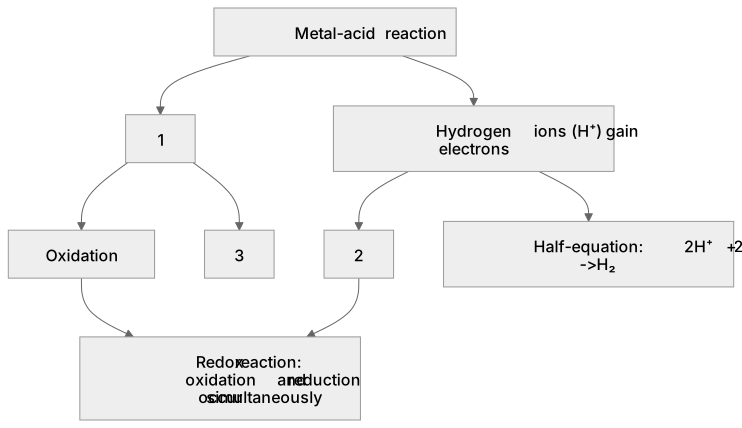
Some boxes have lost their names. Pick the right name for each number.
1Box 1
2Box 2
3Box 3
There is more to this lesson
The full lesson goes on to check your understanding and help you earn the marks. Create a free account to carry on, with your progress saved.
A week of Premium from your first lesson · Then the free plan continues · No card, no charge
Test your understanding of Reactions of acids with metals: explain in terms of gain or loss of electrons, that these are redox reactions
Active recall beats re-reading. Take an instant quiz now to test what you’ve learned and lock it into long-term memory.
A week of Premium from your first lesson · Then the free plan continues · No card, no charge