AQA · GCSE · Combined Science
Course version: 8464 · Version from Sept 2018
Reactions of acids with metals: identify which species are oxidised and which are reduced in given chemical equations.
Look at the charges on the atoms and ions.
- 3 key terms
Study notes
From the checked teaching notes for this specification point.
The idea
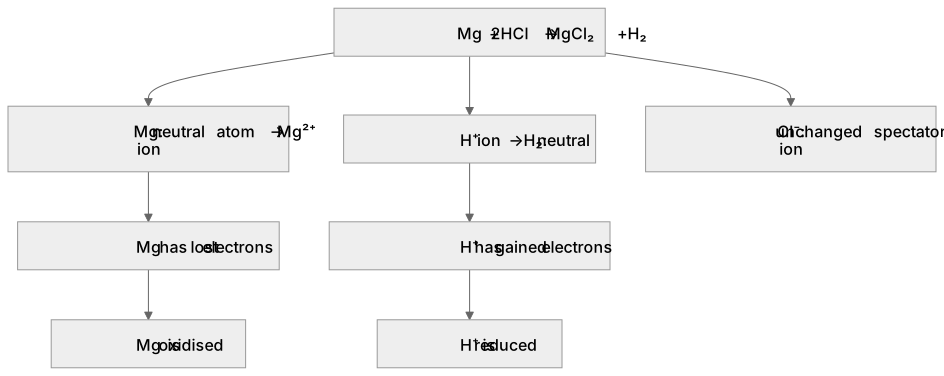
Look at the charges on the atoms and ions. Elements have no charge. In the reaction Mg + 2HCl → MgCl₂ + H₂, magnesium starts as a neutral atom (Mg) and becomes a positive ion (Mg²⁺) in magnesium chloride. It has lost electrons, so it is oxidised. The hydrogen starts as a positive ion (H⁺) in hydrochloric acid and becomes neutral hydrogen gas (H₂). It has gained electrons, so it is reduced. The chloride ions (Cl⁻) remain unchanged and are spectator ions. Always identify the specific ion or atom involved.
What earns the marks
- Identify the metal atom as the species that is oxidised in a metal-acid reaction.
- Identify the hydrogen ion (H⁺) as the species that is reduced.
- Justify the oxidation of the metal by stating it has lost electrons to form a positive ion.
- Justify the reduction of hydrogen by stating that hydrogen ions have gained electrons to form neutral hydrogen molecules.
Common mistakes and how to put them right
Identifying the entire acid (e.g., HCl) as being reduced.
Put it right: Specify that only the hydrogen ions (H⁺) are reduced.
Stating that the metal compound (e.g., MgCl₂) is oxidised.
Put it right: Identify the neutral metal reactant (e.g., Mg) as the species that is oxidised.
Confusing oxidation and reduction.
Put it right: Use the OIL RIG acronym to remember that Oxidation Is Loss and Reduction Is Gain of electrons.
Exam tips
- Look for the element that goes from having no charge to a positive charge; this is the species that is oxidised.
- Cross out spectator ions (like Cl⁻ or SO₄²⁻) in the equation to help you focus on the species that actually lose or gain electrons.
Try the lesson
The start of the Reactions of acids with metals: identify which species are oxidised and which are reduced in given chemical equations. lesson, made from checked teaching notes for this specification point.
Have a go first
Magnesium reacts with hydrochloric acid to produce magnesium chloride and hydrogen gas. The ionic equation for this reaction is: Mg + 2H⁺ → Mg²⁺ + H₂. Which species is reduced in this reaction?
Listen
Look at the charges on the atoms and ions. Elements have no charge. In the reaction Mg + 2HCl → MgCl₂ + H₂, magnesium starts as a neutral atom (Mg) and becomes a positive ion (Mg²⁺) in magnesium chloride. It has lost electrons, so it is oxidised. The hydrogen starts as a positive ion (H⁺) in hydrochloric acid and becomes neutral hydrogen gas (H₂). It has gained electrons, so it is reduced. The chloride ions (Cl⁻) remain unchanged and are spectator ions. Always identify the specific ion or atom involved. A strong answer earns marks for these points. Identify the metal atom as the species that is oxidised in a metal-acid reaction. Identify the hydrogen ion (H⁺) as the species that is reduced. Justify the oxidation of the metal by stating it has lost electrons to form a positive ion. Justify the reduction of hydrogen by stating that hydrogen ions have gained electrons to form neutral hydrogen molecules. A common slip: Identifying the entire acid (e.g., HCl) as being reduced. Instead, Specify that only the hydrogen ions (H⁺) are reduced. Exam tip: Look for the element that goes from having no charge to a positive charge; this is the species that is oxidised.
See it
Key words
Say what each word means before you turn the card.
Identifying oxidised and reduced species
Try answering aloud or in your head before turning the card.
Electron transfer in equations
Try answering aloud or in your head before turning the card.
Spectator ions
Try answering aloud or in your head before turning the card.
See every definition
- Identifying oxidised and reduced species
- Working out which species are oxidised and which are reduced in given chemical equations by tracking electron transfer and looking at the charges on the atoms and ions.
- Electron transfer in equations
- Tracking the loss or gain of electrons, where a species that has lost electrons is oxidised and one that has gained electrons is reduced.
- Spectator ions
- Ions that remain unchanged in a chemical equation, such as the chloride ions in a metal-acid reaction.
Label the diagram
Some boxes have lost their names. Pick the right name for each number.
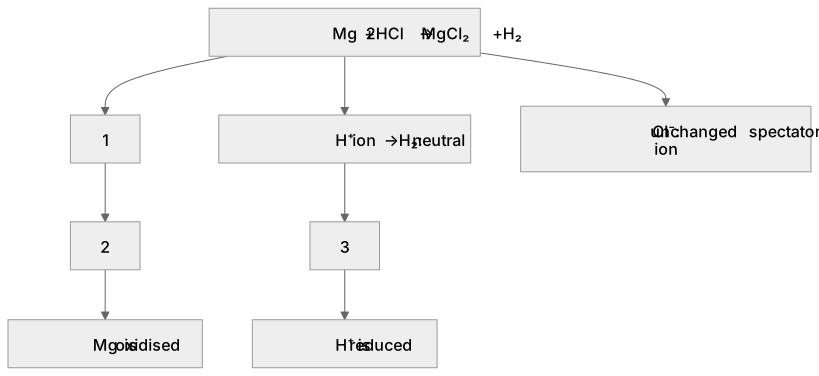
1Box 1
2Box 2
3Box 3
There is more to this lesson
The full lesson goes on to check your understanding and help you earn the marks. Create a free account to carry on, with your progress saved.
A week of Premium from your first lesson · Then the free plan continues · No card, no charge
Test your understanding of Reactions of acids with metals: identify which species are oxidised and which are reduced in given chemical equations.
Active recall beats re-reading. Take an instant quiz now to test what you’ve learned and lock it into long-term memory.
A week of Premium from your first lesson · Then the free plan continues · No card, no charge