AQA · GCSE · Combined Science
Course version: 8464 · Version from Sept 2018
Relative atomic mass: The relative atomic mass of an element is an average value that takes account of the abundance of the isotopes of the element.
Relative atomic mass, Aᵣ, is the average mass of the atoms of an element compared with 1/12 of the mass of a carbon-12 atom.
- 2 key terms
Study notes
From the checked teaching notes for this specification point.
The idea
Relative atomic mass, Aᵣ, is the average mass of the atoms of an element compared with 1/12 of the mass of a carbon-12 atom. Because most elements exist as a mixture of isotopes with different abundances, the average must be weighted. For chlorine, about 75% is chlorine-35 and about 25% is chlorine-37, so Aᵣ = (75 × 35 + 25 × 37) ÷ 100 = 35.5. The value lies between the isotope masses and is closer to the more abundant isotope. A weighted mean is calculated by multiplying each isotope mass by its abundance, adding the products, then dividing by the total abundance.
What earns the marks
- Defines relative atomic mass as an average mass compared with 1/12 of the mass of a carbon-12 atom.
- Explains that the average is weighted by the abundance of each isotope.
- Calculates a weighted mean using isotope masses and percentage or fractional abundances.
- Interprets an Aᵣ value as lying between the isotope masses and closer to the most abundant isotope.
- Uses data for chlorine, copper or another element to find Aᵣ from isotope abundances.
Common mistakes and how to put them right
Averaging isotope masses without using abundances.
Put it right by weighting each mass by its abundance before dividing.
Treating Aᵣ as the mass of a single atom.
Put it right by describing it as an average over the isotope mixture.
Forgetting to divide by the total abundance, often 100 for percentages.
Put it right by completing the weighted mean calculation.
Exam tips
- Write the weighted mean as a single expression before calculating, for example (75 × 35 + 25 × 37) ÷ 100.
- Check that the answer lies between the isotope masses and nearer the more abundant isotope.
- Show the abundance values you use, especially when they are given as percentages or decimals.
Try the lesson
The start of the Relative atomic mass: The relative atomic mass of an element is an average value that takes account of the abundance of the isotopes of the element. lesson, made from checked teaching notes for this specification point.
Have a go first
An element has two isotopes. Isotope A has a mass number of 10 and isotope B has a mass number of 11. Which statement describes the relative atomic mass of this element?
Listen
Relative atomic mass, Aᵣ, is the average mass of the atoms of an element compared with 1/12 of the mass of a carbon-12 atom. Because most elements exist as a mixture of isotopes with different abundances, the average must be weighted. For chlorine, about 75% is chlorine-35 and about 25% is chlorine-37, so Aᵣ = (75 × 35 + 25 × 37) ÷ 100 = 35.5. The value lies between the isotope masses and is closer to the more abundant isotope. A weighted mean is calculated by multiplying each isotope mass by its abundance, adding the products, then dividing by the total abundance. A strong answer earns marks for these points. Defines relative atomic mass as an average mass compared with 1/12 of the mass of a carbon-12 atom. Explains that the average is weighted by the abundance of each isotope. Calculates a weighted mean using isotope masses and percentage or fractional abundances. Interprets an Aᵣ value as lying between the isotope masses and closer to the most abundant isotope. A common slip: Averaging isotope masses without using abundances. Instead, weighting each mass by its abundance before dividing. Exam tip: Write the weighted mean as a single expression before calculating, for example (75 × 35 + 25 × 37) ÷ 100.
See it
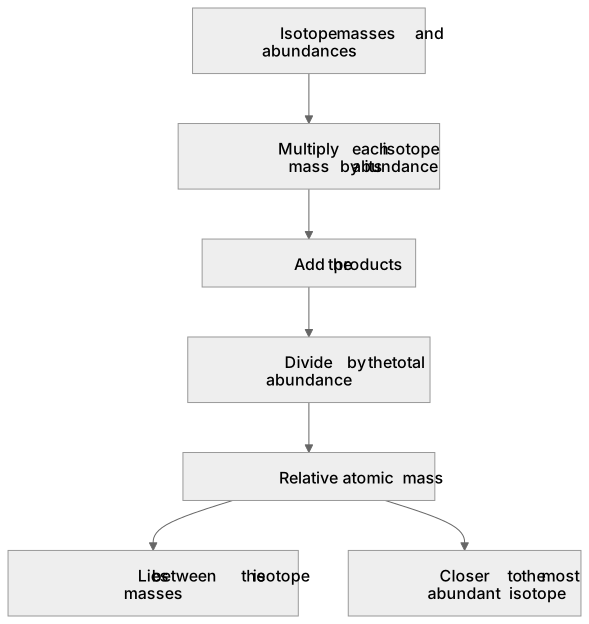
Key words
Say what each word means before you turn the card.
Relative atomic mass
Try answering aloud or in your head before turning the card.
Weighted mean
Try answering aloud or in your head before turning the card.
See every definition
- Relative atomic mass
- An average mass of the atoms of an element compared with 1/12 of the mass of a carbon-12 atom.
- Weighted mean
- Calculated by multiplying each isotope mass by its abundance, adding the products, then dividing by the total abundance.
Label the diagram
Some boxes have lost their names. Pick the right name for each number.
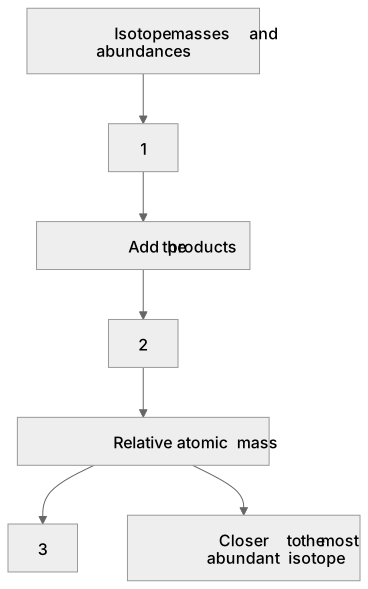
1Box 1
2Box 2
3Box 3
There is more to this lesson
The full lesson goes on to check your understanding and help you earn the marks. Create a free account to carry on, with your progress saved.
A week of Premium from your first lesson · Then the free plan continues · No card, no charge
Test your understanding of Relative atomic mass: The relative atomic mass of an element is an average value that takes account of the abundance of the isotopes of the element.
Active recall beats re-reading. Take an instant quiz now to test what you’ve learned and lock it into long-term memory.
A week of Premium from your first lesson · Then the free plan continues · No card, no charge