AQA · GCSE · Combined Science
Course version: 8464 · Version from Sept 2018
Representation of reactions at electrodes as half equations (HT only): 2H+ + 2e⁻ → H₂
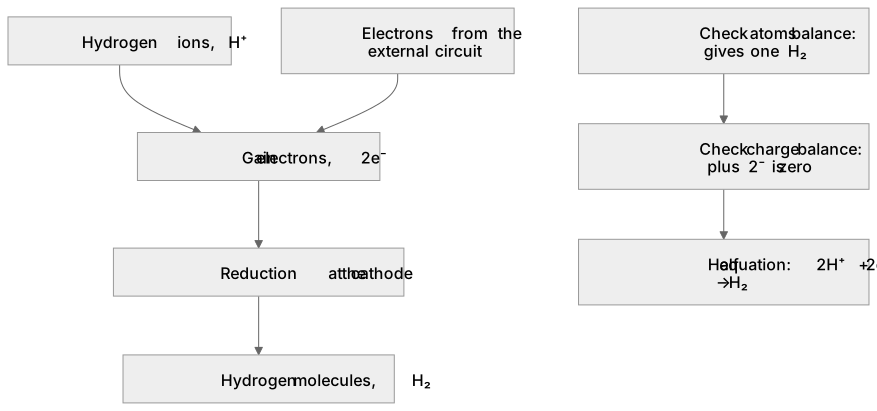
This half equation shows hydrogen ions, H⁺, being reduced to hydrogen gas, H₂, at the cathode during electrolysis.
Study notes
From the checked teaching notes for this specification point.
The idea
This half equation shows hydrogen ions, H⁺, being reduced to hydrogen gas, H₂, at the cathode during electrolysis. The equation must balance in both charge and atoms. Two H⁺ ions each gain one electron, giving two electrons in total, so the charge on the left is 2⁺ plus 2⁻, which is zero, matching the neutral H₂ on the right. The two hydrogen atoms on the left become the two hydrogen atoms in the H₂ molecule on the right. In aqueous solutions, H⁺ ions are attracted to the negative cathode, where they gain electrons. For example, in the electrolysis of dilute sulfuric acid, hydrogen is produced at the cathode. Representing these reactions as half equations is a Higher Tier only skill.
What earns the marks
- Identifies the reactant as hydrogen ions, H⁺, and the product as hydrogen molecules, H₂.
- States that reduction occurs at the cathode because electrons are gained.
- Balances atoms: two H⁺ ions produce one H₂ molecule, so the equation has 2H⁺ and H₂.
- Balances charge: two H⁺ ions carry a total charge of 2⁺, so two electrons, 2e⁻, are needed to give zero charge on both sides.
- Explains that the electrons come from the external circuit and are supplied at the negative electrode.
- Recognises that this half equation represents the cathode reaction in electrolysis of aqueous solutions containing H⁺ ions.
Common mistakes and how to put them right
Writing H⁺ + e⁻ → H₂, which is incorrect because it does not balance hydrogen atoms or charge.
Put it right: The correct equation is 2H⁺ + 2e⁻ → H₂.
Writing 2H⁺ + 2e⁻ → H₂²⁺ or H₂⁺, which incorrectly assigns a charge to the hydrogen molecule; H₂ is neutral.
Placing this reaction at the anode instead of the cathode.
Put it right: Oxidation occurs at the anode, while reduction of H⁺ occurs at the cathode.
Exam tips
- Check both atom balance and charge balance before writing the final half equation.
- Remember the mnemonic 'reduction at the cathode' because both reduction and cathode begin with consonants, while oxidation and anode begin with vowels.
- If asked to identify the electrode, link the gain of electrons to the negative electrode and state that hydrogen gas is formed.
- Note that writing and balancing half equations is assessed at Higher Tier only.
Try the lesson
The start of the Representation of reactions at electrodes as half equations (HT only): 2H+ + 2e⁻ → H₂ lesson, made from checked teaching notes for this specification point.
Have a go first
In the half equation 2H⁺ + 2e⁻ → H₂, what is the total charge on the left-hand side?
Listen
This half equation shows hydrogen ions, H⁺, being reduced to hydrogen gas, H₂, at the cathode during electrolysis. The equation must balance in both charge and atoms. Two H⁺ ions each gain one electron, giving two electrons in total, so the charge on the left is 2⁺ plus 2⁻, which is zero, matching the neutral H₂ on the right. The two hydrogen atoms on the left become the two hydrogen atoms in the H₂ molecule on the right. In aqueous solutions, H⁺ ions are attracted to the negative cathode, where they gain electrons. For example, in the electrolysis of dilute sulfuric acid, hydrogen is produced at the cathode. Representing these reactions as half equations is a Higher Tier only skill. A strong answer earns marks for these points. Identifies the reactant as hydrogen ions, H⁺, and the product as hydrogen molecules, H₂. States that reduction occurs at the cathode because electrons are gained. Balances atoms: two H⁺ ions produce one H₂ molecule, so the equation has 2H⁺ and H₂. Balances charge: two H⁺ ions carry a total charge of 2⁺, so two electrons, 2e⁻, are needed to give zero charge on both sides. Exam tip: Check both atom balance and charge balance before writing the final half equation.
See it
Label the diagram
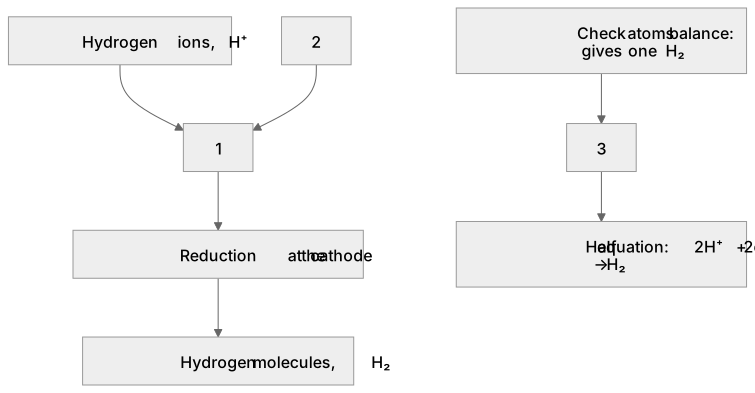
Some boxes have lost their names. Pick the right name for each number.
1Box 1
2Box 2
3Box 3
There is more to this lesson
The full lesson goes on to check your understanding and help you earn the marks. Create a free account to carry on, with your progress saved.
A week of Premium from your first lesson · Then the free plan continues · No card, no charge
Test your understanding of Representation of reactions at electrodes as half equations (HT only): 2H+ + 2e⁻ → H₂
Active recall beats re-reading. Take an instant quiz now to test what you’ve learned and lock it into long-term memory.
A week of Premium from your first lesson · Then the free plan continues · No card, no charge