AQA · GCSE · Combined Science
Course version: 8464 · Version from Sept 2018
Representation of reactions at electrodes as half equations (HT only): At the anode (positive electrode), negatively charged ions lose electrons and so the reactions are oxidations.
Electrolysis uses a direct current supply to drive non-spontaneous changes.
- 2 key terms
Study notes
From the checked teaching notes for this specification point.
The idea
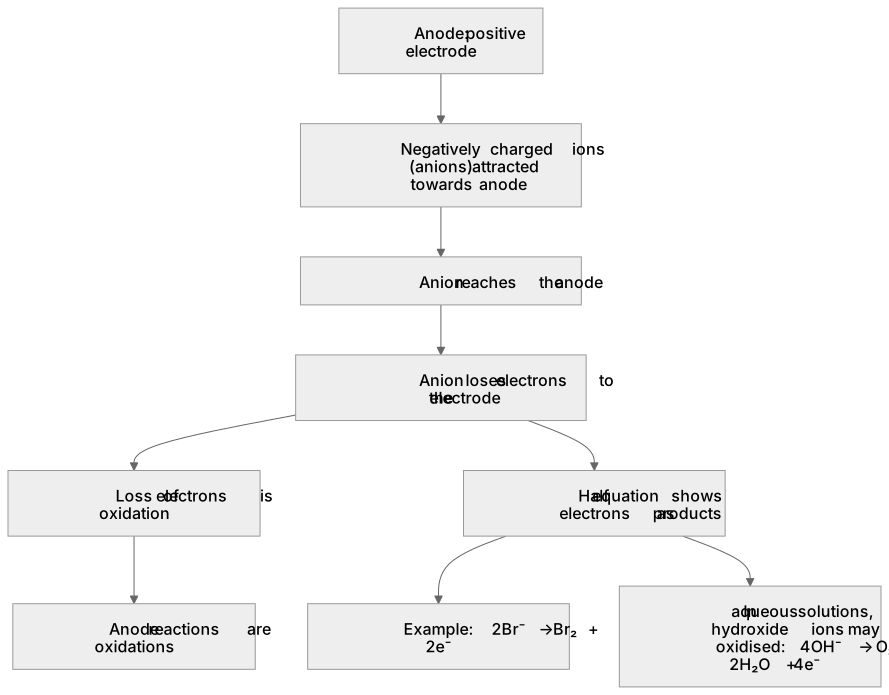
Electrolysis uses a direct current supply to drive non-spontaneous changes. The anode is the positive electrode, so negatively charged ions (anions) are attracted towards it. When an anion reaches the anode, it transfers one or more electrons to the electrode. Loss of electrons is oxidation, so every anode reaction is an oxidation. For example, in molten lead(II) bromide, bromide ions are oxidised: 2Br⁻ → Br₂ + 2e⁻. In aqueous solutions, hydroxide ions may be oxidised instead, producing oxygen: 4OH⁻ → O₂ + 2H₂O + 4e⁻. The electrons flow through the external circuit from anode to cathode. Note that representing these reactions as half equations is assessed at Higher Tier only.
What earns the marks
- The anode is the positive electrode in electrolysis.
- Negatively charged ions (anions) move towards the anode.
- At the anode, anions lose electrons to the electrode.
- Loss of electrons is oxidation, so anode reactions are oxidations.
- A half equation at the anode shows electrons as products, for example 2Br⁻ → Br₂ + 2e⁻.
- In aqueous solutions, hydroxide ions may be oxidised to oxygen rather than a simple anion.
Common mistakes and how to put them right
Thinking the anode is negative because negative ions go there.
Put it right: Anions are attracted to the positive anode.
Writing electrons as reactants in an anode half equation.
Put it right: Oxidation releases electrons, so they appear as products.
Confusing oxidation with gain of oxygen only.
Put it right: In electrode reactions, oxidation is loss of electrons.
Exam tips
- State the electrode sign first, then name the ion and the electron change.
- Check that charge and mass balance in any half equation you write.
- Use the phrase 'loss of electrons is oxidation' to justify why an anode reaction is an oxidation.
- Remember that writing half equations for electrode reactions is a Higher Tier only skill.
Try the lesson
The start of the Representation of reactions at electrodes as half equations (HT only): At the anode (positive electrode), negatively charged ions lose electrons and so the reactions are oxidations. lesson, made from checked teaching notes for this specification point.
Have a go first
In electrolysis, which type of reaction happens at the anode (positive electrode)?
Listen
Electrolysis uses a direct current supply to drive non-spontaneous changes. The anode is the positive electrode, so negatively charged ions (anions) are attracted towards it. When an anion reaches the anode, it transfers one or more electrons to the electrode. Loss of electrons is oxidation, so every anode reaction is an oxidation. For example, in molten lead(II) bromide, bromide ions are oxidised: 2Br⁻ → Br₂ + 2e⁻. In aqueous solutions, hydroxide ions may be oxidised instead, producing oxygen: 4OH⁻ → O₂ + 2H₂O + 4e⁻. The electrons flow through the external circuit from anode to cathode. Note that representing these reactions as half equations is assessed at Higher Tier only. A strong answer earns marks for these points. The anode is the positive electrode in electrolysis. Negatively charged ions (anions) move towards the anode. At the anode, anions lose electrons to the electrode. Loss of electrons is oxidation, so anode reactions are oxidations. A common slip: Thinking the anode is negative because negative ions go there. Instead, anions are attracted to the positive anode. Exam tip: State the electrode sign first, then name the ion and the electron change.
See it
Key words
Say what each word means before you turn the card.
Electrolysis
Try answering aloud or in your head before turning the card.
Half equations
Try answering aloud or in your head before turning the card.
See every definition
- Electrolysis
- A process that uses a direct current supply to drive non-spontaneous changes.
- Half equations
- A representation of reactions at electrodes, showing electrons as products at the anode, assessed at Higher Tier only.
Label the diagram
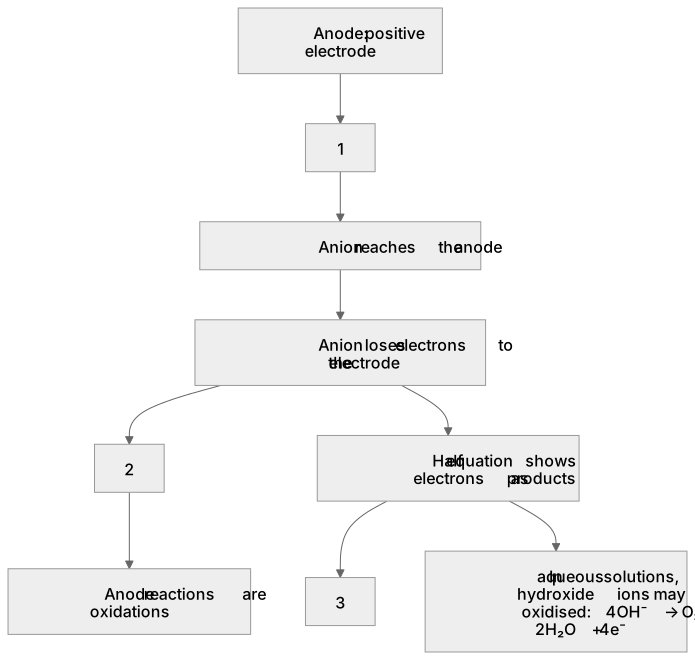
Some boxes have lost their names. Pick the right name for each number.
1Box 1
2Box 2
3Box 3
There is more to this lesson
The full lesson goes on to check your understanding and help you earn the marks. Create a free account to carry on, with your progress saved.
A week of Premium from your first lesson · Then the free plan continues · No card, no charge
Test your understanding of Representation of reactions at electrodes as half equations (HT only): At the anode (positive electrode), negatively charged ions lose electrons and so the reactions are oxidations.
Active recall beats re-reading. Take an instant quiz now to test what you’ve learned and lock it into long-term memory.
A week of Premium from your first lesson · Then the free plan continues · No card, no charge