AQA · GCSE · Combined Science
Course version: 8464 · Version from Sept 2018
Resistant bacteria: MRSA is resistant to antibiotics.
MRSA stands for meticillin-resistant Staphylococcus aureus, a bacterium that commonly lives harmlessly on skin but can cause serious infection if it enters wounds or the bloodstream.
Study notes
From the checked teaching notes for this specification point.
The idea
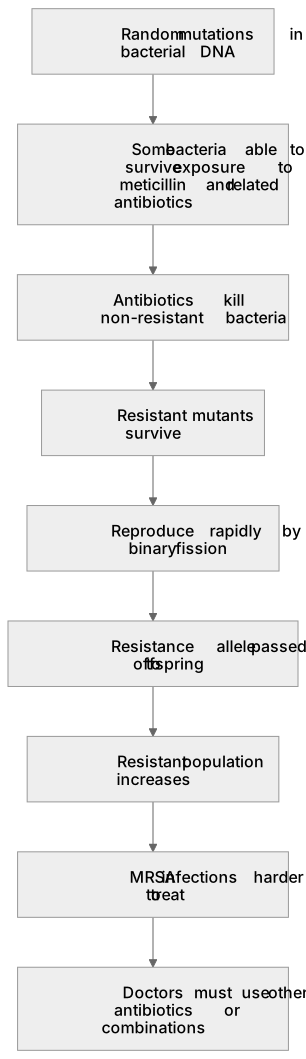
MRSA stands for meticillin-resistant Staphylococcus aureus, a bacterium that commonly lives harmlessly on skin but can cause serious infection if it enters wounds or the bloodstream. Resistance means an antibiotic that once killed the bacterium, or stopped its growth, no longer works against it. In MRSA this resistance arose by natural selection: random mutations in bacterial DNA produced some individuals able to survive exposure to meticillin and related antibiotics. Those survivors reproduced rapidly by binary fission, passing the resistance allele to their offspring, so the resistant population increased. Because MRSA is not affected by many commonly used antibiotics, infections are harder to treat and doctors must use other antibiotics or combinations. This explains why antibiotic resistance is a serious medical and evolutionary issue.
What earns the marks
- MRSA is a strain of the bacterium Staphylococcus aureus.
- Resistance means the antibiotic no longer kills the bacterium or stops its growth.
- Resistance arises from random mutations in bacterial DNA, giving some bacteria a survival advantage.
- Natural selection occurs when antibiotics kill non-resistant bacteria while resistant mutants survive and reproduce.
- Bacteria reproduce rapidly by binary fission, so the proportion of resistant bacteria in a population increases.
- Resistant alleles can be passed to offspring, and in some cases resistance genes can transfer between bacteria.
- MRSA infections are difficult to treat because many commonly used antibiotics are ineffective, so alternative antibiotics are needed.
Common mistakes and how to put them right
Thinking that bacteria become resistant because they choose to or because the antibiotic teaches them to change.
Put it right: Resistance results from random mutation followed by natural selection.
Believing that the antibiotic creates the mutation.
Put it right: Mutations occur randomly and the antibiotic selects the bacteria that already have the mutation.
Confusing resistance with the body becoming immune to antibiotics.
Put it right: It is the bacterial population that becomes resistant, not the human patient.
Exam tips
- Use the phrase 'random mutation' and 'natural selection' when explaining how resistance develops.
- Link resistance to survival and reproduction: resistant bacteria survive, reproduce by binary fission, and increase in number.
- If asked why MRSA is a problem, state that commonly used antibiotics no longer work, so treatment is more difficult.
Try the lesson
The start of the Resistant bacteria: MRSA is resistant to antibiotics. lesson, made from checked teaching notes for this specification point.
Have a go first
What does it mean when a doctor says that MRSA is resistant to an antibiotic?
Listen
MRSA stands for meticillin-resistant Staphylococcus aureus, a bacterium that commonly lives harmlessly on skin but can cause serious infection if it enters wounds or the bloodstream. Resistance means an antibiotic that once killed the bacterium, or stopped its growth, no longer works against it. In MRSA this resistance arose by natural selection: random mutations in bacterial DNA produced some individuals able to survive exposure to meticillin and related antibiotics. Those survivors reproduced rapidly by binary fission, passing the resistance allele to their offspring, so the resistant population increased. Because MRSA is not affected by many commonly used antibiotics, infections are harder to treat and doctors must use other antibiotics or combinations. This explains why antibiotic resistance is a serious medical and evolutionary issue. A strong answer earns marks for these points. MRSA is a strain of the bacterium Staphylococcus aureus. Resistance means the antibiotic no longer kills the bacterium or stops its growth. Resistance arises from random mutations in bacterial DNA, giving some bacteria a survival advantage. Natural selection occurs when antibiotics kill non-resistant bacteria while resistant mutants survive and reproduce. A common slip: Thinking that bacteria become resistant because they choose to or because the antibiotic teaches them to change. Instead, resistance results from random mutation followed by natural selection. Exam tip: Use the phrase 'random mutation' and 'natural selection' when explaining how resistance develops.
See it
Label the diagram
Some boxes have lost their names. Pick the right name for each number.
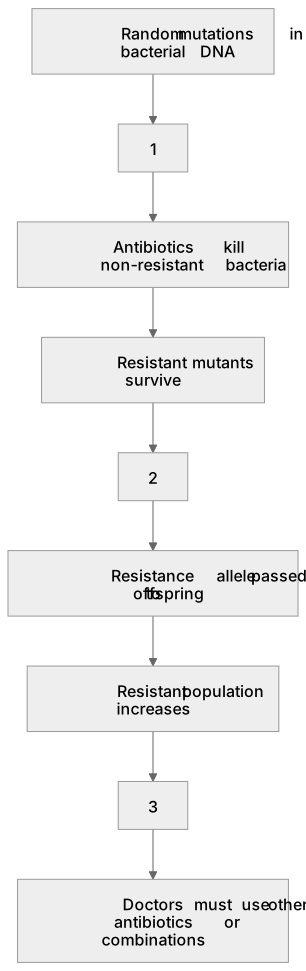
1Box 1
2Box 2
3Box 3
There is more to this lesson
The full lesson goes on to check your understanding and help you earn the marks. Create a free account to carry on, with your progress saved.
A week of Premium from your first lesson · Then the free plan continues · No card, no charge
Test your understanding of Resistant bacteria: MRSA is resistant to antibiotics.
Active recall beats re-reading. Take an instant quiz now to test what you’ve learned and lock it into long-term memory.
A week of Premium from your first lesson · Then the free plan continues · No card, no charge