AQA · GCSE · Combined Science
Course version: 8464 · Version from Sept 2018
Resistant bacteria: patients should complete their course of antibiotics so all bacteria are killed and none survive to mutate and form resistant strains
A course of antibiotics is prescribed so that the concentration of the drug remains high enough for long enough to kill the bacteria causing the infection.
- 4 key terms
Study notes
From the checked teaching notes for this specification point.
The idea
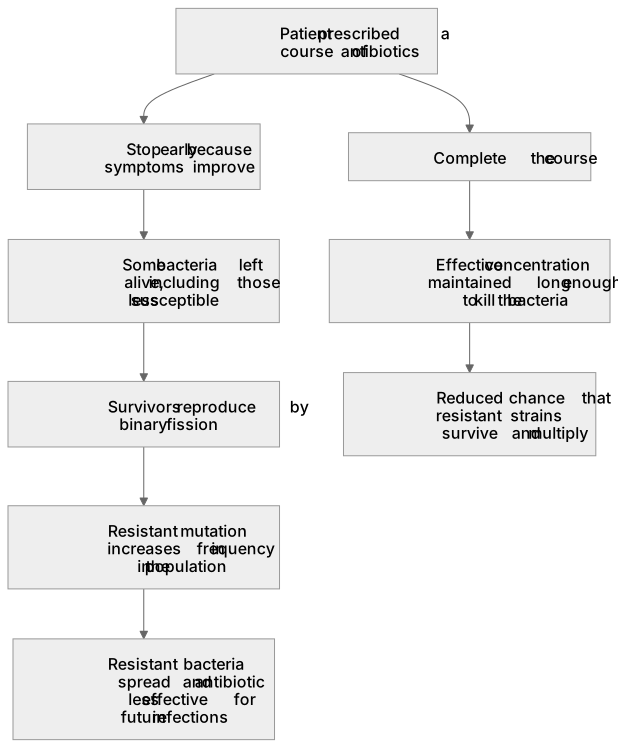
A course of antibiotics is prescribed so that the concentration of the drug remains high enough for long enough to kill the bacteria causing the infection. If a patient stops early because they feel better, some bacteria may still be alive. These survivors are more likely to include individuals with random mutations that make them less affected by the antibiotic. They reproduce quickly by binary fission, so the resistant allele becomes more common in the population. Completing the course keeps killing susceptible bacteria and reduces the chance that resistant survivors multiply and spread. This is why patients should follow the prescribed dose, interval and duration rather than stopping when symptoms improve.
What earns the marks
- Completing the course maintains an effective concentration of antibiotic for long enough to kill the bacteria causing the infection.
- Stopping early can leave some bacteria alive, including any that are less susceptible to the antibiotic.
- Surviving bacteria reproduce by binary fission, so a resistant mutation can increase in frequency in the population.
- Resistant bacteria can then spread to other people and make the original antibiotic less effective for treating future infections.
- Following the prescribed dose, timing and duration reduces the chance that resistant strains survive and multiply.
Common mistakes and how to put them right
Stopping antibiotics as soon as symptoms improve.
Put it right: Symptoms can improve before all bacteria are killed, so the full prescribed course should be completed.
Thinking bacteria mutate because they are exposed to the antibiotic.
Put it right: Mutations occur randomly, and the antibiotic selects the bacteria that already have a resistant mutation.
Believing that completing the course makes a person immune to future infection.
Put it right: It reduces the chance of resistant survivors from that infection but does not provide immunity.
Exam tips
- Use natural selection vocabulary: random mutation, survival, reproduction and increase in frequency of the resistant allele.
- Explain the link between an incomplete course, surviving bacteria and the formation of resistant strains rather than simply saying that antibiotics stop working.
- Refer to the prescribed dose and duration, and explain that the patient should not save or share antibiotics.
Try the lesson
The start of the Resistant bacteria: patients should complete their course of antibiotics so all bacteria are killed and none survive to mutate and form resistant strains lesson, made from checked teaching notes for this specification point.
Have a go first
A patient starts to feel better after taking antibiotics for two days and stops taking them. Why is this a problem?
Listen
A course of antibiotics is prescribed so that the concentration of the drug remains high enough for long enough to kill the bacteria causing the infection. If a patient stops early because they feel better, some bacteria may still be alive. These survivors are more likely to include individuals with random mutations that make them less affected by the antibiotic. They reproduce quickly by binary fission, so the resistant allele becomes more common in the population. Completing the course keeps killing susceptible bacteria and reduces the chance that resistant survivors multiply and spread. This is why patients should follow the prescribed dose, interval and duration rather than stopping when symptoms improve. A strong answer earns marks for these points. Completing the course maintains an effective concentration of antibiotic for long enough to kill the bacteria causing the infection. Stopping early can leave some bacteria alive, including any that are less susceptible to the antibiotic. Surviving bacteria reproduce by binary fission, so a resistant mutation can increase in frequency in the population. Resistant bacteria can then spread to other people and make the original antibiotic less effective for treating future infections. A common slip: Stopping antibiotics as soon as symptoms improve. Instead, symptoms can improve before all bacteria are killed, so the full prescribed course should be completed. Exam tip: Use natural selection vocabulary: random mutation, survival, reproduction and increase in frequency of the resistant allele.
See it
Key words
Say what each word means before you turn the card.
Natural selection and evolution of resistance
Try answering aloud or in your head before turning the card.
Bacterial reproduction by binary fission
Try answering aloud or in your head before turning the card.
Antibiotic stewardship and patient adherence
Try answering aloud or in your head before turning the card.
Prevention of resistant strains spreading in populations
Try answering aloud or in your head before turning the card.
See every definition
- Natural selection and evolution of resistance
- Surviving bacteria are more likely to include individuals with random mutations that make them less affected by the antibiotic, and these reproduce so the resistant allele becomes more common in the population.
- Bacterial reproduction by binary fission
- Surviving bacteria reproduce quickly by this method, so a resistant mutation can increase in frequency in the population.
- Antibiotic stewardship and patient adherence
- Patients should follow the prescribed dose, interval and duration rather than stopping when symptoms improve, so all bacteria are killed and none survive to mutate and form resistant strains.
- Prevention of resistant strains spreading in populations
- Completing the course keeps killing susceptible bacteria and reduces the chance that resistant survivors multiply and spread.
Label the diagram
Some boxes have lost their names. Pick the right name for each number.
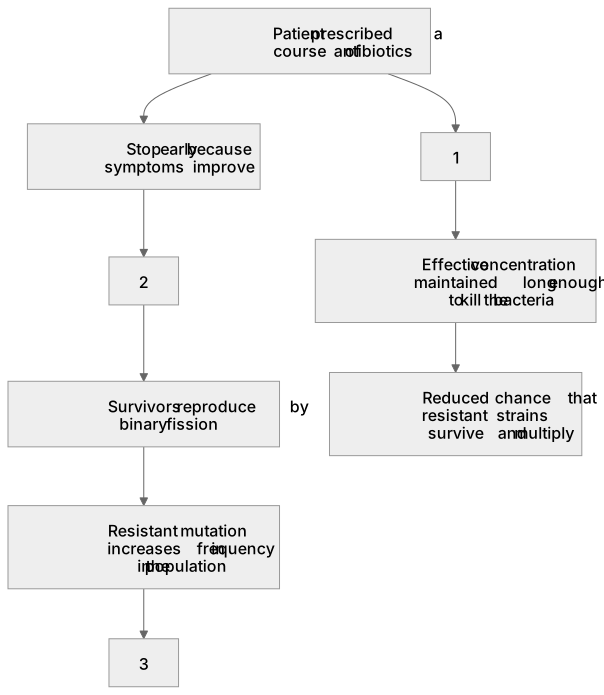
1Box 1
2Box 2
3Box 3
There is more to this lesson
The full lesson goes on to check your understanding and help you earn the marks. Create a free account to carry on, with your progress saved.
A week of Premium from your first lesson · Then the free plan continues · No card, no charge
Test your understanding of Resistant bacteria: patients should complete their course of antibiotics so all bacteria are killed and none survive to mutate and form resistant strains
Active recall beats re-reading. Take an instant quiz now to test what you’ve learned and lock it into long-term memory.
A week of Premium from your first lesson · Then the free plan continues · No card, no charge