AQA · GCSE · Combined Science
Course version: 8464 · Version from Sept 2018
Resistant bacteria: the agricultural use of antibiotics should be restricted.
Antibiotics are medicines that kill bacteria or stop their growth.
Study notes
From the checked teaching notes for this specification point.
The idea
Antibiotics are medicines that kill bacteria or stop their growth. When farmers give antibiotics to livestock, often to prevent disease in crowded conditions or to promote faster growth, bacteria in those animals are exposed to the drug. Any bacterium with a random mutation that lets it survive reproduces rapidly, so resistant strains build up in the animals, in their waste and in the environment. These resistant bacteria can reach humans through food, water or direct contact, making infections harder to treat. Restricting agricultural use means giving antibiotics only when a vet confirms a bacterial infection, rather than routinely, which slows the spread of resistance and keeps these medicines effective for treating serious human infections.
What earns the marks
- Antibiotics kill bacteria or inhibit bacterial growth, so they are ineffective against viruses and cannot treat viral infections.
- Routine or preventive agricultural use exposes large numbers of bacteria to antibiotics, increasing the chance that resistant mutants survive and reproduce.
- Resistant bacteria can pass from livestock to humans via food, water, animal contact or the environment, so agricultural use affects human health.
- Restricting use to cases of confirmed bacterial infection in animals reduces selection pressure, slowing the emergence and spread of resistant strains.
- Preserving antibiotic effectiveness matters because some human infections, such as certain blood or wound infections, can only be treated with antibiotics.
Common mistakes and how to put them right
Thinking antibiotics kill viruses.
Put it right: Antibiotics act on bacteria, so they cannot treat viral illnesses such as colds or flu.
Assuming resistance develops in the human patient only.
Put it right: Resistance can arise in farm animals and then spread to humans through food, water or contact.
Believing restricting agricultural use stops all resistance.
Put it right: It slows the spread of resistance but does not eliminate it, because resistance also develops through human medical use.
Exam tips
- Link each point back to natural selection: mutation, survival, reproduction and inheritance of the resistant allele.
- Use the phrase 'reduces selection pressure' when explaining why restricting use helps, and say what is being selected for.
- Give a named route of transmission, such as contaminated food or water, rather than saying 'it spreads'.
Try the lesson
The start of the Resistant bacteria: the agricultural use of antibiotics should be restricted. lesson, made from checked teaching notes for this specification point.
Have a go first
Farmers sometimes give antibiotics to healthy farm animals to stop them getting ill. Why do scientists say this use of antibiotics should be restricted?
Listen
Antibiotics are medicines that kill bacteria or stop their growth. When farmers give antibiotics to livestock, often to prevent disease in crowded conditions or to promote faster growth, bacteria in those animals are exposed to the drug. Any bacterium with a random mutation that lets it survive reproduces rapidly, so resistant strains build up in the animals, in their waste and in the environment. These resistant bacteria can reach humans through food, water or direct contact, making infections harder to treat. Restricting agricultural use means giving antibiotics only when a vet confirms a bacterial infection, rather than routinely, which slows the spread of resistance and keeps these medicines effective for treating serious human infections. A strong answer earns marks for these points. Antibiotics kill bacteria or inhibit bacterial growth, so they are ineffective against viruses and cannot treat viral infections. Routine or preventive agricultural use exposes large numbers of bacteria to antibiotics, increasing the chance that resistant mutants survive and reproduce. Resistant bacteria can pass from livestock to humans via food, water, animal contact or the environment, so agricultural use affects human health. Restricting use to cases of confirmed bacterial infection in animals reduces selection pressure, slowing the emergence and spread of resistant strains. A common slip: Thinking antibiotics kill viruses. Instead, antibiotics act on bacteria, so they cannot treat viral illnesses such as colds or flu. Exam tip: Link each point back to natural selection: mutation, survival, reproduction and inheritance of the resistant allele.
See it
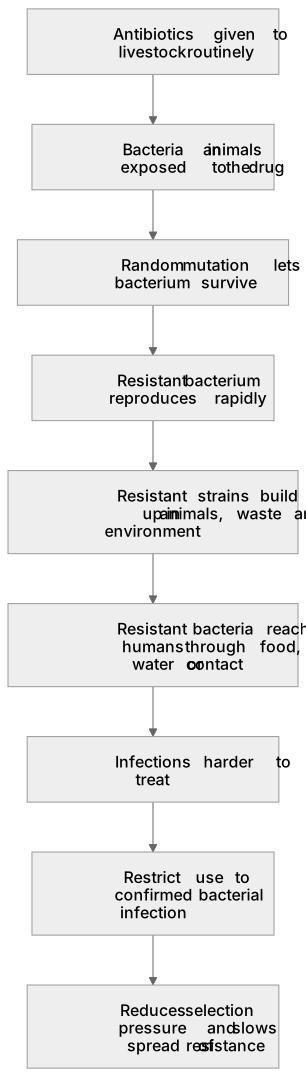
Label the diagram
Some boxes have lost their names. Pick the right name for each number.
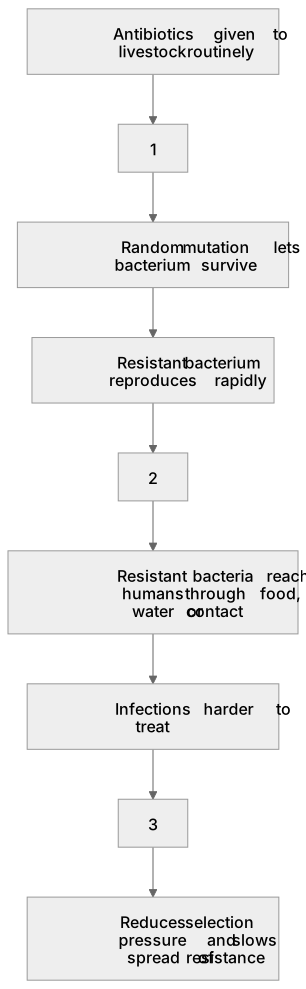
1Box 1
2Box 2
3Box 3
There is more to this lesson
The full lesson goes on to check your understanding and help you earn the marks. Create a free account to carry on, with your progress saved.
A week of Premium from your first lesson · Then the free plan continues · No card, no charge
Test your understanding of Resistant bacteria: the agricultural use of antibiotics should be restricted.
Active recall beats re-reading. Take an instant quiz now to test what you’ve learned and lock it into long-term memory.
A week of Premium from your first lesson · Then the free plan continues · No card, no charge