AQA · GCSE · Combined Science
Course version: 8464 · Version from Sept 2018
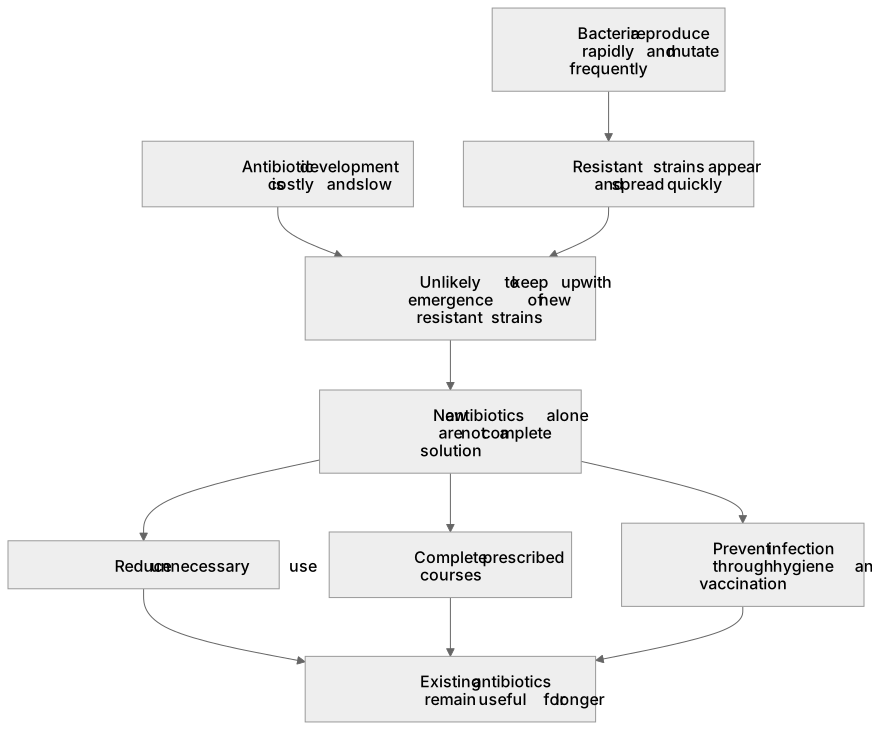
Resistant bacteria: The development of new antibiotics is costly and slow. It is unlikely to keep up with the emergence of new resistant strains.
Discovering and testing a new antibiotic takes many years and large amounts of money.
- 2 key terms
Study notes
From the checked teaching notes for this specification point.
The idea
Discovering and testing a new antibiotic takes many years and large amounts of money. Researchers must find a compound that kills bacteria, then test it for safety and effectiveness in laboratories, animals and human trials before it can be prescribed. Because bacteria reproduce rapidly and mutations for resistance appear constantly, new resistant strains can emerge faster than new drugs can be approved. This means relying only on new antibiotics is not a complete solution. Reducing unnecessary use, completing prescribed courses and preventing infection through hygiene and vaccination all help slow resistance, so existing antibiotics remain useful for longer.
What earns the marks
- Developing a new antibiotic requires years of laboratory research, safety testing and clinical trials before it can be used.
- The process is expensive, so pharmaceutical companies may have limited financial incentive to develop antibiotics compared with other medicines.
- Bacteria reproduce rapidly and mutate frequently, so resistant strains can appear and spread quickly.
- New resistant strains may emerge faster than new antibiotics can be discovered, tested and approved.
- Slowing resistance through reduced unnecessary use, good hygiene and infection control helps existing antibiotics remain effective.
Common mistakes and how to put them right
Thinking a new antibiotic can be created quickly once resistance appears.
Put it right: Development takes many years of testing and trials.
Assuming resistance only appears after a new drug is used.
Put it right: Resistant mutants can already exist in a population before the drug is widely used.
Believing new antibiotics alone solve resistance.
Put it right: They help, but reducing unnecessary use and preventing infection are also needed.
Exam tips
- Compare timescales explicitly: state that bacterial reproduction is fast while drug development is slow.
- Use the idea of selection pressure to explain why resistant strains increase when antibiotics are used.
- When asked for solutions, give more than one measure, such as restricting use, completing courses and improving hygiene.
Try the lesson
The start of the Resistant bacteria: The development of new antibiotics is costly and slow. It is unlikely to keep up with the emergence of new resistant strains. lesson, made from checked teaching notes for this specification point.
Have a go first
Why is it difficult for scientists to keep supplying new antibiotics that work against resistant bacteria?
Listen
Discovering and testing a new antibiotic takes many years and large amounts of money. Researchers must find a compound that kills bacteria, then test it for safety and effectiveness in laboratories, animals and human trials before it can be prescribed. Because bacteria reproduce rapidly and mutations for resistance appear constantly, new resistant strains can emerge faster than new drugs can be approved. This means relying only on new antibiotics is not a complete solution. Reducing unnecessary use, completing prescribed courses and preventing infection through hygiene and vaccination all help slow resistance, so existing antibiotics remain useful for longer. A strong answer earns marks for these points. Developing a new antibiotic requires years of laboratory research, safety testing and clinical trials before it can be used. The process is expensive, so pharmaceutical companies may have limited financial incentive to develop antibiotics compared with other medicines. Bacteria reproduce rapidly and mutate frequently, so resistant strains can appear and spread quickly. New resistant strains may emerge faster than new antibiotics can be discovered, tested and approved. A common slip: Thinking a new antibiotic can be created quickly once resistance appears. Instead, development takes many years of testing and trials. Exam tip: Compare timescales explicitly: state that bacterial reproduction is fast while drug development is slow.
See it
Key words
Say what each word means before you turn the card.
Antibiotic development
Try answering aloud or in your head before turning the card.
Infection prevention
Try answering aloud or in your head before turning the card.
See every definition
- Antibiotic development
- Discovering and testing a new antibiotic takes many years and large amounts of money, requiring laboratory research, safety testing and clinical trials.
- Infection prevention
- Preventing infection through hygiene and vaccination helps slow resistance, so existing antibiotics remain useful for longer.
Label the diagram
Some boxes have lost their names. Pick the right name for each number.
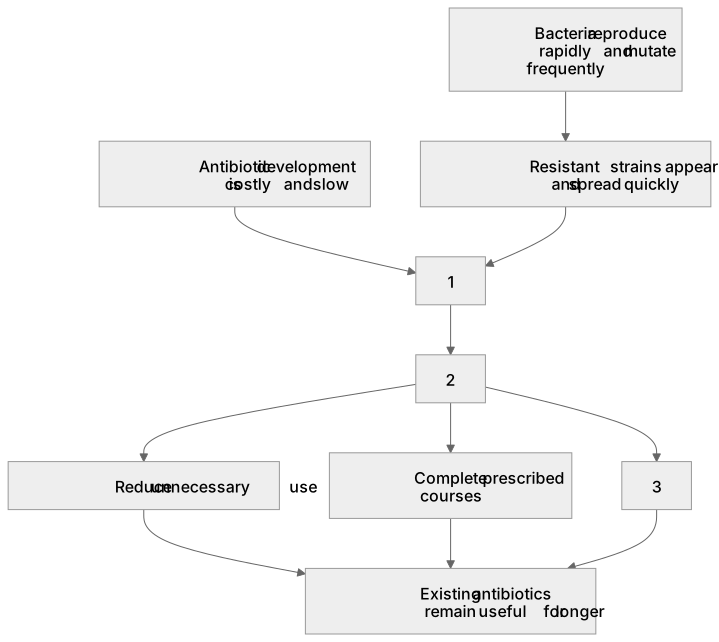
1Box 1
2Box 2
3Box 3
There is more to this lesson
The full lesson goes on to check your understanding and help you earn the marks. Create a free account to carry on, with your progress saved.
A week of Premium from your first lesson · Then the free plan continues · No card, no charge
Test your understanding of Resistant bacteria: The development of new antibiotics is costly and slow. It is unlikely to keep up with the emergence of new resistant strains.
Active recall beats re-reading. Take an instant quiz now to test what you’ve learned and lock it into long-term memory.
A week of Premium from your first lesson · Then the free plan continues · No card, no charge