AQA · GCSE · Combined Science
Course version: 8464 · Version from Sept 2018
Reversible reactions: For example:
This statement introduces a worked example of a reversible reaction whose direction changes with conditions.
Study notes
From the checked teaching notes for this specification point.
The idea
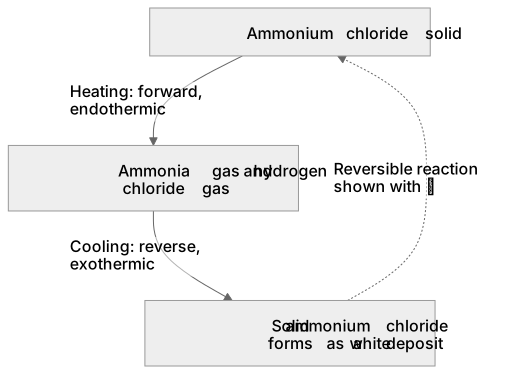
This statement introduces a worked example of a reversible reaction whose direction changes with conditions. A suitable example is the thermal decomposition of ammonium chloride. When ammonium chloride is heated, it decomposes into ammonia gas and hydrogen chloride gas: NH₄Cl(s) ⇌ NH₃(g) + HCl(g). On cooling, the gases recombine to form solid ammonium chloride again, often seen as a white deposit. The forward reaction is endothermic, so heating favours decomposition; the reverse reaction is exothermic, so cooling favours recombination. This shows that changing the temperature changes the direction in which the reaction proceeds. The example also shows that the reaction is reversible and that the direction can be reversed by changing conditions.
What earns the marks
- The example must be a genuine reversible reaction, written with the ⇌ symbol, showing both forward and reverse changes.
- Heating ammonium chloride causes it to decompose into ammonia and hydrogen chloride gases, which is the forward, endothermic direction.
- Cooling the gaseous products causes ammonia and hydrogen chloride to recombine into solid ammonium chloride, which is the reverse, exothermic direction.
- The observed white deposit on cooling is evidence that the reverse reaction has occurred and that the direction has changed.
- The example demonstrates that changing the temperature changes which direction is favoured, because heating favours the endothermic direction and cooling favours the exothermic direction.
- A full answer links the symbol, the named substances and the condition change to the direction of reaction.
Common mistakes and how to put them right
Writing the equation without the ⇌ symbol.
Put it right: Use ⇌ to show that the reaction is reversible.
Claiming that ammonium chloride melts when heated.
Put it right: It decomposes into ammonia and hydrogen chloride gases, which recombine on cooling.
Saying that cooling drives the forward reaction.
Put it right: Cooling favours the reverse, exothermic reaction, forming solid ammonium chloride again.
Omitting state symbols; the correction is to include (s) and (g) so the change of state and the recombination are clear.
Exam tips
- Choose a named example you can write accurately, including the ⇌ symbol and correct state symbols.
- State the condition change, such as heating or cooling, and then state which direction is favoured and why.
- Describe the observable change, such as a white solid forming on cooling, to support your explanation.
- Keep the explanation focused on direction and conditions rather than giving unnecessary detail about laboratory apparatus.
Try the lesson
The start of the Reversible reactions: For example: lesson, made from checked teaching notes for this specification point.
Have a go first
Which equation shows a correct example of a reversible reaction where the direction can be changed by heating and cooling?
Listen
This statement introduces a worked example of a reversible reaction whose direction changes with conditions. A suitable example is the thermal decomposition of ammonium chloride. When ammonium chloride is heated, it decomposes into ammonia gas and hydrogen chloride gas: NH₄Cl(s) ⇌ NH₃(g) + HCl(g). On cooling, the gases recombine to form solid ammonium chloride again, often seen as a white deposit. The forward reaction is endothermic, so heating favours decomposition; the reverse reaction is exothermic, so cooling favours recombination. This shows that changing the temperature changes the direction in which the reaction proceeds. The example also shows that the reaction is reversible and that the direction can be reversed by changing conditions. A strong answer earns marks for these points. The example must be a genuine reversible reaction, written with the ⇌ symbol, showing both forward and reverse changes. Heating ammonium chloride causes it to decompose into ammonia and hydrogen chloride gases, which is the forward, endothermic direction. Cooling the gaseous products causes ammonia and hydrogen chloride to recombine into solid ammonium chloride, which is the reverse, exothermic direction. The observed white deposit on cooling is evidence that the reverse reaction has occurred and that the direction has changed. A common slip: Writing the equation without the ⇌ symbol. Instead, use ⇌ to show that the reaction is reversible. Exam tip: Choose a named example you can write accurately, including the ⇌ symbol and correct state symbols.
See it
Label the diagram
Some boxes have lost their names. Pick the right name for each number.
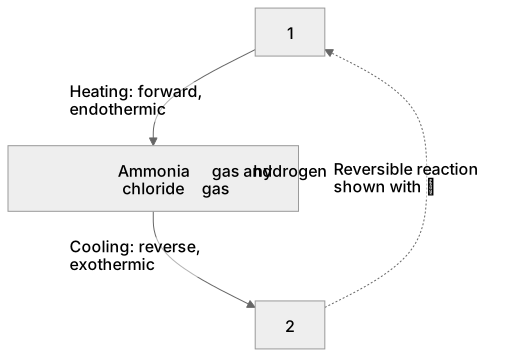
1Box 1
2Box 2
There is more to this lesson
The full lesson goes on to check your understanding and help you earn the marks. Create a free account to carry on, with your progress saved.
A week of Premium from your first lesson · Then the free plan continues · No card, no charge
Test your understanding of Reversible reactions: For example:
Active recall beats re-reading. Take an instant quiz now to test what you’ve learned and lock it into long-term memory.
A week of Premium from your first lesson · Then the free plan continues · No card, no charge