AQA · GCSE · Combined Science
Course version: 8464 · Version from Sept 2018
Selective breeding: Large or unusual flowers.
Selective breeding (artificial selection) is used by humans to develop organisms with desirable characteristics.
- 4 key terms
Study notes
From the checked teaching notes for this specification point.
The idea
Selective breeding (artificial selection) is used by humans to develop organisms with desirable characteristics. For flowering plants, growers choose parents that already show the wanted feature, such as large blooms or unusual petal shapes and colours, then breed them together. Their offspring vary, so only those showing the desired flowers most strongly are kept and bred again. This is repeated over many generations, so the alleles controlling large or unusual flowers become more common in the population. For example, a plant with wide petals is crossed with another wide-petalled plant; seedlings with narrow petals are discarded, while the widest-flowered plants are crossed. The characteristic is inherited, so the change is genetic, not simply caused by better feeding or care.
What earns the marks
- Selective breeding involves humans choosing which organisms reproduce, rather than leaving reproduction to natural selection.
- Parents are selected because they already show the desired characteristic, for example large flowers or unusual petal colour, shape or number.
- The selected parents are bred together and their offspring show variation in flower size or appearance.
- Only offspring with the most desirable flowers are allowed to breed in the next generation.
- The change is inherited because the selected alleles are passed on in gametes, so it is a genetic change rather than an environmental effect.
Common mistakes and how to put them right
Thinking the plant grows larger flowers simply because it is given more water or fertiliser.
Put it right: Selective breeding changes allele frequencies, so the improvement is inherited.
Believing that all offspring of two large-flowered parents will automatically have large flowers.
Put it right: Offspring vary, so selection must continue over several generations.
Confusing selective breeding with genetic engineering.
Put it right: Selective breeding crosses existing organisms and selects offspring, whereas genetic engineering transfers a specific gene.
Exam tips
- Name the characteristic and state the selection criterion, for example 'plants with the largest flowers are chosen to breed'.
- Use the phrase 'over many generations' to show that the allele frequency changes gradually.
- Link the desired flower feature to alleles being passed on in gametes, rather than describing only the appearance of the plant.
Try the lesson
The start of the Selective breeding: Large or unusual flowers. lesson, made from checked teaching notes for this specification point.
Have a go first
A gardener wants a flower bed to contain plants that produce unusually large flowers. Which action is a correct first step in selective breeding for this aim?
Listen
Selective breeding (artificial selection) is used by humans to develop organisms with desirable characteristics. For flowering plants, growers choose parents that already show the wanted feature, such as large blooms or unusual petal shapes and colours, then breed them together. Their offspring vary, so only those showing the desired flowers most strongly are kept and bred again. This is repeated over many generations, so the alleles controlling large or unusual flowers become more common in the population. For example, a plant with wide petals is crossed with another wide-petalled plant; seedlings with narrow petals are discarded, while the widest-flowered plants are crossed. The characteristic is inherited, so the change is genetic, not simply caused by better feeding or care. A strong answer earns marks for these points. Selective breeding involves humans choosing which organisms reproduce, rather than leaving reproduction to natural selection. Parents are selected because they already show the desired characteristic, for example large flowers or unusual petal colour, shape or number. The selected parents are bred together and their offspring show variation in flower size or appearance. Only offspring with the most desirable flowers are allowed to breed in the next generation. A common slip: Thinking the plant grows larger flowers simply because it is given more water or fertiliser. Instead, selective breeding changes allele frequencies, so the improvement is inherited. Exam tip: Name the characteristic and state the selection criterion, for example 'plants with the largest flowers are chosen to breed'.
See it
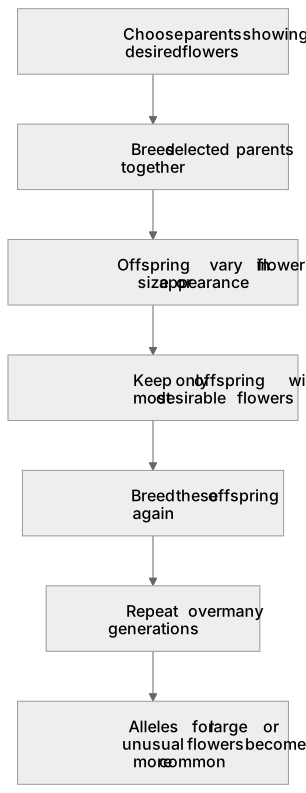
Put it in order
Put these steps in the order they happen.
- 1. Breed selected parents together
- 2. Offspring vary in flower size or appearance
- 3. Keep only offspring with most desirable flowers
- 4. Breed these offspring again
- 5. Repeat over many generations
- 6. Alleles for large or unusual flowers become more common
- 7. Choose parents showing desired flowers
Key words
Say what each word means before you turn the card.
Artificial selection by humans
Try answering aloud or in your head before turning the card.
Inheritance of desired characteristics
Try answering aloud or in your head before turning the card.
Variation in offspring
Try answering aloud or in your head before turning the card.
Change in allele frequency over generations
Try answering aloud or in your head before turning the card.
See every definition
- Artificial selection by humans
- Humans choose which organisms reproduce, rather than leaving reproduction to natural selection.
- Inheritance of desired characteristics
- Selected alleles are passed on in gametes, so the change is genetic rather than an environmental effect.
- Variation in offspring
- The offspring of selected parents show variation in flower size or appearance, so only some are chosen to breed.
- Change in allele frequency over generations
- Repeating the process over many generations increases the proportion of alleles for large or unusual flowers in the population.
Label the diagram
Some boxes have lost their names. Pick the right name for each number.
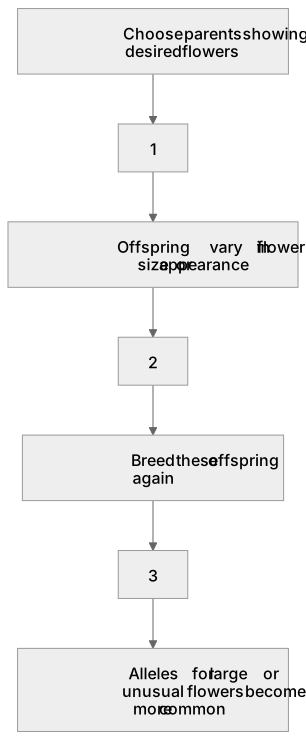
1Box 1
2Box 2
3Box 3
There is more to this lesson
The full lesson goes on to check your understanding and help you earn the marks. Create a free account to carry on, with your progress saved.
A week of Premium from your first lesson · Then the free plan continues · No card, no charge
Test your understanding of Selective breeding: Large or unusual flowers.
Active recall beats re-reading. Take an instant quiz now to test what you’ve learned and lock it into long-term memory.
A week of Premium from your first lesson · Then the free plan continues · No card, no charge