AQA · GCSE · Combined Science
Course version: 8464 · Version from Sept 2018
Selective breeding: Students should be able to explain the impact of selective breeding of food plants and domesticated animals.
Selective breeding is when humans choose organisms with desirable characteristics and breed them together, repeatedly over many generations.
Study notes
From the checked teaching notes for this specification point.
The idea
Selective breeding is when humans choose organisms with desirable characteristics and breed them together, repeatedly over many generations. For food plants, farmers may select wheat with high yield or disease resistance; for domesticated animals, they may select cows that produce more milk or chickens that grow quickly. The impact is that the chosen features become more common in the population, so food production can increase. However, selective breeding reduces genetic variation, because only a few individuals are bred. This makes populations more vulnerable to new diseases or changes in the environment, and can cause health problems in some domesticated animals.
What earns the marks
- Selective breeding involves choosing parents with desired characteristics and breeding them together over several generations.
- In food plants, examples include selecting for higher yield, disease resistance or better flavour, which can improve food security.
- In domesticated animals, examples include selecting for increased milk or meat production, or for temperament, which can benefit farmers.
- A negative impact is reduced genetic variation, making populations more susceptible to disease or environmental change.
- Another negative impact can be inherited health problems in some domesticated animals, such as breathing difficulties in certain breeds.
Common mistakes and how to put them right
Thinking selective breeding creates new alleles.
Put it right: It selects from existing variation, so no new alleles are produced.
Assuming selective breeding always benefits the organism.
Put it right: It benefits humans, but can harm the organism's health or reduce its genetic diversity.
Confusing selective breeding with genetic engineering.
Put it right: Selective breeding involves breeding existing organisms, whereas genetic engineering directly alters DNA.
Exam tips
- Give at least one named example for a food plant and one for a domesticated animal to show understanding of both contexts.
- Balance your answer by explaining both benefits, such as increased yield, and drawbacks, such as reduced genetic variation.
- Use the term 'genetic variation' when explaining why selectively bred populations may be at greater risk from disease.
Try the lesson
The start of the Selective breeding: Students should be able to explain the impact of selective breeding of food plants and domesticated animals. lesson, made from checked teaching notes for this specification point.
Have a go first
A farmer selectively breeds cows to produce the maximum amount of milk. What is a potential negative impact of this selective breeding over many generations?
Listen
Selective breeding is when humans choose organisms with desirable characteristics and breed them together, repeatedly over many generations. For food plants, farmers may select wheat with high yield or disease resistance; for domesticated animals, they may select cows that produce more milk or chickens that grow quickly. The impact is that the chosen features become more common in the population, so food production can increase. However, selective breeding reduces genetic variation, because only a few individuals are bred. This makes populations more vulnerable to new diseases or changes in the environment, and can cause health problems in some domesticated animals. A strong answer earns marks for these points. Selective breeding involves choosing parents with desired characteristics and breeding them together over several generations. In food plants, examples include selecting for higher yield, disease resistance or better flavour, which can improve food security. In domesticated animals, examples include selecting for increased milk or meat production, or for temperament, which can benefit farmers. A negative impact is reduced genetic variation, making populations more susceptible to disease or environmental change. A common slip: Thinking selective breeding creates new alleles. Instead, it selects from existing variation, so no new alleles are produced. Exam tip: Give at least one named example for a food plant and one for a domesticated animal to show understanding of both contexts.
See it
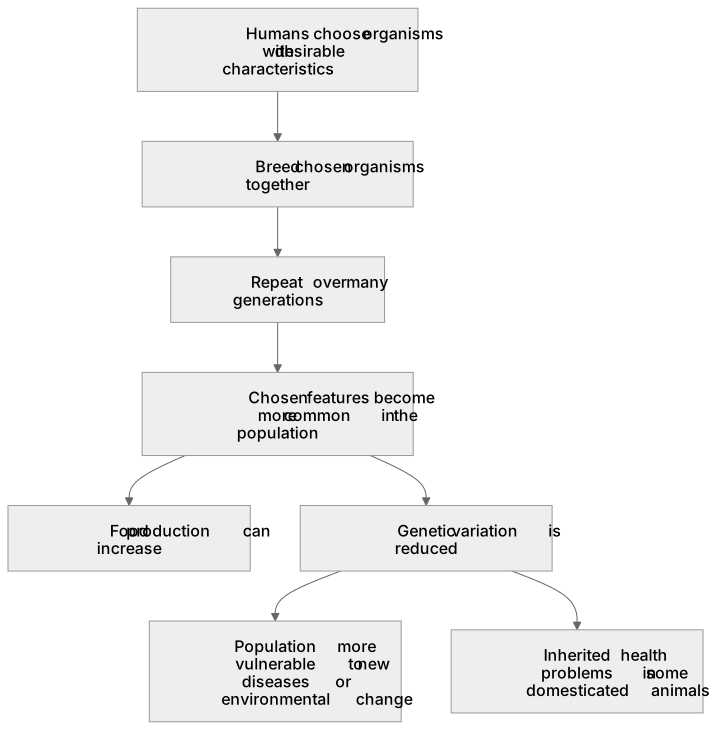
Label the diagram
Some boxes have lost their names. Pick the right name for each number.
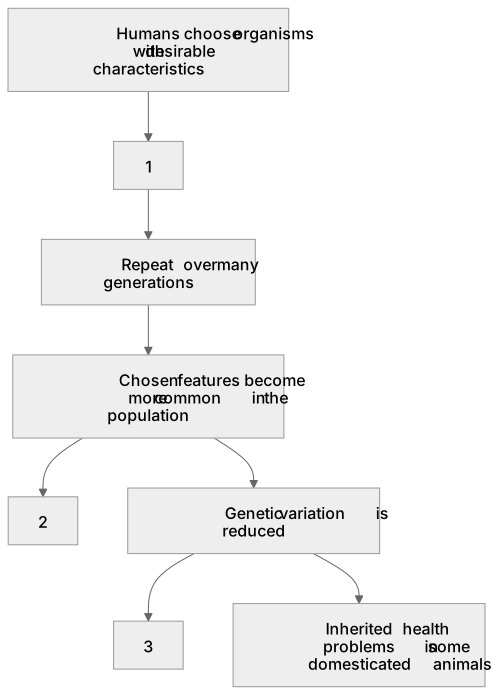
1Box 1
2Box 2
3Box 3
There is more to this lesson
The full lesson goes on to check your understanding and help you earn the marks. Create a free account to carry on, with your progress saved.
A week of Premium from your first lesson · Then the free plan continues · No card, no charge
Test your understanding of Selective breeding: Students should be able to explain the impact of selective breeding of food plants and domesticated animals.
Active recall beats re-reading. Take an instant quiz now to test what you’ve learned and lock it into long-term memory.
A week of Premium from your first lesson · Then the free plan continues · No card, no charge