AQA · GCSE · Combined Science
Course version: 8464 · Version from Sept 2018
Selective breeding: The characteristic can be chosen for usefulness or appearance:
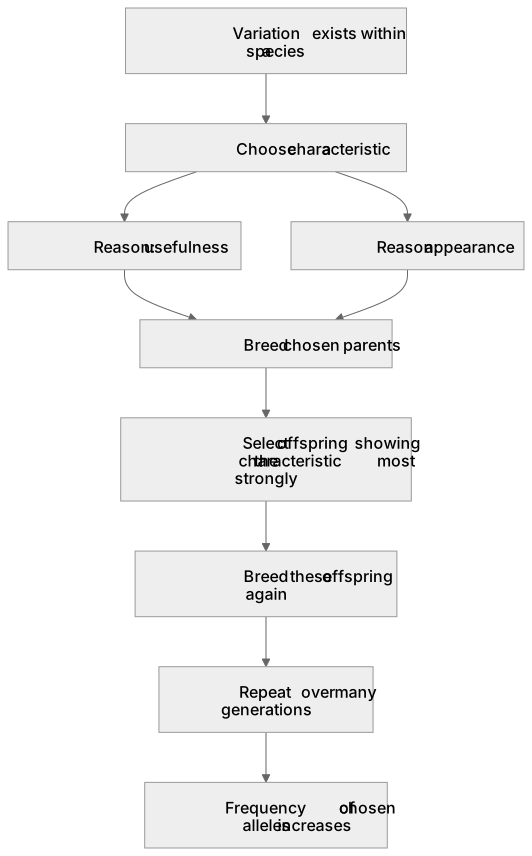
Selective breeding works because variation exists within a species, and humans decide which variants become parents of the next generation.
- 4 key terms
Study notes
From the checked teaching notes for this specification point.
The idea
Selective breeding works because variation exists within a species, and humans decide which variants become parents of the next generation. A characteristic is chosen either for usefulness, such as higher milk yield in cattle, disease resistance in wheat or larger fruit size, or for appearance, such as flower colour in roses, feather colour in poultry or coat colour in dogs. The chosen parents are bred, and their offspring that show the desired characteristic most strongly are bred again. Repeating this over many generations increases the frequency of the chosen alleles in the population. The characteristic must be heritable, so selecting a feature caused only by environment, such as a plant grown with extra fertiliser, will not reliably pass it on.
What earns the marks
- Selective breeding requires inherited variation in the chosen characteristic within the population.
- Usefulness examples include higher yield, disease resistance, hardiness or improved nutritional content.
- Appearance examples include colour, size, shape or other physical features valued by breeders.
- The chosen parents are bred together and the best offspring are selected to breed in the next generation.
- Repeating selection over many generations increases the proportion of individuals showing the desired characteristic.
- Only heritable characteristics respond to selection; environmentally caused features do not reliably pass to offspring.
Common mistakes and how to put them right
Thinking any chosen feature will be inherited.
Put it right by checking that the characteristic is controlled by genes and shows variation between individuals.
Confusing selective breeding with genetic engineering.
Put it right by stating that selective breeding crosses existing organisms and does not directly transfer genes between species.
Assuming one round of breeding is enough.
Put it right by explaining that many generations of selection are usually needed to change the population.
Classifying temperament as an appearance characteristic.
Put it right: Temperament is behavioural, not physical appearance, so it is not an appearance example.
Exam tips
- Name the organism, the chosen characteristic and whether the reason is usefulness or appearance in your first sentence.
- Use the phrase heritable variation to show the characteristic can be passed on.
- Describe the cycle of selection and breeding rather than only stating the final outcome.
Try the lesson
The start of the Selective breeding: The characteristic can be chosen for usefulness or appearance: lesson, made from checked teaching notes for this specification point.
Have a go first
A farmer decides which animals will be used to breed the next generation of the herd. Which statement describes why the farmer chooses specific animals for selective breeding?
Listen
Selective breeding works because variation exists within a species, and humans decide which variants become parents of the next generation. A characteristic is chosen either for usefulness, such as higher milk yield in cattle, disease resistance in wheat or larger fruit size, or for appearance, such as flower colour in roses, feather colour in poultry or coat colour in dogs. The chosen parents are bred, and their offspring that show the desired characteristic most strongly are bred again. Repeating this over many generations increases the frequency of the chosen alleles in the population. The characteristic must be heritable, so selecting a feature caused only by environment, such as a plant grown with extra fertiliser, will not reliably pass it on. A strong answer earns marks for these points. Selective breeding requires inherited variation in the chosen characteristic within the population. Usefulness examples include higher yield, disease resistance, hardiness or improved nutritional content. Appearance examples include colour, size, shape or other physical features valued by breeders. The chosen parents are bred together and the best offspring are selected to breed in the next generation. A common slip: Thinking any chosen feature will be inherited. Instead, checking that the characteristic is controlled by genes and shows variation between individuals. Exam tip: Name the organism, the chosen characteristic and whether the reason is usefulness or appearance in your first sentence.
See it
Key words
Say what each word means before you turn the card.
inherited variation
Try answering aloud or in your head before turning the card.
artificial selection
Try answering aloud or in your head before turning the card.
usefulness versus appearance
Try answering aloud or in your head before turning the card.
change in allele frequency over generations
Try answering aloud or in your head before turning the card.
See every definition
- inherited variation
- Differences within a species that are controlled by genes, so they can be passed on to offspring.
- artificial selection
- Humans decide which variants become parents of the next generation, choosing a characteristic for usefulness or appearance.
- usefulness versus appearance
- A characteristic is chosen either for usefulness or for appearance when deciding which variants become parents.
- change in allele frequency over generations
- Repeating selection over many generations increases the frequency of the chosen alleles in the population.
Label the diagram
Some boxes have lost their names. Pick the right name for each number.
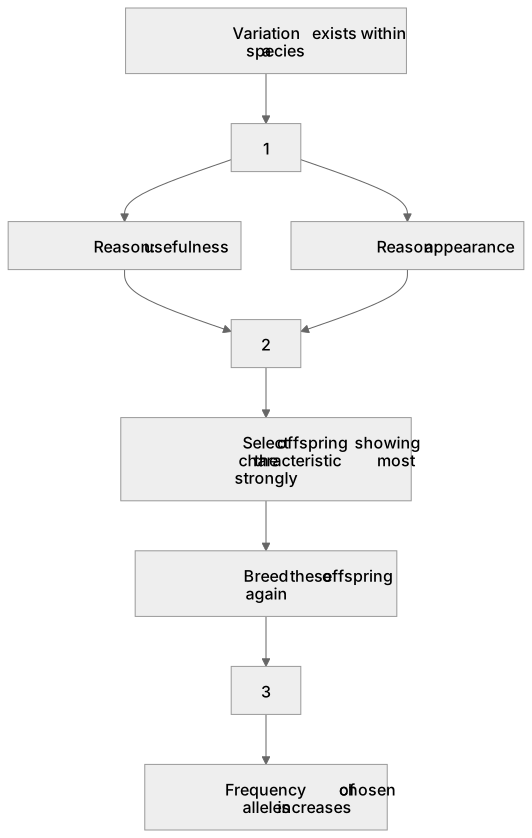
1Box 1
2Box 2
3Box 3
There is more to this lesson
The full lesson goes on to check your understanding and help you earn the marks. Create a free account to carry on, with your progress saved.
A week of Premium from your first lesson · Then the free plan continues · No card, no charge
Test your understanding of Selective breeding: The characteristic can be chosen for usefulness or appearance:
Active recall beats re-reading. Take an instant quiz now to test what you’ve learned and lock it into long-term memory.
A week of Premium from your first lesson · Then the free plan continues · No card, no charge