AQA · GCSE · Combined Science
Course version: 8464 · Version from Sept 2018
Sex determination: In females the sex chromosomes are the same (XX).
Human body cells are diploid, so each contains 23 pairs of chromosomes.
Study notes
From the checked teaching notes for this specification point.
The idea
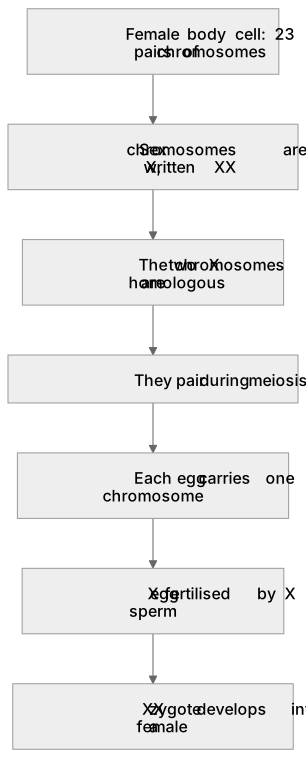
Human body cells are diploid, so each contains 23 pairs of chromosomes. One pair, the sex chromosomes, determines sex. In females this pair is homologous: both chromosomes are X, written XX. Because the two are the same size and carry the same genes, they pair normally during meiosis. A female therefore produces eggs that all carry one X chromosome. When an X-bearing egg is fertilised by an X-bearing sperm the resulting zygote is XX, so the offspring is female. This explains why the mother's contribution does not determine sex; the sperm's sex chromosome does.
For example: A genetic diagram crossing XX with XY gives XX and XY offspring in roughly equal numbers.
What earns the marks
- Human body cells contain 23 pairs of chromosomes, one pair being the sex chromosomes.
- In females the two sex chromosomes are both X, so they are the same and written XX.
- The X chromosomes are homologous, carrying the same genes in the same order, so they pair during meiosis.
- All normal eggs produced by a female carry a single X chromosome.
- Fertilisation of an X egg by an X sperm gives an XX zygote, which develops into a female.
- Because a female has only X chromosomes, she cannot determine the sex of her offspring; the sperm does.
Common mistakes and how to put them right
Writing that females have 'two X chromosomes but they are different' —.
Put it right: The two X chromosomes are homologous and the same type.
Stating that females produce both X and Y eggs —.
Put it right: Females produce only X eggs, while males produce X and Y sperm.
Saying sex is decided by the mother's chromosome —.
Put it right: The sperm's sex chromosome determines the sex of the offspring.
Exam tips
- Use a Punnett square or genetic diagram with parental gametes X and X for the mother and X and Y for the father to show the 1:1 ratio of XX to XY.
- Always write sex chromosomes as XX or XY, not as single letters, and label gametes clearly as eggs and sperm.
- Link the answer back to meiosis: homologous X chromosomes separate so each egg receives one X.
Try the lesson
The start of the Sex determination: In females the sex chromosomes are the same (XX). lesson, made from checked teaching notes for this specification point.
Have a go first
Which pair of sex chromosomes is found in a human female?
Listen
Human body cells are diploid, so each contains 23 pairs of chromosomes. One pair, the sex chromosomes, determines sex. In females this pair is homologous: both chromosomes are X, written XX. Because the two are the same size and carry the same genes, they pair normally during meiosis. A female therefore produces eggs that all carry one X chromosome. When an X-bearing egg is fertilised by an X-bearing sperm the resulting zygote is XX, so the offspring is female. This explains why the mother's contribution does not determine sex; the sperm's sex chromosome does. For example, a genetic diagram crossing XX with XY gives XX and XY offspring in roughly equal numbers. A strong answer earns marks for these points. Human body cells contain 23 pairs of chromosomes, one pair being the sex chromosomes. In females the two sex chromosomes are both X, so they are the same and written XX. The X chromosomes are homologous, carrying the same genes in the same order, so they pair during meiosis. All normal eggs produced by a female carry a single X chromosome. A common slip: Writing that females have 'two X chromosomes but they are different' — the error is confusing sex chromosomes with non-homologous pairs. Instead, the two X chromosomes are homologous and the same type. Exam tip: Use a Punnett square or genetic diagram with parental gametes X and X for the mother and X and Y for the father to show the 1:1 ratio of XX to XY.
See it
Put it in order
Put these steps in the order they happen.
- 1. Sex chromosomes are both X, written XX
- 2. The two X chromosomes are homologous
- 3. They pair during meiosis
- 4. Each egg carries one X chromosome
- 5. X egg fertilised by X sperm
- 6. XX zygote develops into a female
- 7. Female body cell: 23 pairs of chromosomes
Label the diagram
Some boxes have lost their names. Pick the right name for each number.
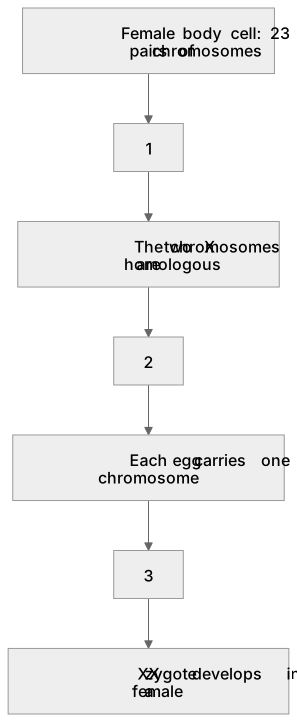
1Box 1
2Box 2
3Box 3
There is more to this lesson
The full lesson goes on to check your understanding and help you earn the marks. Create a free account to carry on, with your progress saved.
A week of Premium from your first lesson · Then the free plan continues · No card, no charge
Test your understanding of Sex determination: In females the sex chromosomes are the same (XX).
Active recall beats re-reading. Take an instant quiz now to test what you’ve learned and lock it into long-term memory.
A week of Premium from your first lesson · Then the free plan continues · No card, no charge