AQA · GCSE · Combined Science
Course version: 8464 · Version from Sept 2018
Sex determination: Students should understand and use direct proportion and simple ratios in genetic crosses.
Genetic crosses predict the proportions of offspring genotypes and phenotypes.
- 4 key terms
Study notes
From the checked teaching notes for this specification point.
The idea
Genetic crosses predict the proportions of offspring genotypes and phenotypes. Direct proportion means that as the number of fertilisations increases, the expected number of offspring of a particular type increases in step with it. A simple ratio compares the expected numbers of different outcomes, such as 3:1 for a monohybrid cross between two heterozygotes or 1:1 for sex inheritance. To use these ideas, complete the cross, count the boxes for each outcome, then express the counts as a ratio in simplest form. For example, a cross giving three tall and one short outcome has a 3:1 ratio, so the probability of tall is 3 ÷ 4 = 0.75 or 75%. If 200 offspring are expected, the predicted number of tall plants is 0.75 × 200 = 150. Ratios describe expected proportions, not guaranteed results in every small family or sample.
What earns the marks
- Correctly counting the outcomes in a completed genetic cross before forming a ratio.
- Expressing the outcome as a simple ratio in its lowest terms, for example 3:1 or 1:1.
- Converting a ratio into a probability by dividing the number of favourable outcomes by the total number of outcomes.
- Using direct proportion to predict expected numbers, for example multiplying the probability by the total number of offspring.
- Recognising that expected ratios describe probability and may not match small observed samples exactly.
- Maintaining correct genotype and phenotype labels when interpreting the ratio.
Common mistakes and how to put them right
Reversing the ratio, such as writing 1:3 instead of 3:1.
Put it right: State clearly which value refers to which phenotype and keep the order consistent.
Treating a 3:1 ratio as a guarantee that three-quarters of actual offspring must show the dominant phenotype.
Put it right: It is an expected probability, and chance variation is larger in small samples.
Adding the parts of a ratio incorrectly when finding a probability.
Put it right: The total number of outcomes is the sum of all parts, so 3:1 gives four equal parts.
Exam tips
- Write the ratio and then convert it to a fraction or decimal before calculating predicted numbers.
- Show each step of a proportion calculation so method marks can be awarded even if the final value is wrong.
- Check that the ratio is in simplest form and that the order of the ratio matches the order requested in the question.
Try the lesson
The start of the Sex determination: Students should understand and use direct proportion and simple ratios in genetic crosses. lesson, made from checked teaching notes for this specification point.
Have a go first
In a genetic cross between a female (XX) and a male (XY), what is the expected ratio of female to male offspring?
Listen
Genetic crosses predict the proportions of offspring genotypes and phenotypes. Direct proportion means that as the number of fertilisations increases, the expected number of offspring of a particular type increases in step with it. A simple ratio compares the expected numbers of different outcomes, such as 3:1 for a monohybrid cross between two heterozygotes or 1:1 for sex inheritance. To use these ideas, complete the cross, count the boxes for each outcome, then express the counts as a ratio in simplest form. For example, a cross giving three tall and one short outcome has a 3:1 ratio, so the probability of tall is 3 ÷ 4 = 0.75 or 75%. If 200 offspring are expected, the predicted number of tall plants is 0.75 × 200 = 150. Ratios describe expected proportions, not guaranteed results in every small family or sample. A strong answer earns marks for these points. Correctly counting the outcomes in a completed genetic cross before forming a ratio. Expressing the outcome as a simple ratio in its lowest terms, for example 3:1 or 1:1. Converting a ratio into a probability by dividing the number of favourable outcomes by the total number of outcomes. Using direct proportion to predict expected numbers, for example multiplying the probability by the total number of offspring. A common slip: Reversing the ratio, such as writing 1:3 instead of 3:1. Instead, state clearly which value refers to which phenotype and keep the order consistent. Exam tip: Write the ratio and then convert it to a fraction or decimal before calculating predicted numbers.
See it
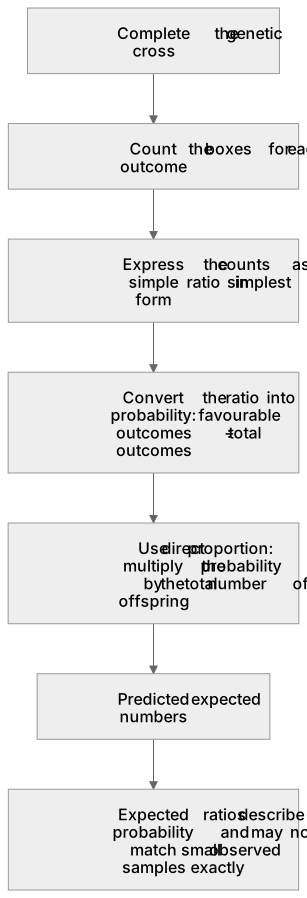
Put it in order
Put these steps in the order they happen.
- 1. Count the boxes for each outcome
- 2. Express the counts as a simple ratio in simplest form
- 3. Convert the ratio into a probability: favourable outcomes ÷ total outcomes
- 4. Use direct proportion: multiply the probability by the total number of offspring
- 5. Predicted expected numbers
- 6. Expected ratios describe probability and may not match small observed samples exactly
- 7. Complete the genetic cross
Key words
Say what each word means before you turn the card.
Direct proportion
Try answering aloud or in your head before turning the card.
Simple ratio
Try answering aloud or in your head before turning the card.
Probability
Try answering aloud or in your head before turning the card.
Expected ratios
Try answering aloud or in your head before turning the card.
See every definition
- Direct proportion
- As the number of fertilisations increases, the expected number of offspring of a particular type increases in step with it.
- Simple ratio
- Compares the expected numbers of different outcomes, such as 3:1 for a monohybrid cross between two heterozygotes or 1:1 for sex inheritance.
- Probability
- Found by dividing the number of favourable outcomes by the total number of outcomes, so a 3:1 ratio gives 3 ÷ 4 = 0.75 or 75%.
- Expected ratios
- Describe probability and may not match small observed samples exactly, as chance variation is larger in small samples.
Label the diagram
Some boxes have lost their names. Pick the right name for each number.
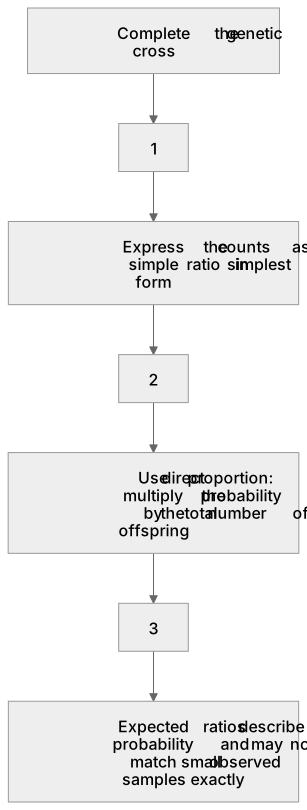
1Box 1
2Box 2
3Box 3
There is more to this lesson
The full lesson goes on to check your understanding and help you earn the marks. Create a free account to carry on, with your progress saved.
A week of Premium from your first lesson · Then the free plan continues · No card, no charge
Test your understanding of Sex determination: Students should understand and use direct proportion and simple ratios in genetic crosses.
Active recall beats re-reading. Take an instant quiz now to test what you’ve learned and lock it into long-term memory.
A week of Premium from your first lesson · Then the free plan continues · No card, no charge