AQA · GCSE · Combined Science
Course version: 8464 · Version from Sept 2018
Sexual and asexual reproduction: sperm and egg cells in animals
In animals the male gamete is the sperm cell and the female gamete is the egg cell, also called the ovum.
- 4 key terms
Study notes
From the checked teaching notes for this specification point.
The idea
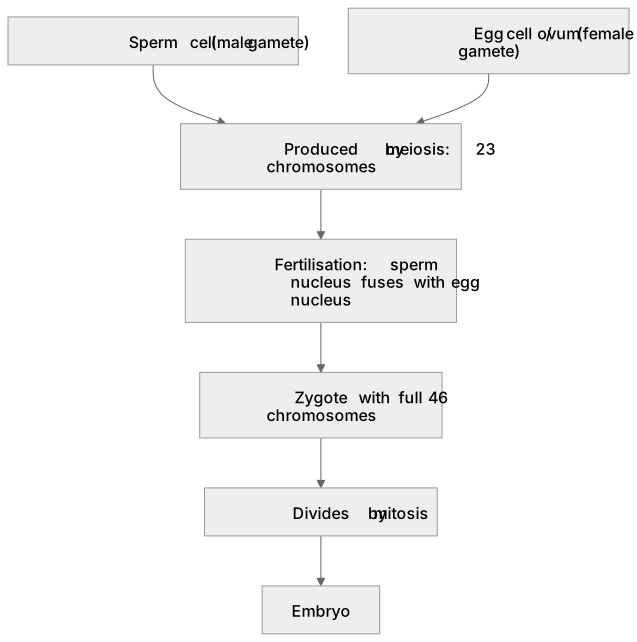
In animals the male gamete is the sperm cell and the female gamete is the egg cell, also called the ovum. Both are produced by meiosis, so each nucleus contains half the normal chromosome number: in humans, 23 chromosomes. The sperm is adapted for movement, with a tail to swim and many mitochondria to release energy for swimming, and its acrosome contains enzymes to digest a path into the egg. The egg is larger and non-motile, with food reserves in the cytoplasm to support the early embryo and a jelly coat that changes after fertilisation to block further sperm. At fertilisation the sperm nucleus fuses with the egg nucleus, forming a zygote with the full 46 chromosomes. The zygote then divides by mitosis to develop into an embryo.
What earns the marks
- The sperm is the male gamete and the egg (ovum) is the female gamete in animals.
- The sperm has a tail and many mitochondria for swimming and releasing energy.
- The egg is larger, non-motile and contains food reserves for the early embryo.
- Fertilisation is the fusion of the sperm nucleus and egg nucleus to form a zygote.
- The zygote has the full chromosome number and divides by mitosis to form the embryo.
Common mistakes and how to put them right
Calling the egg a cell with a full set of chromosomes.
Put it right: The egg nucleus is haploid, carrying 23 chromosomes in humans.
Saying the sperm cell has no cytoplasm or mitochondria.
Put it right: It has a small amount of cytoplasm and many mitochondria to supply energy for swimming.
Confusing fertilisation with implantation.
Put it right: Fertilisation is the fusion of gamete nuclei, while implantation is the embedding of the embryo in the uterus lining.
Exam tips
- Name both gametes and give their chromosome numbers to show they are haploid.
- When asked about adaptation, link each sperm or egg feature to its function, such as tail for swimming or food store for the embryo.
- Describe fertilisation as the fusion of nuclei, not just the joining of whole cells, to gain credit for the genetic point.
Try the lesson
The start of the Sexual and asexual reproduction: sperm and egg cells in animals lesson, made from checked teaching notes for this specification point.
Have a go first
In animals, which cell is the male gamete?
Listen
In animals the male gamete is the sperm cell and the female gamete is the egg cell, also called the ovum. Both are produced by meiosis, so each nucleus contains half the normal chromosome number: in humans, 23 chromosomes. The sperm is adapted for movement, with a tail to swim and many mitochondria to release energy for swimming, and its acrosome contains enzymes to digest a path into the egg. The egg is larger and non-motile, with food reserves in the cytoplasm to support the early embryo and a jelly coat that changes after fertilisation to block further sperm. At fertilisation the sperm nucleus fuses with the egg nucleus, forming a zygote with the full 46 chromosomes. The zygote then divides by mitosis to develop into an embryo. A strong answer earns marks for these points. The sperm is the male gamete and the egg (ovum) is the female gamete in animals. The sperm has a tail and many mitochondria for swimming and releasing energy. The egg is larger, non-motile and contains food reserves for the early embryo. Fertilisation is the fusion of the sperm nucleus and egg nucleus to form a zygote. A common slip: Calling the egg a cell with a full set of chromosomes. Instead, the egg nucleus is haploid, carrying 23 chromosomes in humans. Exam tip: Name both gametes and give their chromosome numbers to show they are haploid.
See it
Key words
Say what each word means before you turn the card.
Gametes in animals
Try answering aloud or in your head before turning the card.
Cell specialisation and adaptation
Try answering aloud or in your head before turning the card.
Fertilisation and zygote formation
Try answering aloud or in your head before turning the card.
Chromosome number and meiosis
Try answering aloud or in your head before turning the card.
See every definition
- Gametes in animals
- The male gamete is the sperm cell and the female gamete is the egg cell, also called the ovum.
- Cell specialisation and adaptation
- The sperm has a tail to swim and many mitochondria to release energy, while the egg is larger and non-motile with food reserves in the cytoplasm.
- Fertilisation and zygote formation
- The sperm nucleus fuses with the egg nucleus, forming a zygote with the full 46 chromosomes.
- Chromosome number and meiosis
- Both gametes are produced by meiosis, so each nucleus contains half the normal chromosome number, 23 in humans.
Label the diagram
Some boxes have lost their names. Pick the right name for each number.
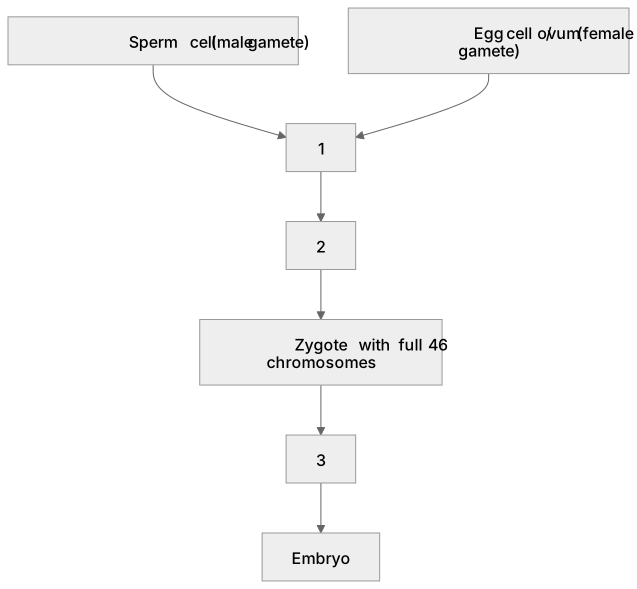
1Box 1
2Box 2
3Box 3
There is more to this lesson
The full lesson goes on to check your understanding and help you earn the marks. Create a free account to carry on, with your progress saved.
A week of Premium from your first lesson · Then the free plan continues · No card, no charge
Test your understanding of Sexual and asexual reproduction: sperm and egg cells in animals
Active recall beats re-reading. Take an instant quiz now to test what you’ve learned and lock it into long-term memory.
A week of Premium from your first lesson · Then the free plan continues · No card, no charge