AQA · GCSE · Combined Science
Course version: 8464 · Version from Sept 2018
Size and mass of atoms: Almost all of the mass of an atom is in the nucleus.
An atom is mostly empty space.
- 3 key terms
Study notes
From the checked teaching notes for this specification point.
The idea
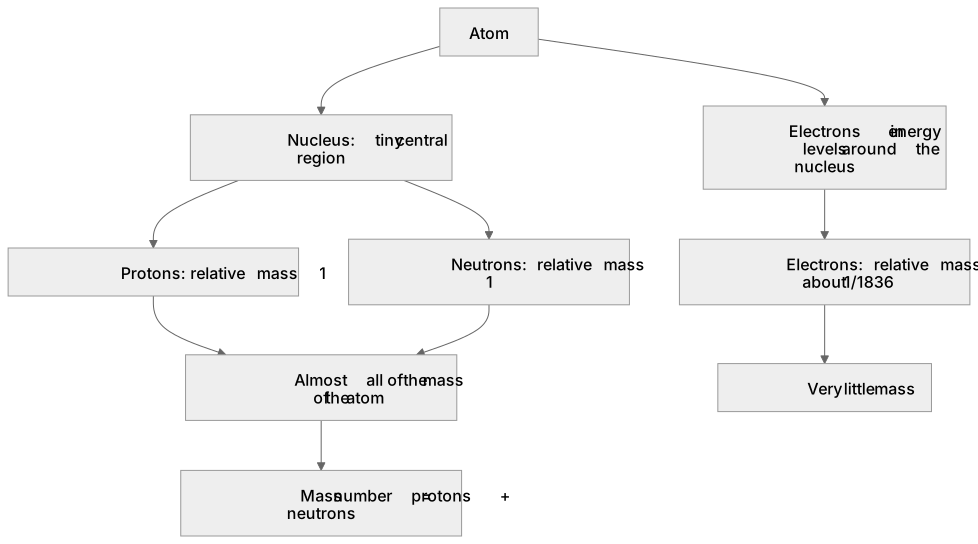
An atom is mostly empty space. The nucleus, a tiny central region containing protons and neutrons, carries almost all of the atom's mass because each proton and neutron has a relative mass of 1, while each electron has a relative mass of about 1/1836. The electrons occupy energy levels around the nucleus and contribute very little mass. For example, in a carbon-12 atom the nucleus contains 6 protons and 6 neutrons, giving a relative mass of 12, whereas its 6 electrons add only about 0.003. This explains why the mass number equals the number of protons plus neutrons and why relative atomic mass is dominated by nuclear particles.
What earns the marks
- State that the nucleus contains protons and neutrons, which are the particles that give an atom almost all of its mass.
- Compare relative masses: a proton and a neutron each have a relative mass of 1, whereas an electron has a relative mass of about 1/1836.
- Explain that electrons occupy energy levels around the nucleus and contribute a negligible fraction of the total atomic mass.
- Use the carbon-12 example: 6 protons plus 6 neutrons give a relative mass of 12, while 6 electrons add only about 0.003.
- Link the idea to mass number: mass number equals the number of protons plus the number of neutrons, so it reflects nuclear mass.
Common mistakes and how to put them right
Thinking that electrons make a large contribution to atomic mass because they move quickly.
Put it right by comparing relative masses, where an electron is about 1/1836 of a proton.
Believing that the nucleus occupies most of the atom's volume.
Put it right by stating that the nucleus is tiny compared with the whole atom, even though it contains almost all the mass.
Confusing mass number with relative atomic mass.
Put it right by noting that mass number counts protons and neutrons, while relative atomic mass is a weighted mean that also accounts for isotopes.
Exam tips
- Use the phrase 'almost all of the mass' rather than 'all of the mass', because electrons do contribute a very small amount.
- When explaining, quote relative masses: proton 1, neutron 1, electron about 1/1836.
- Link your answer to the structure of the atom: a small, dense nucleus surrounded by electrons in energy levels.
Try the lesson
The start of the Size and mass of atoms: Almost all of the mass of an atom is in the nucleus. lesson, made from checked teaching notes for this specification point.
Have a go first
In an atom, where is almost all of the mass located?
Listen
An atom is mostly empty space. The nucleus, a tiny central region containing protons and neutrons, carries almost all of the atom's mass because each proton and neutron has a relative mass of 1, while each electron has a relative mass of about 1/1836. The electrons occupy energy levels around the nucleus and contribute very little mass. For example, in a carbon-12 atom the nucleus contains 6 protons and 6 neutrons, giving a relative mass of 12, whereas its 6 electrons add only about 0.003. This explains why the mass number equals the number of protons plus neutrons and why relative atomic mass is dominated by nuclear particles. A strong answer earns marks for these points. State that the nucleus contains protons and neutrons, which are the particles that give an atom almost all of its mass. Compare relative masses: a proton and a neutron each have a relative mass of 1, whereas an electron has a relative mass of about 1/1836. Explain that electrons occupy energy levels around the nucleus and contribute a negligible fraction of the total atomic mass. Use the carbon-12 example: 6 protons plus 6 neutrons give a relative mass of 12, while 6 electrons add only about 0.003. A common slip: Thinking that electrons make a large contribution to atomic mass because they move quickly. Instead, comparing relative masses, where an electron is about 1/1836 of a proton. Exam tip: Use the phrase 'almost all of the mass' rather than 'all of the mass', because electrons do contribute a very small amount.
See it
Key words
Say what each word means before you turn the card.
Subatomic particles
Try answering aloud or in your head before turning the card.
Relative mass
Try answering aloud or in your head before turning the card.
Mass number
Try answering aloud or in your head before turning the card.
See every definition
- Subatomic particles
- Protons and neutrons are found in the nucleus and give an atom almost all of its mass, while electrons occupy energy levels around the nucleus.
- Relative mass
- A proton and a neutron each have a relative mass of 1, whereas an electron has a relative mass of about 1/1836.
- Mass number
- This equals the number of protons plus the number of neutrons, so it reflects nuclear mass.
Label the diagram
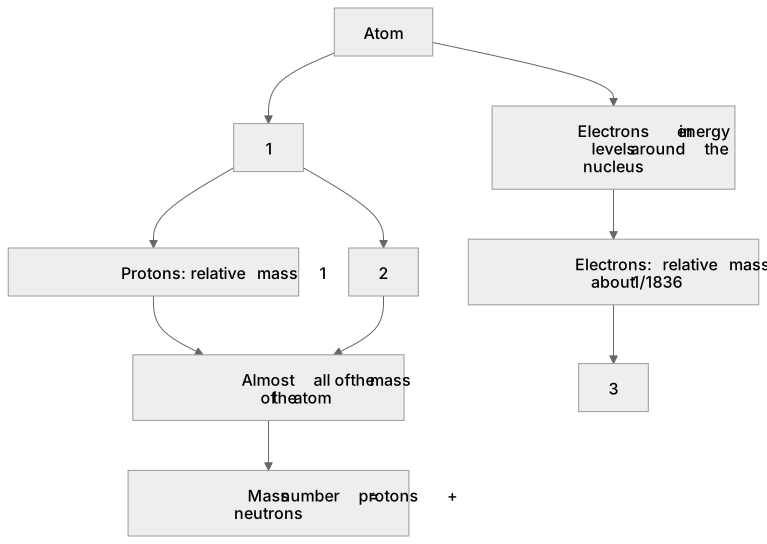
Some boxes have lost their names. Pick the right name for each number.
1Box 1
2Box 2
3Box 3
There is more to this lesson
The full lesson goes on to check your understanding and help you earn the marks. Create a free account to carry on, with your progress saved.
A week of Premium from your first lesson · Then the free plan continues · No card, no charge
Test your understanding of Size and mass of atoms: Almost all of the mass of an atom is in the nucleus.
Active recall beats re-reading. Take an instant quiz now to test what you’ve learned and lock it into long-term memory.
A week of Premium from your first lesson · Then the free plan continues · No card, no charge