AQA · GCSE · Combined Science
Course version: 8464 · Version from Sept 2018
Size and mass of atoms: Atoms can be represented as shown in this example:
This statement introduces the standard symbolic representation of an atom, often called nuclide notation.
- 4 key terms
Study notes
From the checked teaching notes for this specification point.
The idea
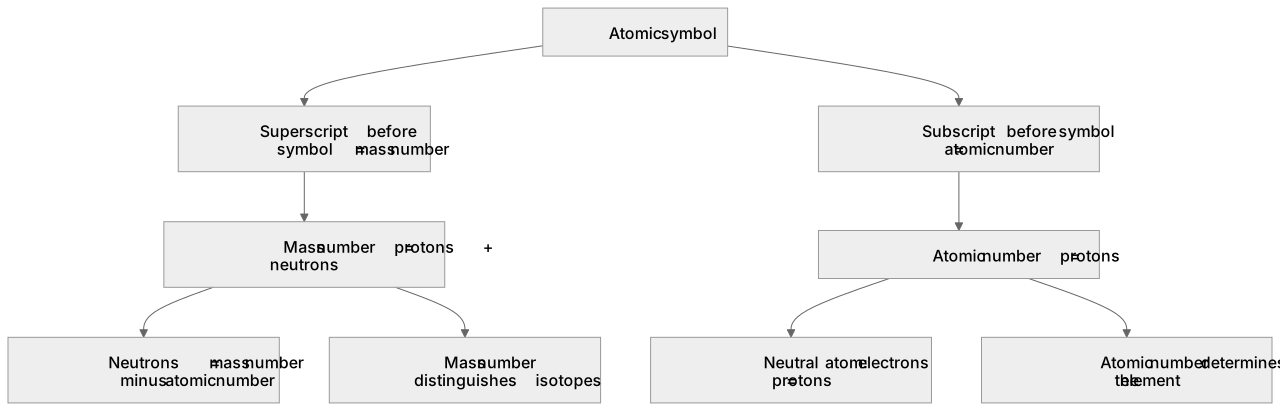
This statement introduces the standard symbolic representation of an atom, often called nuclide notation. In this convention the mass number is written as a superscript before the element symbol and the atomic number as a subscript before it, for example ²³Na₁₁ or, more commonly in AQA materials, ²³₁₁Na. The mass number counts protons plus neutrons in the nucleus, while the atomic number counts protons and defines the element. For a neutral atom, the number of electrons equals the number of protons, so the symbol also tells you the electron count. For example, ²³₁₁Na has 11 protons, 12 neutrons and 11 electrons. The representation is a compact way of showing the composition of any atom or ion, and it underpins calculations of subatomic particle numbers.
What earns the marks
- Recognises that the superscript before the symbol is the mass number, equal to protons plus neutrons.
- Recognises that the subscript before the symbol is the atomic number, equal to the number of protons.
- States that in a neutral atom the number of electrons equals the number of protons.
- Uses a given symbol such as ²³₁₁Na to deduce 11 protons, 12 neutrons and 11 electrons.
- Explains that the atomic number determines the element and that the mass number distinguishes isotopes of that element.
Common mistakes and how to put them right
Writing the mass number as a subscript and the atomic number as a superscript.
Put it right by remembering that the larger number is the mass number and sits above the atomic number.
Assuming the number of neutrons equals the atomic number.
Put it right by calculating neutrons as mass number minus atomic number.
Treating the mass number as the number of electrons.
Put it right by using the atomic number for protons and electrons in a neutral atom.
Exam tips
- Always write the mass number above and the atomic number below, aligned to the left of the element symbol.
- When asked for particle numbers, show the subtraction mass number minus atomic number for neutrons.
- Check whether the species is neutral or an ion before stating the electron count.
Try the lesson
The start of the Size and mass of atoms: Atoms can be represented as shown in this example: lesson, made from checked teaching notes for this specification point.
Have a go first
An atom of lithium is represented by the symbol ⁷₃Li. What does the number 3 in this symbol tell you about the atom?
Listen
This statement introduces the standard symbolic representation of an atom, often called nuclide notation. In this convention the mass number is written as a superscript before the element symbol and the atomic number as a subscript before it, for example ²³Na₁₁ or, more commonly in AQA materials, ²³₁₁Na. The mass number counts protons plus neutrons in the nucleus, while the atomic number counts protons and defines the element. For a neutral atom, the number of electrons equals the number of protons, so the symbol also tells you the electron count. For example, ²³₁₁Na has 11 protons, 12 neutrons and 11 electrons. The representation is a compact way of showing the composition of any atom or ion, and it underpins calculations of subatomic particle numbers. A strong answer earns marks for these points. Recognises that the superscript before the symbol is the mass number, equal to protons plus neutrons. Recognises that the subscript before the symbol is the atomic number, equal to the number of protons. States that in a neutral atom the number of electrons equals the number of protons. Uses a given symbol such as ²³₁₁Na to deduce 11 protons, 12 neutrons and 11 electrons. A common slip: Writing the mass number as a subscript and the atomic number as a superscript. Instead, remembering that the larger number is the mass number and sits above the atomic number. Exam tip: Always write the mass number above and the atomic number below, aligned to the left of the element symbol.
See it
Key words
Say what each word means before you turn the card.
Nuclide notation
Try answering aloud or in your head before turning the card.
Mass number
Try answering aloud or in your head before turning the card.
Atomic number
Try answering aloud or in your head before turning the card.
Isotopes
Try answering aloud or in your head before turning the card.
See every definition
- Nuclide notation
- A standard symbolic representation of an atom in which the mass number is written as a superscript and the atomic number as a subscript before the element symbol.
- Mass number
- The number written as a superscript before the element symbol, counting protons plus neutrons in the nucleus.
- Atomic number
- The number written as a subscript before the element symbol, counting protons and defining the element.
- Isotopes
- Atoms of the same element, determined by the atomic number, that are distinguished by their mass number.
Label the diagram
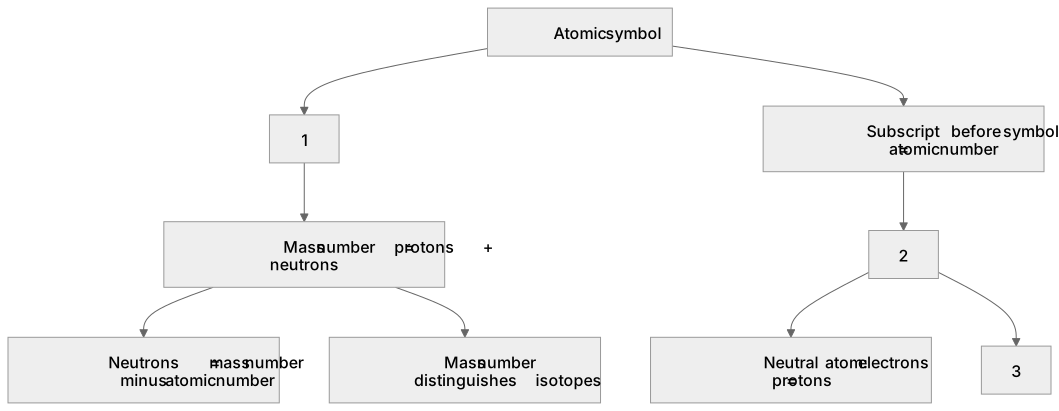
Some boxes have lost their names. Pick the right name for each number.
1Box 1
2Box 2
3Box 3
There is more to this lesson
The full lesson goes on to check your understanding and help you earn the marks. Create a free account to carry on, with your progress saved.
A week of Premium from your first lesson · Then the free plan continues · No card, no charge
Test your understanding of Size and mass of atoms: Atoms can be represented as shown in this example:
Active recall beats re-reading. Take an instant quiz now to test what you’ve learned and lock it into long-term memory.
A week of Premium from your first lesson · Then the free plan continues · No card, no charge