AQA · GCSE · Combined Science
Course version: 8464 · Version from Sept 2018
Size and mass of atoms: Atoms of the same element can have different numbers of neutrons; these atoms are called isotopes of that element.
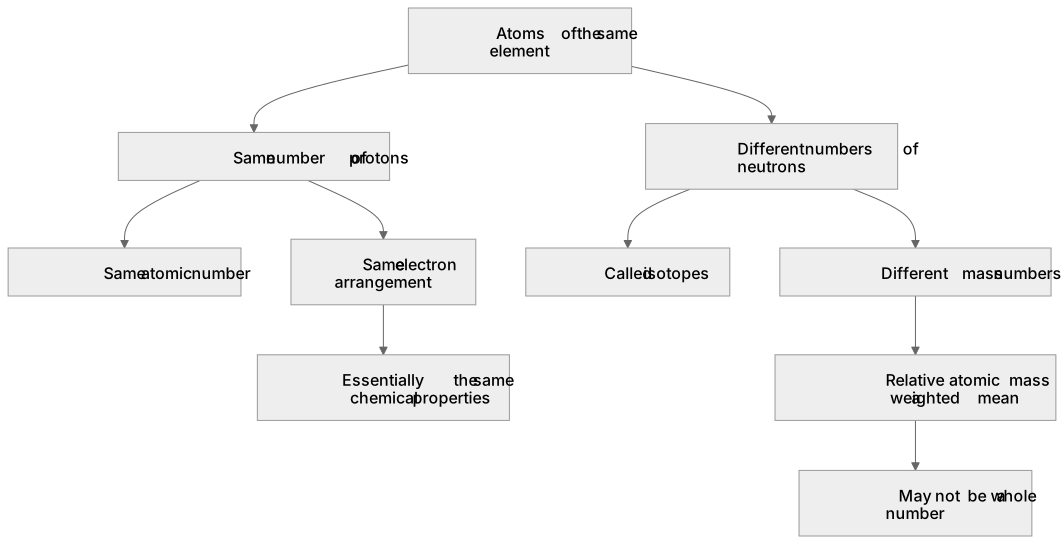
Isotopes are atoms of the same element with the same number of protons but different numbers of neutrons, so they have the same atomic number but different mass numbers.
- 2 key terms
Study notes
From the checked teaching notes for this specification point.
The idea
Isotopes are atoms of the same element with the same number of protons but different numbers of neutrons, so they have the same atomic number but different mass numbers. Chlorine, for example, has isotopes with mass numbers 35 and 37 (³⁵Cl and ³⁷Cl): both have 17 protons, but one has 18 neutrons and the other 20. Because proton number fixes the element, isotopes share chemical properties; differing neutron numbers change mass and some physical behaviour. Relative atomic mass is the weighted mean of isotope masses, so it need not be a whole number. Isotopes may be stable or radioactive.
What earns the marks
- Isotopes have the same number of protons, so they are atoms of the same element.
- Isotopes have different numbers of neutrons and therefore different mass numbers.
- The atomic number is the same for all isotopes of an element.
- Chemical properties are essentially the same because electron arrangement is the same.
- Relative atomic mass is a weighted mean of the masses of the isotopes, so it may not be a whole number.
- Isotopes of an element may include stable and radioactive forms.
Common mistakes and how to put them right
Saying isotopes have different numbers of protons.
Put it right by stating that proton number is identical and only neutron number differs.
Claiming isotopes have completely different chemical properties.
Put it right by explaining that identical electron arrangements give essentially the same chemistry.
Treating relative atomic mass as a simple average of mass numbers.
Put it right by using the weighted mean that accounts for isotopic abundance.
Exam tips
- Define isotopes using both 'same protons' and 'different neutrons' to secure the mark.
- Use a named example such as chlorine-35 and chlorine-37 to make the explanation concrete.
- If asked to compare, state clearly what is the same and what is different rather than describing each isotope separately.
Try the lesson
The start of the Size and mass of atoms: Atoms of the same element can have different numbers of neutrons; these atoms are called isotopes of that element. lesson, made from checked teaching notes for this specification point.
Have a go first
Atoms of the same element that have different numbers of neutrons are called what?
Listen
Isotopes are atoms of the same element with the same number of protons but different numbers of neutrons, so they have the same atomic number but different mass numbers. Chlorine, for example, has isotopes with mass numbers 35 and 37 (³⁵Cl and ³⁷Cl): both have 17 protons, but one has 18 neutrons and the other 20. Because proton number fixes the element, isotopes share chemical properties; differing neutron numbers change mass and some physical behaviour. Relative atomic mass is the weighted mean of isotope masses, so it need not be a whole number. Isotopes may be stable or radioactive. A strong answer earns marks for these points. Isotopes have the same number of protons, so they are atoms of the same element. Isotopes have different numbers of neutrons and therefore different mass numbers. The atomic number is the same for all isotopes of an element. Chemical properties are essentially the same because electron arrangement is the same. A common slip: Saying isotopes have different numbers of protons. Instead, stating that proton number is identical and only neutron number differs. Exam tip: Define isotopes using both 'same protons' and 'different neutrons' to secure the mark.
See it
Key words
Say what each word means before you turn the card.
Isotopes
Try answering aloud or in your head before turning the card.
Relative atomic mass
Try answering aloud or in your head before turning the card.
See every definition
- Isotopes
- Atoms of the same element with the same number of protons but different numbers of neutrons, so they have the same atomic number but different mass numbers.
- Relative atomic mass
- The weighted mean of isotope masses, so it need not be a whole number.
Label the diagram
Some boxes have lost their names. Pick the right name for each number.
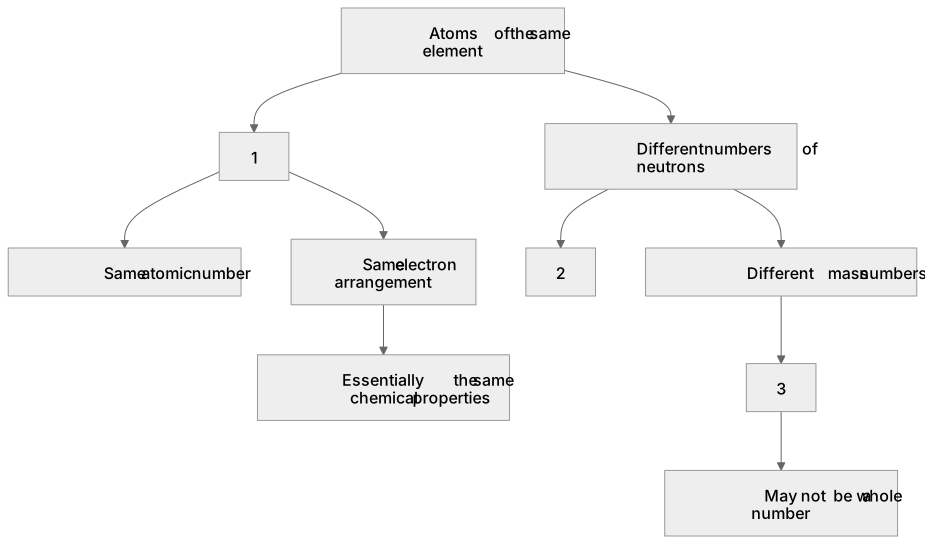
1Box 1
2Box 2
3Box 3
There is more to this lesson
The full lesson goes on to check your understanding and help you earn the marks. Create a free account to carry on, with your progress saved.
A week of Premium from your first lesson · Then the free plan continues · No card, no charge
Test your understanding of Size and mass of atoms: Atoms of the same element can have different numbers of neutrons; these atoms are called isotopes of that element.
Active recall beats re-reading. Take an instant quiz now to test what you’ve learned and lock it into long-term memory.
A week of Premium from your first lesson · Then the free plan continues · No card, no charge