AQA · GCSE · Combined Science
Course version: 8464 · Version from Sept 2018
Size and mass of atoms: Students should be able to relate size and scale of atoms to objects in the physical world.
Atoms are extremely small, with a typical radius of about 1 × 10⁻¹⁰ m.
- 4 key terms
Study notes
From the checked teaching notes for this specification point.
The idea
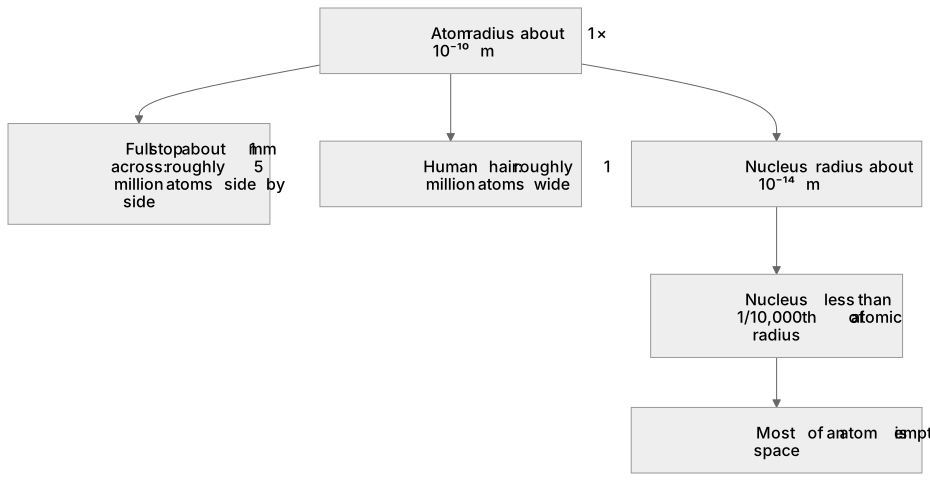
Atoms are extremely small, with a typical radius of about 1 × 10⁻¹⁰ m. To relate this to the physical world, consider a full stop about 1 mm across: roughly 5 million atoms could sit side by side across it. Another comparison is a human hair, which is roughly 1 million atoms wide. These comparisons show that atoms are far smaller than everyday objects. The nucleus is smaller still, with a radius of about 1 × 10⁻¹⁴ m, which is less than 1/10,000th of the atomic radius, meaning most of an atom is empty space. Scale diagrams and powers of ten help keep these numbers manageable.
What earns the marks
- States that a typical atom has a radius of about 1 × 10⁻¹⁰ m.
- Uses a familiar object, such as a full stop or a human hair, to compare with atomic size.
- Explains that a human hair is roughly 1 million atoms wide.
- Describes the nucleus as having a radius of about 1 × 10⁻¹⁴ m.
- Recognises that most of an atom is empty space between the nucleus and the electrons.
Common mistakes and how to put them right
Saying an atom has a diameter of 1 × 10⁻¹⁰ m.
Put it right by stating it is the radius.
Confusing the radius of the nucleus with the atom.
Put it right by noting the nucleus radius is about 1 × 10⁻¹⁴ m.
Writing 10⁻¹⁰ as 10-10.
Put it right by using the raised exponent 10⁻¹⁰.
Exam tips
- Quote the approximate atomic radius as 1 × 10⁻¹⁰ m and link it to a named everyday object.
- When comparing nucleus and atom, give both approximate radii so the scale difference is clear.
Try the lesson
The start of the Size and mass of atoms: Students should be able to relate size and scale of atoms to objects in the physical world. lesson, made from checked teaching notes for this specification point.
Have a go first
A human hair is about 0.1 millimetres wide. If an atom has a radius of 0.1 nanometres, roughly how many atoms placed side by side would span this width?
Listen
Atoms are extremely small, with a typical radius of about 1 × 10⁻¹⁰ m. To relate this to the physical world, consider a full stop about 1 mm across: roughly 5 million atoms could sit side by side across it. Another comparison is a human hair, which is roughly 1 million atoms wide. These comparisons show that atoms are far smaller than everyday objects. The nucleus is smaller still, with a radius of about 1 × 10⁻¹⁴ m, which is less than 1/10,000th of the atomic radius, meaning most of an atom is empty space. Scale diagrams and powers of ten help keep these numbers manageable. A strong answer earns marks for these points. States that a typical atom has a radius of about 1 × 10⁻¹⁰ m. Uses a familiar object, such as a full stop or a human hair, to compare with atomic size. Explains that a human hair is roughly 1 million atoms wide. Describes the nucleus as having a radius of about 1 × 10⁻¹⁴ m. A common slip: Saying an atom has a diameter of 1 × 10⁻¹⁰ m. Instead, stating it is the radius. Exam tip: Quote the approximate atomic radius as 1 × 10⁻¹⁰ m and link it to a named everyday object.
See it
Key words
Say what each word means before you turn the card.
Atomic radius
Try answering aloud or in your head before turning the card.
Nucleus
Try answering aloud or in your head before turning the card.
Powers of ten
Try answering aloud or in your head before turning the card.
Empty space
Try answering aloud or in your head before turning the card.
See every definition
- Atomic radius
- A typical atom has a radius of about 1 × 10⁻¹⁰ m.
- Nucleus
- It has a radius of about 1 × 10⁻¹⁴ m, which is less than 1/10,000th of the atomic radius.
- Powers of ten
- These, along with scale diagrams, help keep these numbers manageable.
- Empty space
- Most of an atom is empty space between the nucleus and the electrons.
Label the diagram
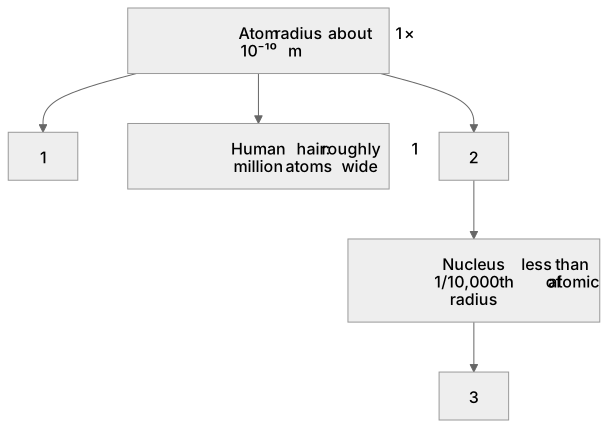
Some boxes have lost their names. Pick the right name for each number.
1Box 1
2Box 2
3Box 3
There is more to this lesson
The full lesson goes on to check your understanding and help you earn the marks. Create a free account to carry on, with your progress saved.
A week of Premium from your first lesson · Then the free plan continues · No card, no charge
Test your understanding of Size and mass of atoms: Students should be able to relate size and scale of atoms to objects in the physical world.
Active recall beats re-reading. Take an instant quiz now to test what you’ve learned and lock it into long-term memory.
A week of Premium from your first lesson · Then the free plan continues · No card, no charge