AQA · GCSE · Combined Science
Course version: 8464 · Version from Sept 2018
Size and mass of atoms: The sum of the protons and neutrons in an atom is its mass number.
The mass number counts the particles packed into an atom's nucleus: protons and neutrons together.
- 4 key terms
Study notes
From the checked teaching notes for this specification point.
The idea
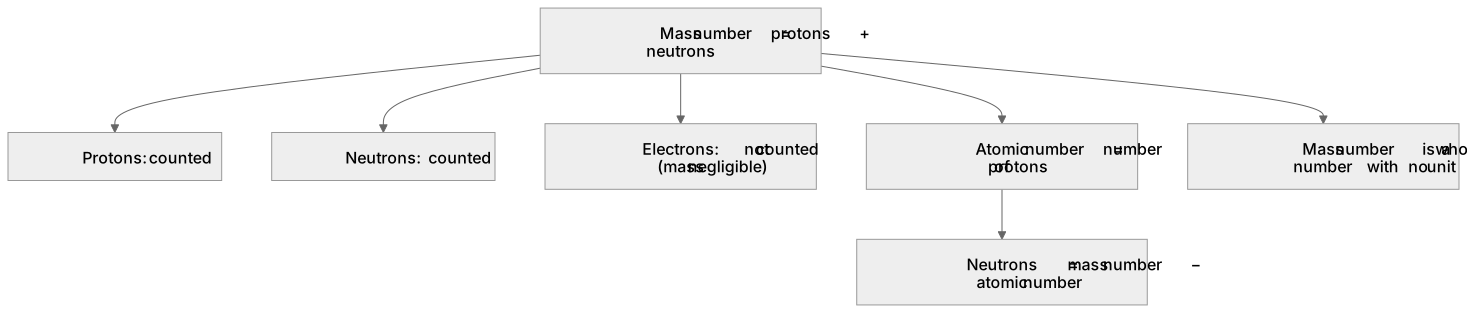
The mass number counts the particles packed into an atom's nucleus: protons and neutrons together. Electrons are ignored because their mass is negligible compared with nucleons. For sodium, 11 protons plus 12 neutrons gives a mass number of 23, written as ²³Na or shown top-left of the symbol. To find neutrons, subtract the atomic number from the mass number: 23 − 11 = 12. The atomic number identifies the element and equals the proton count; the mass number identifies the particular atom. Because the mass number is a count of nucleons, it is a whole number with no unit. Isotopes of an element share the same atomic number but differ in mass number.
What earns the marks
- Mass number = number of protons + number of neutrons in the nucleus.
- Electrons are not included because their mass is negligible relative to protons and neutrons.
- Atomic number = number of protons; for a neutral atom it also equals the number of electrons.
- Number of neutrons = mass number − atomic number.
- Mass number is a whole-number count of nucleons and carries no unit.
- In nuclide notation, the mass number is written as a superscript before the symbol, for example ²³Na.
Common mistakes and how to put them right
Including electrons in the mass number.
Put it right by stating that only protons and neutrons are counted because electron mass is negligible.
Confusing mass number with relative atomic mass.
Put it right by noting that mass number is a whole-number nucleon count, whereas relative atomic mass is a weighted mean that may not be whole.
Subtracting incorrectly to find neutrons, for example doing atomic number − mass number.
Put it right by using neutrons = mass number − atomic number.
Exam tips
- Write the equation mass number = protons + neutrons before substituting values, so the arithmetic is clear.
- Check that your neutron count is a whole number; a fractional answer signals a slip.
- When reading nuclide notation, identify the superscript as mass number and the subscript as atomic number before calculating.
Try the lesson
The start of the Size and mass of atoms: The sum of the protons and neutrons in an atom is its mass number. lesson, made from checked teaching notes for this specification point.
Have a go first
Which two subatomic particles are added together to calculate the mass number of an atom?
Listen
The mass number counts the particles packed into an atom's nucleus: protons and neutrons together. Electrons are ignored because their mass is negligible compared with nucleons. For sodium, 11 protons plus 12 neutrons gives a mass number of 23, written as ²³Na or shown top-left of the symbol. To find neutrons, subtract the atomic number from the mass number: 23 − 11 = 12. The atomic number identifies the element and equals the proton count; the mass number identifies the particular atom. Because the mass number is a count of nucleons, it is a whole number with no unit. Isotopes of an element share the same atomic number but differ in mass number. A strong answer earns marks for these points. Mass number = number of protons + number of neutrons in the nucleus. Electrons are not included because their mass is negligible relative to protons and neutrons. Atomic number = number of protons; for a neutral atom it also equals the number of electrons. Number of neutrons = mass number − atomic number. A common slip: Including electrons in the mass number. Instead, stating that only protons and neutrons are counted because electron mass is negligible. Exam tip: Write the equation mass number = protons + neutrons before substituting values, so the arithmetic is clear.
See it
Key words
Say what each word means before you turn the card.
Mass number
Try answering aloud or in your head before turning the card.
Atomic number
Try answering aloud or in your head before turning the card.
Nuclide notation
Try answering aloud or in your head before turning the card.
Isotopes
Try answering aloud or in your head before turning the card.
See every definition
- Mass number
- The sum of the protons and neutrons in an atom, a whole-number count of nucleons with no unit.
- Atomic number
- The number of protons, which identifies the element and for a neutral atom also equals the number of electrons.
- Nuclide notation
- A way of writing an atom in which the mass number is written as a superscript before the symbol.
- Isotopes
- Atoms of an element that share the same atomic number but differ in mass number.
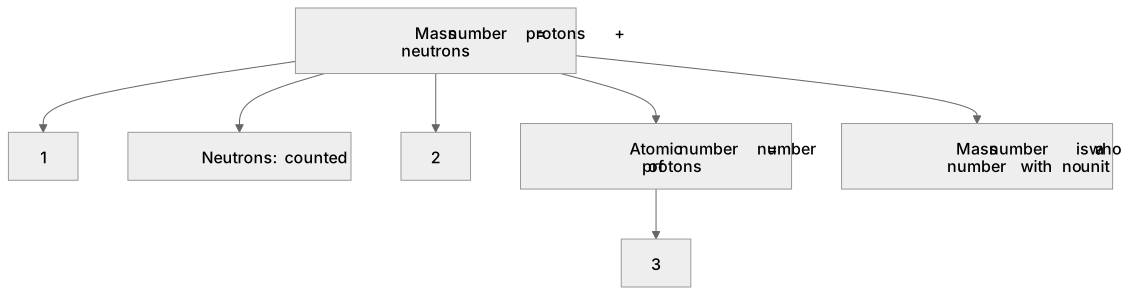
Label the diagram
Some boxes have lost their names. Pick the right name for each number.
1Box 1
2Box 2
3Box 3
There is more to this lesson
The full lesson goes on to check your understanding and help you earn the marks. Create a free account to carry on, with your progress saved.
A week of Premium from your first lesson · Then the free plan continues · No card, no charge
Test your understanding of Size and mass of atoms: The sum of the protons and neutrons in an atom is its mass number.
Active recall beats re-reading. Take an instant quiz now to test what you’ve learned and lock it into long-term memory.
A week of Premium from your first lesson · Then the free plan continues · No card, no charge