AQA · GCSE · Combined Science
Course version: 8464 · Version from Sept 2018
Soluble salts: Salt solutions can be crystallised to produce solid salts.
Crystallisation recovers a dissolved salt from its solution by removing the solvent.
- 3 key terms
Study notes
From the checked teaching notes for this specification point.
The idea
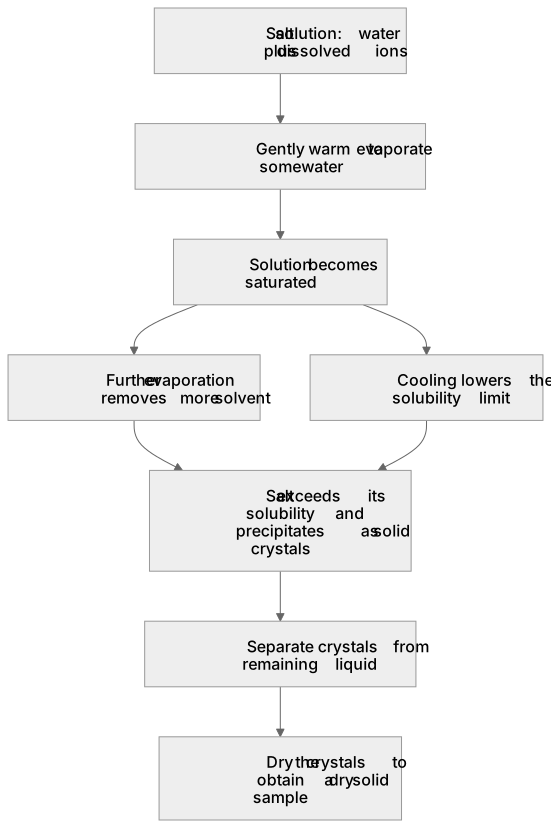
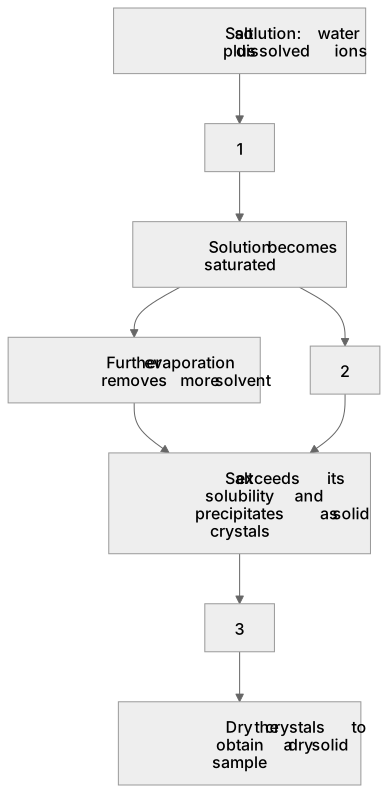
Crystallisation recovers a dissolved salt from its solution by removing the solvent. A salt solution contains water plus dissolved ions, for example sodium chloride solution contains Na⁺ and Cl⁻ ions. Gently warming the solution evaporates some water, increasing the concentration until the solution becomes saturated. Once saturated, further evaporation removes more solvent, or cooling lowers the solubility limit of the salt. Both processes cause the dissolved salt to exceed its solubility and precipitate out of solution as solid crystals. The crystals are separated from the remaining liquid, then dried. This links to soluble salt preparation: after reacting an acid with a base, the solution is filtered to remove excess solid, then crystallised to give a pure, dry solid salt.
What earns the marks
- Crystallisation separates a dissolved salt from its solution by removing water, usually through gentle heating and then cooling.
- Evaporating some water makes the solution saturated; further evaporation removes more solvent, causing crystals to form.
- Cooling a saturated solution lowers the solubility limit of the salt, causing the solid to precipitate out as crystals.
- The solid salt is separated from the remaining solution, for example by filtration or by decanting off the liquid.
- The crystals are dried, for example in a warm place or using filter paper, to obtain a dry solid sample.
Common mistakes and how to put them right
Heating the solution strongly until all the water boils away.
Put it right: Evaporate gently to the point of crystallisation and then let crystals form.
Thinking the solid salt is made by a chemical reaction during crystallisation.
Put it right: Crystallisation is a physical separation, not a new reaction; the salt was already present as dissolved ions.
Stating that the salt becomes insoluble during crystallisation.
Put it right: The salt remains soluble, but its solubility limit is exceeded as solvent is removed or the solution is cooled, causing it to precipitate.
Exam tips
- Name the equipment and the key step: evaporating basin, gentle heating, then cooling to form crystals.
- Explain why gentle heating is used rather than boiling to dryness, linking to safety and to avoiding decomposition.
- State clearly that the crystals are separated and dried, so the final product is described as pure and dry.
Try the lesson
The start of the Soluble salts: Salt solutions can be crystallised to produce solid salts. lesson, made from checked teaching notes for this specification point.
Have a go first
A student has a solution of copper sulfate in water and wants to obtain solid copper sulfate crystals from it. Which process should the student use?
Listen
Crystallisation recovers a dissolved salt from its solution by removing the solvent. A salt solution contains water plus dissolved ions, for example sodium chloride solution contains Na⁺ and Cl⁻ ions. Gently warming the solution evaporates some water, increasing the concentration until the solution becomes saturated. Once saturated, further evaporation removes more solvent, or cooling lowers the solubility limit of the salt. Both processes cause the dissolved salt to exceed its solubility and precipitate out of solution as solid crystals. The crystals are separated from the remaining liquid, then dried. This links to soluble salt preparation: after reacting an acid with a base, the solution is filtered to remove excess solid, then crystallised to give a pure, dry solid salt. A strong answer earns marks for these points. Crystallisation separates a dissolved salt from its solution by removing water, usually through gentle heating and then cooling. Evaporating some water makes the solution saturated; further evaporation removes more solvent, causing crystals to form. Cooling a saturated solution lowers the solubility limit of the salt, causing the solid to precipitate out as crystals. The solid salt is separated from the remaining solution, for example by filtration or by decanting off the liquid. A common slip: Heating the solution strongly until all the water boils away: this can spit and may decompose some salts. Instead, evaporate gently to the point of crystallisation and then let crystals form. Exam tip: Name the equipment and the key step: evaporating basin, gentle heating, then cooling to form crystals.
See it
Key words
Say what each word means before you turn the card.
Crystallisation
Try answering aloud or in your head before turning the card.
Solubility limit
Try answering aloud or in your head before turning the card.
Precipitate
Try answering aloud or in your head before turning the card.
See every definition
- Crystallisation
- Recovers a dissolved salt from its solution by removing the solvent, causing the dissolved salt to exceed its solubility and precipitate out as solid crystals.
- Solubility limit
- The point the dissolved salt exceeds as solvent is removed or the solution is cooled, causing it to precipitate out of solution.
- Precipitate
- What the dissolved salt does when it exceeds its solubility, coming out of solution as solid crystals.
Label the diagram
Some boxes have lost their names. Pick the right name for each number.
1Box 1
2Box 2
3Box 3
There is more to this lesson
The full lesson goes on to check your understanding and help you earn the marks. Create a free account to carry on, with your progress saved.
A week of Premium from your first lesson · Then the free plan continues · No card, no charge
Test your understanding of Soluble salts: Salt solutions can be crystallised to produce solid salts.
Active recall beats re-reading. Take an instant quiz now to test what you’ve learned and lock it into long-term memory.
A week of Premium from your first lesson · Then the free plan continues · No card, no charge