AQA · GCSE · Combined Science
Course version: 8464 · Version from Sept 2018
Soluble salts: Students should be able to describe how to make pure, dry samples of named soluble salts from information provided.
To make a pure, dry sample of a named soluble salt, choose the right acid and solid reactant so the required salt forms.
- 2 key terms
Study notes
From the checked teaching notes for this specification point.
The idea
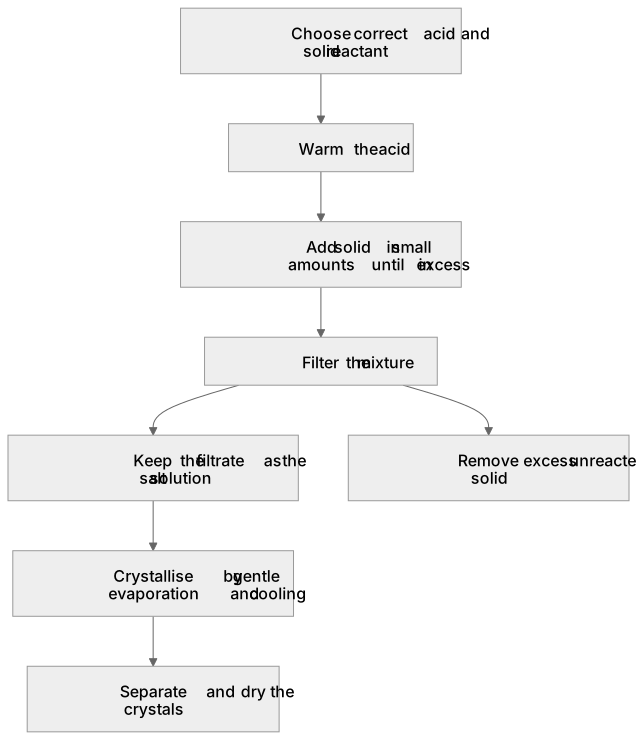
To make a pure, dry sample of a named soluble salt, choose the right acid and solid reactant so the required salt forms. For example, copper(II) sulfate can be made from copper(II) oxide and dilute sulfuric acid. Warm the acid, add the solid in small amounts until it is in excess, then filter to remove unreacted solid. The filtrate contains the salt solution. Crystallise it by gentle evaporation and cooling, then separate and dry the crystals. The excess solid ensures all the acid is used up, so the product is not contaminated by acid. Naming the salt correctly depends on the acid used: hydrochloric acid gives chlorides, sulfuric acid gives sulfates, and nitric acid gives nitrates.
What earns the marks
- Select the correct acid and solid reactant to produce the named salt, for example sulfuric acid and copper(II) oxide for copper(II) sulfate.
- Add the solid reactant in excess to the warm acid so that all the acid reacts and no acid remains in the product.
- Filter the mixture to remove the excess unreacted solid, keeping the filtrate as the salt solution.
- Crystallise the filtrate by gentle evaporation and cooling, then separate and dry the crystals to obtain a pure, dry sample.
- Name the salt from its ions, for example copper(II) sulfate contains Cu²⁺ and SO₄²⁻ ions.
Common mistakes and how to put them right
Adding too little solid reactant so acid remains.
Put it right: Add solid until no more dissolves, ensuring it is in excess.
Filtering before the reaction is complete or filtering the wrong part.
Put it right: The filtrate is the salt solution, while the residue is the excess solid.
Heating the filtrate strongly to dryness.
Put it right: Gentle evaporation followed by cooling, so pure crystals form rather than a decomposed or spattered product.
Exam tips
- Link the named salt to its acid: hydrochloric acid makes chlorides, sulfuric acid makes sulfates and nitric acid makes nitrates.
- Use the words excess, filter, filtrate, crystallise and dry in the correct order.
- Explain why excess solid is used: it ensures all the acid reacts, so the salt is not contaminated.
Try the lesson
The start of the Soluble salts: Students should be able to describe how to make pure, dry samples of named soluble salts from information provided. lesson, made from checked teaching notes for this specification point.
Have a go first
A student makes copper sulfate crystals by adding copper oxide to warm dilute sulfuric acid. Which step removes the unreacted copper oxide so that only copper sulfate solution remains?
Listen
To make a pure, dry sample of a named soluble salt, choose the right acid and solid reactant so the required salt forms. For example, copper(II) sulfate can be made from copper(II) oxide and dilute sulfuric acid. Warm the acid, add the solid in small amounts until it is in excess, then filter to remove unreacted solid. The filtrate contains the salt solution. Crystallise it by gentle evaporation and cooling, then separate and dry the crystals. The excess solid ensures all the acid is used up, so the product is not contaminated by acid. Naming the salt correctly depends on the acid used: hydrochloric acid gives chlorides, sulfuric acid gives sulfates, and nitric acid gives nitrates. A strong answer earns marks for these points. Select the correct acid and solid reactant to produce the named salt, for example sulfuric acid and copper(II) oxide for copper(II) sulfate. Add the solid reactant in excess to the warm acid so that all the acid reacts and no acid remains in the product. Filter the mixture to remove the excess unreacted solid, keeping the filtrate as the salt solution. Crystallise the filtrate by gentle evaporation and cooling, then separate and dry the crystals to obtain a pure, dry sample. A common slip: Adding too little solid reactant so acid remains. Instead, add solid until no more dissolves, ensuring it is in excess. Exam tip: Link the named salt to its acid: hydrochloric acid makes chlorides, sulfuric acid makes sulfates and nitric acid makes nitrates.
See it
Key words
Say what each word means before you turn the card.
filtrate
Try answering aloud or in your head before turning the card.
sulfates
Try answering aloud or in your head before turning the card.
See every definition
- filtrate
- The salt solution kept after the mixture is filtered to remove the excess unreacted solid.
- sulfates
- The salts formed from sulfuric acid, which gives its name to the salt produced with the solid reactant.
Label the diagram
Some boxes have lost their names. Pick the right name for each number.
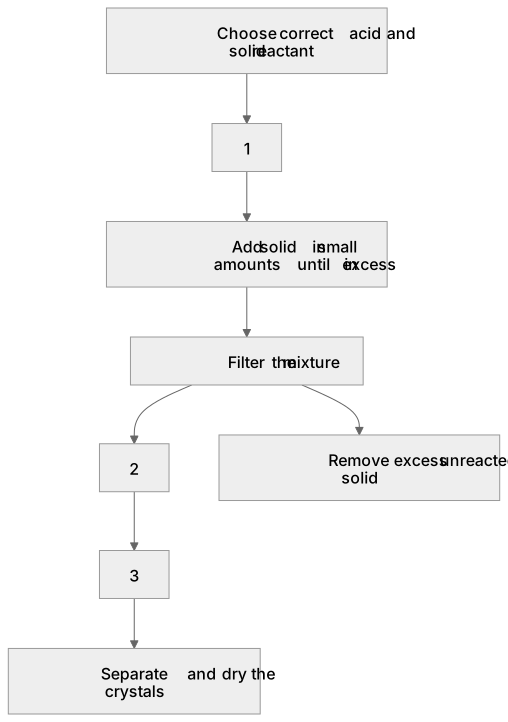
1Box 1
2Box 2
3Box 3
There is more to this lesson
The full lesson goes on to check your understanding and help you earn the marks. Create a free account to carry on, with your progress saved.
A week of Premium from your first lesson · Then the free plan continues · No card, no charge
Test your understanding of Soluble salts: Students should be able to describe how to make pure, dry samples of named soluble salts from information provided.
Active recall beats re-reading. Take an instant quiz now to test what you’ve learned and lock it into long-term memory.
A week of Premium from your first lesson · Then the free plan continues · No card, no charge