AQA · GCSE · Combined Science
Course version: 8464 · Version from Sept 2018
State symbols: In chemical equations, the three states of matter are shown as (s), (l) and (g), with (aq) for aqueous solutions.
State symbols are short labels written after a chemical formula to show the physical state of each substance.
Study notes
From the checked teaching notes for this specification point.
The idea
State symbols are short labels written after a chemical formula to show the physical state of each substance. A solid is (s), a liquid is (l) and a gas is (g). An aqueous solution, meaning a substance dissolved in water, is (aq). For example, sodium chloride solution is NaCl(aq), while solid sodium chloride is NaCl(s). Water is H₂O(l) when pure, but H₂O(g) when steam. The symbol (aq) is not a fourth state of matter; it describes a solid, liquid or gas that has dissolved in water. State symbols are placed immediately after the formula, before any plus sign or arrow. They help chemists see what is present at the start and end of a reaction, and they are needed for ionic equations and for identifying precipitates.
What earns the marks
- Correctly matches (s) to solid, (l) to liquid, (g) to gas and (aq) to an aqueous solution.
- Places each state symbol immediately after the chemical formula it describes, for example HCl(aq) not (aq)HCl.
- Distinguishes an aqueous solution from a pure liquid, for example NaCl(aq) compared with H₂O(l).
- Uses (aq) for a substance dissolved in water even if that substance is normally a gas or solid, for example CO₂(aq).
- Applies state symbols consistently to every formula on both sides of an equation, including ionic equations.
- Recognises that a precipitate is shown as (s) even though it forms in solution.
Common mistakes and how to put them right
Writing (aq) for water.
Put it right: Water is the solvent, so it is always written as H₂O(l) in aqueous reactions, never H₂O(aq).
Putting the state symbol before the formula, such as (s)NaCl.
Put it right: The symbol belongs after the formula, so write NaCl(s).
Using (aq) for a liquid metal such as mercury.
Put it right: Mercury is Hg(l), because (aq) means dissolved in water.
Exam tips
- Read the question wording for clues such as solution, solid, gas or molten, then choose the matching symbol.
- Check every formula in the equation has a state symbol if the question asks for them, including products.
- For ionic equations, label each ion and compound, remembering that a precipitate is (s) and dissolved ions are (aq).
Try the lesson
The start of the State symbols: In chemical equations, the three states of matter are shown as (s), (l) and (g), with (aq) for aqueous solutions. lesson, made from checked teaching notes for this specification point.
Have a go first
Which state symbol is written after the formula of a substance that is dissolved in water?
Listen
State symbols are short labels written after a chemical formula to show the physical state of each substance. A solid is (s), a liquid is (l) and a gas is (g). An aqueous solution, meaning a substance dissolved in water, is (aq). For example, sodium chloride solution is NaCl(aq), while solid sodium chloride is NaCl(s). Water is H₂O(l) when pure, but H₂O(g) when steam. The symbol (aq) is not a fourth state of matter; it describes a solid, liquid or gas that has dissolved in water. State symbols are placed immediately after the formula, before any plus sign or arrow. They help chemists see what is present at the start and end of a reaction, and they are needed for ionic equations and for identifying precipitates. A strong answer earns marks for these points. Correctly matches (s) to solid, (l) to liquid, (g) to gas and (aq) to an aqueous solution. Places each state symbol immediately after the chemical formula it describes, for example HCl(aq) not (aq)HCl. Distinguishes an aqueous solution from a pure liquid, for example NaCl(aq) compared with H₂O(l). Uses (aq) for a substance dissolved in water even if that substance is normally a gas or solid, for example CO₂(aq). Exam tip: Read the question wording for clues such as solution, solid, gas or molten, then choose the matching symbol.
See it
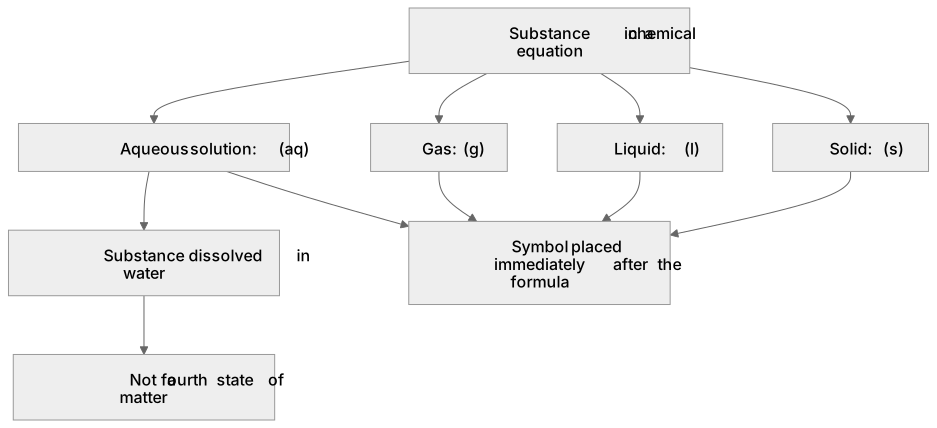
Label the diagram
Some boxes have lost their names. Pick the right name for each number.
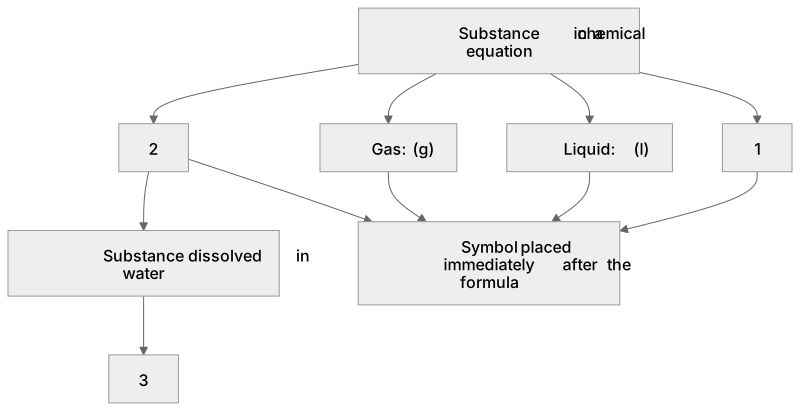
1Box 1
2Box 2
3Box 3
There is more to this lesson
The full lesson goes on to check your understanding and help you earn the marks. Create a free account to carry on, with your progress saved.
A week of Premium from your first lesson · Then the free plan continues · No card, no charge
Test your understanding of State symbols: In chemical equations, the three states of matter are shown as (s), (l) and (g), with (aq) for aqueous solutions.
Active recall beats re-reading. Take an instant quiz now to test what you’ve learned and lock it into long-term memory.
A week of Premium from your first lesson · Then the free plan continues · No card, no charge