AQA · GCSE · Combined Science
Course version: 8464 · Version from Sept 2018
Strong and weak acids (HT only): As the pH decreases by one unit, the hydrogen ion concentration of the solution increases by a factor of 10.
pH is a logarithmic scale, meaning each unit change represents a tenfold change in hydrogen ion concentration.
- 3 key terms
Study notes
From the checked teaching notes for this specification point.
The idea
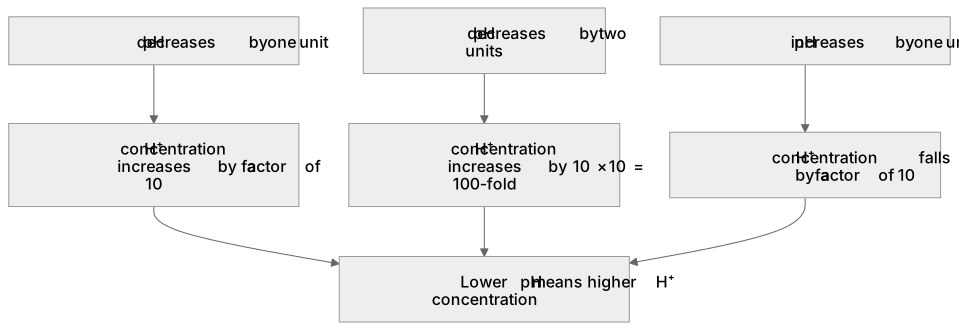
pH is a logarithmic scale, meaning each unit change represents a tenfold change in hydrogen ion concentration. If the pH decreases by one unit, the solution becomes more acidic and the concentration of H⁺ ions becomes 10 times greater. For example, a solution of pH 4 has 10 times the H⁺ concentration of a solution of pH 5, and 100 times that of a solution of pH 6. Conversely, if pH increases by one unit, H⁺ concentration falls by a factor of 10. This mathematical relationship is assessed at Higher Tier only. It allows you to compare solutions without calculating exact concentrations: a two-unit drop in pH means a 10² = 100-fold increase in H⁺ concentration.
What earns the marks
- State that the pH scale is logarithmic, based on hydrogen ion concentration.
- Explain that a decrease of one pH unit corresponds to a tenfold increase in H⁺ concentration.
- Apply the relationship to a numerical example, such as pH 3 having 10 times the H⁺ concentration of pH 4.
- Extend the reasoning to changes of more than one unit, for example a two-unit decrease giving a 10² = 100-fold increase.
- Recognise that an increase in pH by one unit means H⁺ concentration decreases by a factor of 10.
Common mistakes and how to put them right
Treating pH as a linear scale and stating H⁺ concentration increases by one unit.
Put it right: The change is multiplicative, increasing by a factor of 10 for each pH unit drop.
Reversing the direction and claiming H⁺ concentration falls as pH decreases.
Put it right: A lower pH value indicates a higher concentration of H⁺ ions.
For a two-unit pH drop, adding 10 + 10 to get a 20-fold increase.
Put it right: Multiply the factors, so 10 × 10 = 100-fold increase.
Exam tips
- Remember that calculating the exact factor change in hydrogen ion concentration is a Higher Tier only skill.
- Write the factor as a power of 10, such as 10² for a two-unit change, to show the multiplicative relationship clearly.
- Check the direction of the change carefully: decreasing pH means increasing H⁺ concentration.
Try the lesson
The start of the Strong and weak acids (HT only): As the pH decreases by one unit, the hydrogen ion concentration of the solution increases by a factor of 10. lesson, made from checked teaching notes for this specification point.
Have a go first
A solution has a pH of 6. Its pH is then lowered to 5. By what factor does the hydrogen ion concentration increase?
Listen
pH is a logarithmic scale, meaning each unit change represents a tenfold change in hydrogen ion concentration. If the pH decreases by one unit, the solution becomes more acidic and the concentration of H⁺ ions becomes 10 times greater. For example, a solution of pH 4 has 10 times the H⁺ concentration of a solution of pH 5, and 100 times that of a solution of pH 6. Conversely, if pH increases by one unit, H⁺ concentration falls by a factor of 10. This mathematical relationship is assessed at Higher Tier only. It allows you to compare solutions without calculating exact concentrations: a two-unit drop in pH means a 10² = 100-fold increase in H⁺ concentration. A strong answer earns marks for these points. State that the pH scale is logarithmic, based on hydrogen ion concentration. Explain that a decrease of one pH unit corresponds to a tenfold increase in H⁺ concentration. Apply the relationship to a numerical example, such as pH 3 having 10 times the H⁺ concentration of pH 4. Extend the reasoning to changes of more than one unit, for example a two-unit decrease giving a 10² = 100-fold increase. A common slip: Treating pH as a linear scale and stating H⁺ concentration increases by one unit. Instead, the change is multiplicative, increasing by a factor of 10 for each pH unit drop. Exam tip: Remember that calculating the exact factor change in hydrogen ion concentration is a Higher Tier only skill.
See it
Key words
Say what each word means before you turn the card.
The logarithmic nature of the pH scale
Try answering aloud or in your head before turning the card.
Hydrogen ion concentration and acidity
Try answering aloud or in your head before turning the card.
Multiplicative change across pH units
Try answering aloud or in your head before turning the card.
See every definition
- The logarithmic nature of the pH scale
- Each unit change on the scale represents a tenfold change in hydrogen ion concentration.
- Hydrogen ion concentration and acidity
- As the pH decreases by one unit, the hydrogen ion concentration of the solution increases by a factor of 10.
- Multiplicative change across pH units
- A two-unit drop in pH means a 10² = 100-fold increase in H⁺ concentration.
Label the diagram
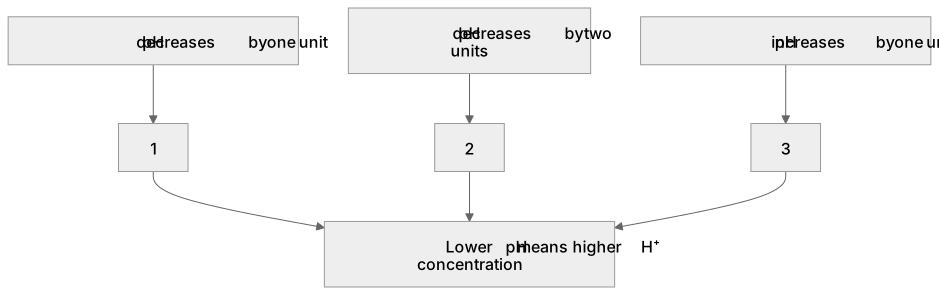
Some boxes have lost their names. Pick the right name for each number.
1Box 1
2Box 2
3Box 3
There is more to this lesson
The full lesson goes on to check your understanding and help you earn the marks. Create a free account to carry on, with your progress saved.
A week of Premium from your first lesson · Then the free plan continues · No card, no charge
Test your understanding of Strong and weak acids (HT only): As the pH decreases by one unit, the hydrogen ion concentration of the solution increases by a factor of 10.
Active recall beats re-reading. Take an instant quiz now to test what you’ve learned and lock it into long-term memory.
A week of Premium from your first lesson · Then the free plan continues · No card, no charge