AQA · GCSE · Combined Science
Course version: 8464 · Version from Sept 2018
The development of the model of the atom (common content with physics): New experimental evidence may lead to a scientific model being changed or replaced.
Scientific models are simplified pictures used to explain observations and predict behaviour.
- 4 key terms
Study notes
From the checked teaching notes for this specification point.
The idea
Scientific models are simplified pictures used to explain observations and predict behaviour. They are not fixed truths: when new experimental evidence conflicts with predictions, scientists must modify or replace the model. In atomic physics, the plum-pudding model pictured negative electrons embedded in a positive sphere. The alpha-scattering experiment showed most alpha particles passed straight through gold foil, but a few were deflected strongly. This evidence was incompatible with a spread-out positive charge, so the model changed to a small, dense, positive nucleus surrounded by mostly empty space. Later, Niels Bohr adapted the nuclear model by suggesting electrons orbit the nucleus at specific distances. The pattern is: collect evidence, test the model, revise or replace it.
What earns the marks
- State that a scientific model is a representation used to explain observations and make predictions, not a final proven truth.
- Explain that a model is changed or replaced when new experimental evidence cannot be explained by the existing model.
- Use the alpha-scattering experiment as a concrete case: most alpha particles passed through, but some were deflected, which required a small dense positive nucleus.
- Describe the sequence of atomic models: indivisible sphere, plum pudding, nuclear model, and Bohr's model with electrons in shells.
- Recognise that a model may be modified rather than completely discarded, and that the replacement must fit the available evidence better.
- Link the idea to the process of peer review and replication, which tests whether evidence is reliable before a model is widely accepted.
Common mistakes and how to put them right
Thinking a model is changed simply because a scientist has a new idea.
Put it right: Change requires new experimental evidence that the current model cannot explain.
Believing the old model was completely useless.
Put it right: Earlier models often explain some observations and are refined rather than wholly rejected.
Confusing a model with reality.
Put it right: A model is a human representation, so it can be limited and later replaced as evidence grows.
Exam tips
- Use the phrase 'new experimental evidence' explicitly when explaining why a model changes.
- Give one named experiment and say what it showed, rather than describing models in general terms only.
- Link each model change to the evidence that forced it, for example alpha scattering leading to the nuclear model.
Try the lesson
The start of the The development of the model of the atom (common content with physics): New experimental evidence may lead to a scientific model being changed or replaced. lesson, made from checked teaching notes for this specification point.
Have a go first
In the early 1800s, John Dalton described atoms as solid spheres that could not be divided. Later experiments provided new evidence about particles inside the atom. What happened to Dalton's model of the atom as a result of this new evidence?
Listen
Scientific models are simplified pictures used to explain observations and predict behaviour. They are not fixed truths: when new experimental evidence conflicts with predictions, scientists must modify or replace the model. In atomic physics, the plum-pudding model pictured negative electrons embedded in a positive sphere. The alpha-scattering experiment showed most alpha particles passed straight through gold foil, but a few were deflected strongly. This evidence was incompatible with a spread-out positive charge, so the model changed to a small, dense, positive nucleus surrounded by mostly empty space. Later, Niels Bohr adapted the nuclear model by suggesting electrons orbit the nucleus at specific distances. The pattern is: collect evidence, test the model, revise or replace it. A strong answer earns marks for these points. State that a scientific model is a representation used to explain observations and make predictions, not a final proven truth. Explain that a model is changed or replaced when new experimental evidence cannot be explained by the existing model. Use the alpha-scattering experiment as a concrete case: most alpha particles passed through, but some were deflected, which required a small dense positive nucleus. Describe the sequence of atomic models: indivisible sphere, plum pudding, nuclear model, and Bohr's model with electrons in shells. A common slip: Thinking a model is changed simply because a scientist has a new idea. Instead, change requires new experimental evidence that the current model cannot explain. Exam tip: Use the phrase 'new experimental evidence' explicitly when explaining why a model changes.
See it
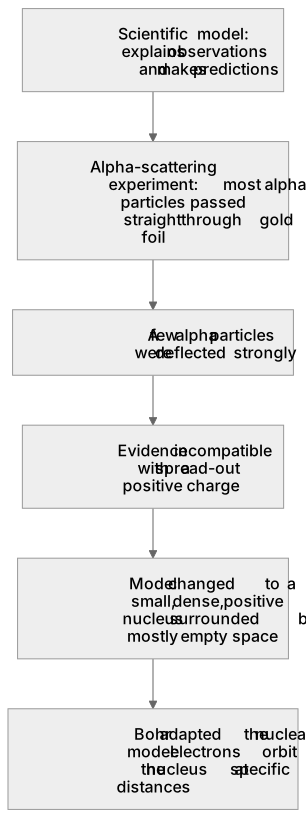
Put it in order
Put these steps in the order they happen.
- 1. Alpha-scattering experiment: most alpha particles passed straight through gold foil
- 2. A few alpha particles were deflected strongly
- 3. Evidence incompatible with a spread-out positive charge
- 4. Model changed to a small, dense, positive nucleus surrounded by mostly empty space
- 5. Bohr adapted the nuclear model: electrons orbit the nucleus at specific distances
- 6. Scientific model: explains observations and makes predictions
Key words
Say what each word means before you turn the card.
scientific model
Try answering aloud or in your head before turning the card.
alpha-scattering experiment
Try answering aloud or in your head before turning the card.
nuclear model
Try answering aloud or in your head before turning the card.
peer review
Try answering aloud or in your head before turning the card.
See every definition
- scientific model
- A simplified picture used to explain observations and predict behaviour, not a fixed truth.
- alpha-scattering experiment
- Showed most alpha particles passed straight through gold foil, but a few were deflected strongly.
- nuclear model
- A small, dense, positive nucleus surrounded by mostly empty space, replacing the plum-pudding model.
- peer review
- Tests whether evidence is reliable before a model is widely accepted, together with replication.
Label the diagram
Some boxes have lost their names. Pick the right name for each number.
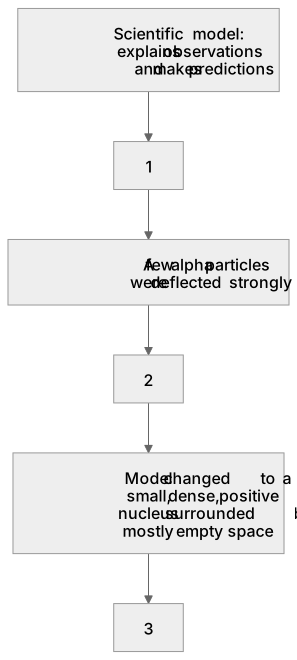
1Box 1
2Box 2
3Box 3
There is more to this lesson
The full lesson goes on to check your understanding and help you earn the marks. Create a free account to carry on, with your progress saved.
A week of Premium from your first lesson · Then the free plan continues · No card, no charge
Test your understanding of The development of the model of the atom (common content with physics): New experimental evidence may lead to a scientific model being changed or replaced.
Active recall beats re-reading. Take an instant quiz now to test what you’ve learned and lock it into long-term memory.
A week of Premium from your first lesson · Then the free plan continues · No card, no charge