AQA · GCSE · Combined Science
Course version: 8464 · Version from Sept 2018
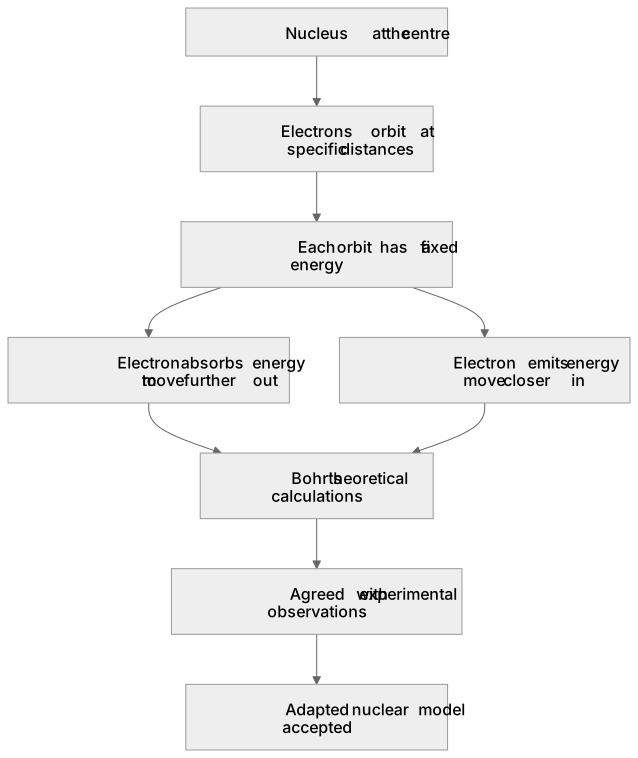
The development of the model of the atom (common content with physics): Niels Bohr adapted the nuclear model by suggesting that electrons orbit the nucleus at specific distances. The theoretical calculations of Bohr agreed with experimental observations.
Before Bohr, the nuclear model had a serious flaw: classical physics predicted that an orbiting electron should radiate energy continuously, spiral inwards and make atoms collapse, yet atoms are…
- 3 key terms
Study notes
From the checked teaching notes for this specification point.
The idea
Before Bohr, the nuclear model had a serious flaw: classical physics predicted that an orbiting electron should radiate energy continuously, spiral inwards and make atoms collapse, yet atoms are stable and emit sharp line spectra. Bohr adapted the model by proposing that electrons orbit the nucleus only at specific distances, called energy levels or shells, and that each allowed orbit corresponds to a particular energy. Electrons can move between levels by absorbing or emitting a fixed amount of energy, often as electromagnetic radiation of a definite frequency. Crucially, Bohr's theoretical calculations matched experimental observations, such as the lines seen in hydrogen's emission spectrum, so his adapted model was accepted and replaced earlier ideas.
What earns the marks
- Bohr adapted the existing nuclear model rather than replacing the nucleus; the nucleus stays at the centre and electrons occupy the space around it.
- Electrons are restricted to specific distances from the nucleus, described as fixed orbits, shells or energy levels, not any distance.
- Each allowed orbit has a fixed energy, so an electron can only have certain energy values.
- An electron changes orbit by absorbing energy to move further out or emitting energy, often as electromagnetic radiation, to move closer in.
- Bohr's theoretical calculations agreed with experimental observations, for example the sharp lines in the hydrogen emission spectrum, which supported the model.
Common mistakes and how to put them right
Saying electrons orbit at any distance.
Put it right by stressing that only specific, allowed orbits or energy levels exist.
Confusing Bohr's change with the discovery of the nucleus.
Put it right by stating that Rutherford's group established the nuclear model and Bohr adapted it by fixing electron orbits.
Claiming Bohr proved electrons are particles called protons.
Put it right by separating Bohr's electron-orbit idea from later work on subatomic particles.
Exam tips
- Link the word 'specific' to fixed energy levels, and use the phrase 'agreed with experimental observations' when explaining why the model was accepted.
- If asked to compare models, describe one clear difference, such as electrons in fixed orbits rather than anywhere, and one piece of supporting evidence.
- Use a labelled diagram of shells around a nucleus to make the idea of specific distances clear in a written answer.
Try the lesson
The start of the The development of the model of the atom (common content with physics): Niels Bohr adapted the nuclear model by suggesting that electrons orbit the nucleus at specific distances. The theoretical calculations of Bohr agreed with experimental observations. lesson, made from checked teaching notes for this specification point.
Have a go first
In Bohr's adaptation of the nuclear model, where are the electrons found?
Listen
Before Bohr, the nuclear model had a serious flaw: classical physics predicted that an orbiting electron should radiate energy continuously, spiral inwards and make atoms collapse, yet atoms are stable and emit sharp line spectra. Bohr adapted the model by proposing that electrons orbit the nucleus only at specific distances, called energy levels or shells, and that each allowed orbit corresponds to a particular energy. Electrons can move between levels by absorbing or emitting a fixed amount of energy, often as electromagnetic radiation of a definite frequency. Crucially, Bohr's theoretical calculations matched experimental observations, such as the lines seen in hydrogen's emission spectrum, so his adapted model was accepted and replaced earlier ideas. A strong answer earns marks for these points. Bohr adapted the existing nuclear model rather than replacing the nucleus; the nucleus stays at the centre and electrons occupy the space around it. Electrons are restricted to specific distances from the nucleus, described as fixed orbits, shells or energy levels, not any distance. Each allowed orbit has a fixed energy, so an electron can only have certain energy values. An electron changes orbit by absorbing energy to move further out or emitting energy, often as electromagnetic radiation, to move closer in. A common slip: Saying electrons orbit at any distance. Instead, stressing that only specific, allowed orbits or energy levels exist. Exam tip: Link the word 'specific' to fixed energy levels, and use the phrase 'agreed with experimental observations' when explaining why the model was accepted.
See it
Key words
Say what each word means before you turn the card.
Energy levels
Try answering aloud or in your head before turning the card.
Evidence supporting a theoretical model
Try answering aloud or in your head before turning the card.
Development of scientific models over time
Try answering aloud or in your head before turning the card.
See every definition
- Energy levels
- Electrons orbit the nucleus only at specific distances, and each allowed orbit corresponds to a particular energy.
- Evidence supporting a theoretical model
- Bohr's theoretical calculations agreed with experimental observations, so his adapted model was accepted and replaced earlier ideas.
- Development of scientific models over time
- Bohr adapted the existing nuclear model rather than replacing the nucleus, which stays at the centre with electrons occupying the space around it.
Label the diagram
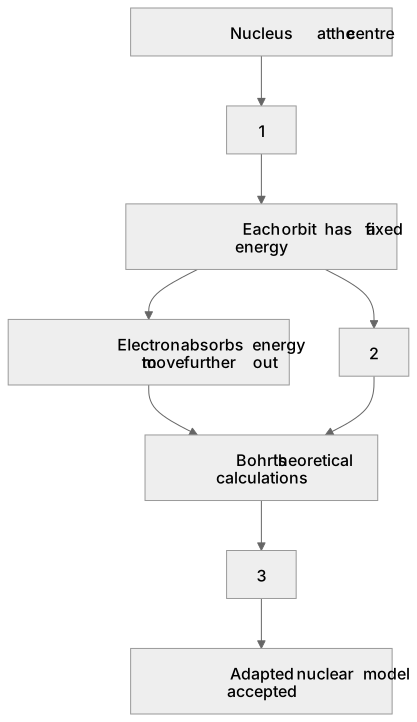
Some boxes have lost their names. Pick the right name for each number.
1Box 1
2Box 2
3Box 3
There is more to this lesson
The full lesson goes on to check your understanding and help you earn the marks. Create a free account to carry on, with your progress saved.
A week of Premium from your first lesson · Then the free plan continues · No card, no charge
Test your understanding of The development of the model of the atom (common content with physics): Niels Bohr adapted the nuclear model by suggesting that electrons orbit the nucleus at specific distances. The theoretical calculations of Bohr agreed with experimental observations.
Active recall beats re-reading. Take an instant quiz now to test what you’ve learned and lock it into long-term memory.
A week of Premium from your first lesson · Then the free plan continues · No card, no charge