AQA · GCSE · Combined Science
Course version: 8464 · Version from Sept 2018
The development of the model of the atom (common content with physics): Students should be able to describe:
This statement introduces the descriptive skills students need when studying how the atomic model changed over time.
- 4 key terms
Study notes
From the checked teaching notes for this specification point.
The idea
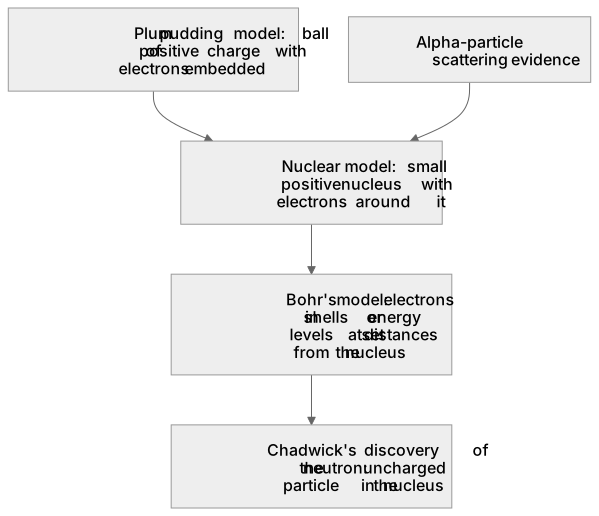
This statement introduces the descriptive skills students need when studying how the atomic model changed over time. You should be able to describe the sequence of models: the plum pudding model, the nuclear model, Bohr's adaptation with shells or energy levels, and Chadwick's discovery of the neutron. For the nuclear model, describe what the model looked like and how the alpha-particle scattering experiment caused the change. A good description outlines the model and links it to evidence where required, for example alpha-particle scattering showing a small positive nucleus. Note that details of the experimental work supporting Bohr and Chadwick are not required. Descriptions should be clear, ordered and use correct terms such as nucleus, electron, neutron and energy level.
What earns the marks
- Describe the plum pudding model as a ball of positive charge with electrons embedded in it.
- Describe the nuclear model as a small positive nucleus with electrons around it, supported by alpha-particle scattering.
- Describe Bohr's model as electrons in shells or energy levels at set distances from the nucleus, noting that details of supporting experiments are not required.
- Describe Chadwick's discovery of the neutron as an uncharged particle in the nucleus, noting that details of supporting experiments are not required.
- Sequence the models correctly and link the change from the plum pudding to the nuclear model to the alpha-particle scattering evidence.
Common mistakes and how to put them right
Mixing up the order of the models.
Put it right: Learn the sequence of the plum pudding model, the nuclear model, Bohr's model, and Chadwick's discovery.
Describing the nuclear model as having electrons embedded in a positive sphere.
Put it right: That is the plum pudding model.
Trying to describe the experimental evidence for Bohr and Chadwick.
Put it right: Only the alpha-particle scattering experiment for the nuclear model is required, details of experiments for Bohr and Chadwick are not needed.
Exam tips
- Use a timeline or flow diagram in your notes to fix the order of the models.
- State the key feature of each model clearly, using correct terms like nucleus and energy level.
- Practise linking the nuclear model to the alpha-particle scattering evidence, but remember you do not need to describe the experiments for Bohr or Chadwick.
Try the lesson
The start of the The development of the model of the atom (common content with physics): Students should be able to describe: lesson, made from checked teaching notes for this specification point.
Have a go first
In the plum pudding model of the atom, how were the electrons described as being arranged?
Listen
This statement introduces the descriptive skills students need when studying how the atomic model changed over time. You should be able to describe the sequence of models: the plum pudding model, the nuclear model, Bohr's adaptation with shells or energy levels, and Chadwick's discovery of the neutron. For the nuclear model, describe what the model looked like and how the alpha-particle scattering experiment caused the change. A good description outlines the model and links it to evidence where required, for example alpha-particle scattering showing a small positive nucleus. Note that details of the experimental work supporting Bohr and Chadwick are not required. Descriptions should be clear, ordered and use correct terms such as nucleus, electron, neutron and energy level. A strong answer earns marks for these points. Describe the plum pudding model as a ball of positive charge with electrons embedded in it. Describe the nuclear model as a small positive nucleus with electrons around it, supported by alpha-particle scattering. Describe Bohr's model as electrons in shells or energy levels at set distances from the nucleus, noting that details of supporting experiments are not required. Describe Chadwick's discovery of the neutron as an uncharged particle in the nucleus, noting that details of supporting experiments are not required. A common slip: Mixing up the order of the models. Instead, learn the sequence of the plum pudding model, the nuclear model, Bohr's model, and Chadwick's discovery. Exam tip: Use a timeline or flow diagram in your notes to fix the order of the models.
See it
Key words
Say what each word means before you turn the card.
plum pudding model
Try answering aloud or in your head before turning the card.
nuclear model
Try answering aloud or in your head before turning the card.
Bohr's model
Try answering aloud or in your head before turning the card.
neutron
Try answering aloud or in your head before turning the card.
See every definition
- plum pudding model
- A ball of positive charge with electrons embedded in it.
- nuclear model
- A small positive nucleus with electrons around it, supported by alpha-particle scattering.
- Bohr's model
- Electrons in shells or energy levels at set distances from the nucleus.
- neutron
- An uncharged particle in the nucleus, discovered by Chadwick.
Label the diagram
Some boxes have lost their names. Pick the right name for each number.
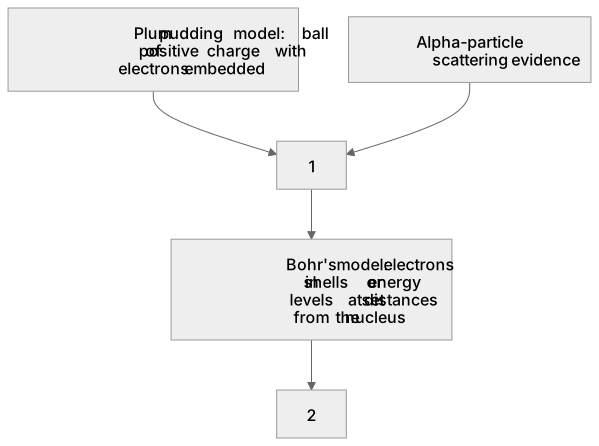
1Box 1
2Box 2
There is more to this lesson
The full lesson goes on to check your understanding and help you earn the marks. Create a free account to carry on, with your progress saved.
A week of Premium from your first lesson · Then the free plan continues · No card, no charge
Test your understanding of The development of the model of the atom (common content with physics): Students should be able to describe:
Active recall beats re-reading. Take an instant quiz now to test what you’ve learned and lock it into long-term memory.
A week of Premium from your first lesson · Then the free plan continues · No card, no charge