AQA · GCSE · Combined Science
Course version: 8464 · Version from Sept 2018
The development of the model of the atom (common content with physics): why the new evidence from the scattering experiment led to a change in the atomic model
Rutherford's team fired alpha particles at thin gold foil, expecting them all to pass straight through the plum pudding model.
- 4 key terms
Study notes
From the checked teaching notes for this specification point.
The idea
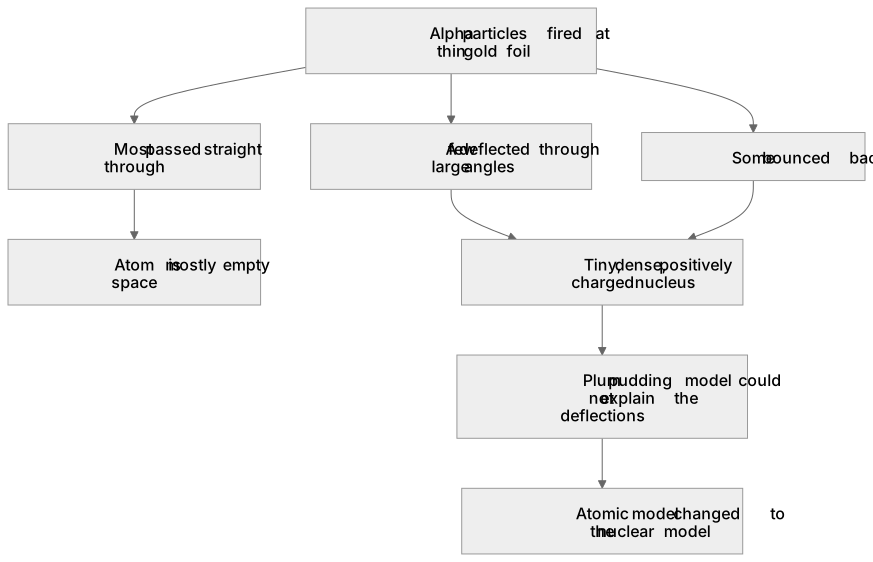
Rutherford's team fired alpha particles at thin gold foil, expecting them all to pass straight through the plum pudding model. Most did, but a few were deflected through large angles and some bounced back. A tiny, dense, positively charged nucleus explains this: it repels the positive alpha particles strongly at close range. Because the old model could not account for these deflections, the evidence forced scientists to replace it with the nuclear model. This shows science is self-correcting: a model survives only while evidence fits, and new data can overturn an accepted idea.
What earns the marks
- State that alpha particles were fired at thin gold foil and most passed straight through, showing the atom is mostly empty space.
- Explain that a small number were deflected through large angles or repelled back, which the plum pudding model could not explain.
- Link the deflections to a tiny, dense, positively charged centre (the nucleus) that repels positive alpha particles.
- Conclude that the new evidence contradicted the old model, so the atomic model was changed to the nuclear model.
- Recognise that scientific models are provisional and are revised when new evidence conflicts with predictions.
Common mistakes and how to put them right
Saying alpha particles are negative.
Put it right by stating they are positive helium nuclei, so the nucleus must be positive to repel them.
Claiming all particles bounced back.
Put it right by noting most passed straight through and only a few were deflected greatly.
Treating the model change as instant or the work of one person.
Put it right by describing it as a gradual revision driven by evidence.
Exam tips
- Use the phrase 'most passed straight through, but a few were deflected' to cover both observations.
- Always link each observation to what it tells you about atomic structure, not just what was seen.
- When asked why the model changed, refer to evidence that did not fit the old model's predictions.
Try the lesson
The start of the The development of the model of the atom (common content with physics): why the new evidence from the scattering experiment led to a change in the atomic model lesson, made from checked teaching notes for this specification point.
Have a go first
In the alpha particle scattering experiment, a small number of alpha particles were deflected back towards the source. What did this observation show about the atom?
Listen
Rutherford's team fired alpha particles at thin gold foil, expecting them all to pass straight through the plum pudding model. Most did, but a few were deflected through large angles and some bounced back. A tiny, dense, positively charged nucleus explains this: it repels the positive alpha particles strongly at close range. Because the old model could not account for these deflections, the evidence forced scientists to replace it with the nuclear model. This shows science is self-correcting: a model survives only while evidence fits, and new data can overturn an accepted idea. A strong answer earns marks for these points. State that alpha particles were fired at thin gold foil and most passed straight through, showing the atom is mostly empty space. Explain that a small number were deflected through large angles or repelled back, which the plum pudding model could not explain. Link the deflections to a tiny, dense, positively charged centre (the nucleus) that repels positive alpha particles. Conclude that the new evidence contradicted the old model, so the atomic model was changed to the nuclear model. A common slip: Saying alpha particles are negative. Instead, stating they are positive helium nuclei, so the nucleus must be positive to repel them. Exam tip: Use the phrase 'most passed straight through, but a few were deflected' to cover both observations.
See it
Key words
Say what each word means before you turn the card.
Evidence and model revision
Try answering aloud or in your head before turning the card.
Atomic structure
Try answering aloud or in your head before turning the card.
Scientific method
Try answering aloud or in your head before turning the card.
Charge and repulsion
Try answering aloud or in your head before turning the card.
See every definition
- Evidence and model revision
- New evidence that conflicts with predictions can overturn an accepted idea, so a model survives only while evidence fits and is revised when new data conflicts with it.
- Atomic structure
- The atom is mostly empty space with a tiny, dense, positively charged centre called the nucleus, which repels positive alpha particles.
- Scientific method
- Science is self-correcting: a model survives only while evidence fits, and new data can overturn an accepted idea.
- Charge and repulsion
- A tiny, dense, positively charged nucleus repels the positive alpha particles strongly at close range, which explains the deflections.
Label the diagram
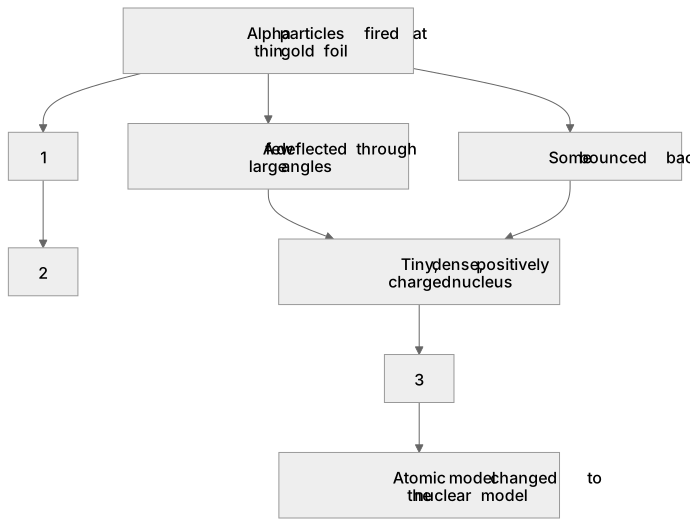
Some boxes have lost their names. Pick the right name for each number.
1Box 1
2Box 2
3Box 3
There is more to this lesson
The full lesson goes on to check your understanding and help you earn the marks. Create a free account to carry on, with your progress saved.
A week of Premium from your first lesson · Then the free plan continues · No card, no charge
Test your understanding of The development of the model of the atom (common content with physics): why the new evidence from the scattering experiment led to a change in the atomic model
Active recall beats re-reading. Take an instant quiz now to test what you’ve learned and lock it into long-term memory.
A week of Premium from your first lesson · Then the free plan continues · No card, no charge