AQA · GCSE · Combined Science
Course version: 8464 · Version from Sept 2018
The effect of changing concentration (HT only): If the concentration of one of the reactants or products is changed, the system is no longer at equilibrium and the concentrations of all the substances will change until equilibrium is reached again.
A reversible reaction in a closed system reaches dynamic equilibrium when forward and reverse rates are equal, keeping all concentrations constant.
Study notes
From the checked teaching notes for this specification point.
The idea
A reversible reaction in a closed system reaches dynamic equilibrium when forward and reverse rates are equal, keeping all concentrations constant. Changing the concentration of one reactant or product makes the rates unequal, temporarily disrupting equilibrium. The system then shifts to oppose the change until a new equilibrium is established. For example, in H₂(g) + I₂(g) ⇌ 2HI(g), adding H₂ increases the forward rate. More HI forms, and H₂ and I₂ concentrations fall until rates match again. Every substance's concentration changes during this adjustment. Note that predicting these effects is a Higher Tier only skill.
What earns the marks
- States that at equilibrium the forward and reverse reaction rates are equal and the concentrations of all substances remain constant.
- Explains that changing the concentration of one reactant or product makes the forward and reverse rates unequal, so the system is no longer at equilibrium.
- Describes the shift in the direction that reduces the effect of the change until a new equilibrium is reached.
- Recognises that the concentrations of all substances, not just the one changed, alter during the shift to the new equilibrium.
- Applies the idea to a named reversible reaction, such as H₂(g) + I₂(g) ⇌ 2HI(g) or N₂(g) + 3H₂(g) ⇌ 2NH₃(g).
- Uses the terms 'dynamic equilibrium' and 'closed system' correctly when explaining the behaviour.
Common mistakes and how to put them right
Thinking that only the concentration of the substance you changed alters.
Put it right: The shift changes the concentrations of all reactants and products until the new equilibrium is reached.
Believing that equilibrium means the reaction has stopped.
Put it right: Equilibrium is dynamic; both forward and reverse reactions continue at equal rates.
Assuming the system returns to the original concentrations.
Put it right: A new equilibrium position is established with different concentrations from before the change.
Exam tips
- When asked to explain the effect of a concentration change, always compare the forward and reverse rates before and after the change.
- Use the phrase 'the equilibrium shifts to oppose the change' and then state the direction (forward or reverse) for the specific reaction given.
- Remember that predicting the effects of concentration changes on equilibrium is assessed at Higher Tier only.
Try the lesson
The start of the The effect of changing concentration (HT only): If the concentration of one of the reactants or products is changed, the system is no longer at equilibrium and the concentrations of all the substances will change until equilibrium is reached again. lesson, made from checked teaching notes for this specification point.
Have a go first
A reversible reaction is at equilibrium. More of one of the reactants is then added to the mixture. What happens to the system?
Listen
A reversible reaction in a closed system reaches dynamic equilibrium when forward and reverse rates are equal, keeping all concentrations constant. Changing the concentration of one reactant or product makes the rates unequal, temporarily disrupting equilibrium. The system then shifts to oppose the change until a new equilibrium is established. For example, in H₂(g) + I₂(g) ⇌ 2HI(g), adding H₂ increases the forward rate. More HI forms, and H₂ and I₂ concentrations fall until rates match again. Every substance's concentration changes during this adjustment. Note that predicting these effects is a Higher Tier only skill. A strong answer earns marks for these points. States that at equilibrium the forward and reverse reaction rates are equal and the concentrations of all substances remain constant. Explains that changing the concentration of one reactant or product makes the forward and reverse rates unequal, so the system is no longer at equilibrium. Describes the shift in the direction that reduces the effect of the change until a new equilibrium is reached. Recognises that the concentrations of all substances, not just the one changed, alter during the shift to the new equilibrium. A common slip: Thinking that only the concentration of the substance you changed alters. Instead, the shift changes the concentrations of all reactants and products until the new equilibrium is reached. Exam tip: When asked to explain the effect of a concentration change, always compare the forward and reverse rates before and after the change.
See it
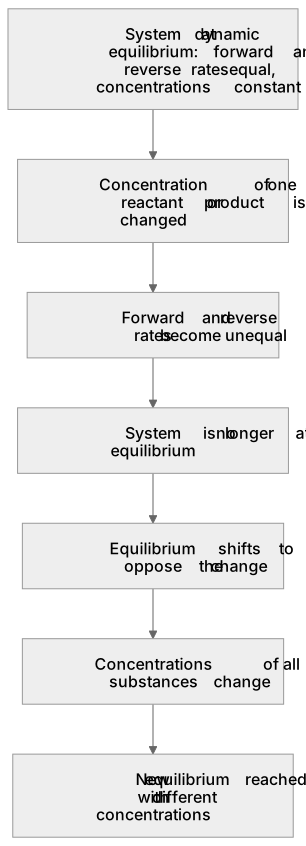
Put it in order
Put these steps in the order they happen.
- 1. Concentration of one reactant or product is changed
- 2. Forward and reverse rates become unequal
- 3. System is no longer at equilibrium
- 4. Equilibrium shifts to oppose the change
- 5. Concentrations of all substances change
- 6. New equilibrium reached with different concentrations
- 7. System at dynamic equilibrium: forward and reverse rates equal, concentrations constant
Label the diagram
Some boxes have lost their names. Pick the right name for each number.
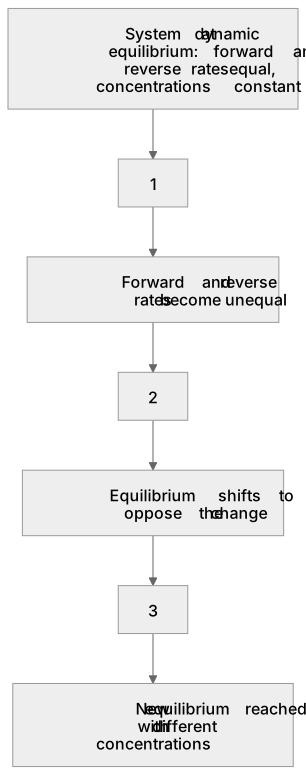
1Box 1
2Box 2
3Box 3
There is more to this lesson
The full lesson goes on to check your understanding and help you earn the marks. Create a free account to carry on, with your progress saved.
A week of Premium from your first lesson · Then the free plan continues · No card, no charge
Test your understanding of The effect of changing concentration (HT only): If the concentration of one of the reactants or products is changed, the system is no longer at equilibrium and the concentrations of all the substances will change until equilibrium is reached again.
Active recall beats re-reading. Take an instant quiz now to test what you’ve learned and lock it into long-term memory.
A week of Premium from your first lesson · Then the free plan continues · No card, no charge