AQA · GCSE · Combined Science
Course version: 8464 · Version from Sept 2018
The effect of temperature changes on equilibrium (HT only): the relative amount of products at equilibrium increases for an endothermic reaction
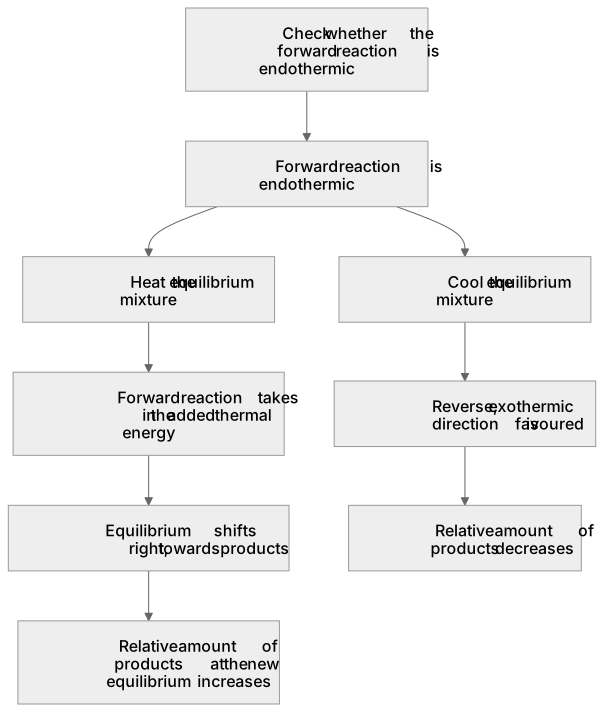
When the forward reaction is endothermic, heating the equilibrium mixture favours that forward direction because it takes in the added thermal energy.
- 3 key terms
Study notes
From the checked teaching notes for this specification point.
The idea
When the forward reaction is endothermic, heating the equilibrium mixture favours that forward direction because it takes in the added thermal energy. More reactant is converted into product, so the relative amount of products at the new equilibrium increases and the yield rises. For example, in CaCO₃(s) ⇌ CaO(s) + CO₂(g), the forward reaction is endothermic, so raising the temperature increases the amount of CaO and CO₂ formed. The reverse applies on cooling: the exothermic direction is favoured and product amount falls. This statement is the specific case of the previous rule, so always check whether the forward reaction is endothermic before predicting an increase in products.
What earns the marks
- For an endothermic forward reaction, increasing temperature shifts equilibrium to the right, towards products.
- The shift occurs because the forward reaction takes in the added thermal energy, opposing the temperature rise.
- The relative amount of products at the new equilibrium is greater than before the temperature increase.
- Cooling the same system favours the reverse, exothermic reaction and decreases the relative amount of products.
- The prediction depends on whether the forward reaction is endothermic or exothermic, so the equation or energy data must be checked first.
Common mistakes and how to put them right
Assuming all forward reactions are endothermic.
Put it right by checking the energy change given for the specific reaction.
Saying the equilibrium shifts left when heated for an endothermic forward reaction.
Put it right by stating it shifts right, increasing products.
Writing that heating increases the rate of the forward reaction only.
Put it right by explaining that both rates change and a new equilibrium position is established.
Exam tips
- Quote the endothermic direction explicitly, then state that the relative amount of products increases.
- Use the equation to name the products whose amount increases, showing the link between theory and the specific reaction.
- If the question gives an energy profile or states the energy change, use it to justify why the forward direction is favoured on heating.
Try the lesson
The start of the The effect of temperature changes on equilibrium (HT only): the relative amount of products at equilibrium increases for an endothermic reaction lesson, made from checked teaching notes for this specification point.
Have a go first
A reversible reaction reaches equilibrium. The forward reaction is endothermic. What happens to the relative amount of products at equilibrium if the temperature is increased?
Listen
When the forward reaction is endothermic, heating the equilibrium mixture favours that forward direction because it takes in the added thermal energy. More reactant is converted into product, so the relative amount of products at the new equilibrium increases and the yield rises. For example, in CaCO₃(s) ⇌ CaO(s) + CO₂(g), the forward reaction is endothermic, so raising the temperature increases the amount of CaO and CO₂ formed. The reverse applies on cooling: the exothermic direction is favoured and product amount falls. This statement is the specific case of the previous rule, so always check whether the forward reaction is endothermic before predicting an increase in products. A strong answer earns marks for these points. For an endothermic forward reaction, increasing temperature shifts equilibrium to the right, towards products. The shift occurs because the forward reaction takes in the added thermal energy, opposing the temperature rise. The relative amount of products at the new equilibrium is greater than before the temperature increase. Cooling the same system favours the reverse, exothermic reaction and decreases the relative amount of products. A common slip: Assuming all forward reactions are endothermic. Instead, checking the energy change given for the specific reaction. Exam tip: Quote the endothermic direction explicitly, then state that the relative amount of products increases.
See it
Key words
Say what each word means before you turn the card.
Endothermic forward reaction
Try answering aloud or in your head before turning the card.
Relative amount of products
Try answering aloud or in your head before turning the card.
Yield
Try answering aloud or in your head before turning the card.
See every definition
- Endothermic forward reaction
- A forward reaction that takes in the added thermal energy, so heating the equilibrium mixture favours that forward direction.
- Relative amount of products
- The proportion of products at the new equilibrium, which increases when an endothermic forward reaction is heated and falls on cooling.
- Yield
- The amount of product obtained, which rises when heating favours an endothermic forward reaction.
Label the diagram
Some boxes have lost their names. Pick the right name for each number.
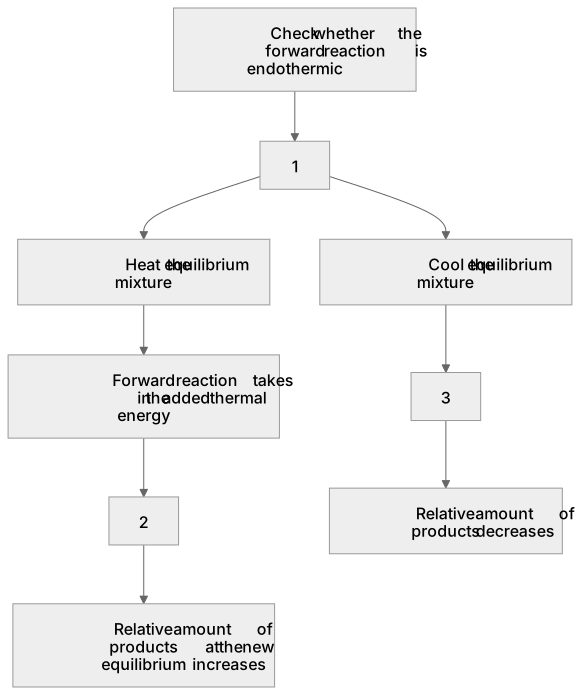
1Box 1
2Box 2
3Box 3
There is more to this lesson
The full lesson goes on to check your understanding and help you earn the marks. Create a free account to carry on, with your progress saved.
A week of Premium from your first lesson · Then the free plan continues · No card, no charge
Test your understanding of The effect of temperature changes on equilibrium (HT only): the relative amount of products at equilibrium increases for an endothermic reaction
Active recall beats re-reading. Take an instant quiz now to test what you’ve learned and lock it into long-term memory.
A week of Premium from your first lesson · Then the free plan continues · No card, no charge