AQA · GCSE · Combined Science
Course version: 8464 · Version from Sept 2018
The effect of temperature changes on equilibrium (HT only): the relative amount of products at equilibrium increases for an exothermic reaction.
When a reversible reaction reaches dynamic equilibrium, the amounts of reactants and products stay constant.
Study notes
From the checked teaching notes for this specification point.
The idea
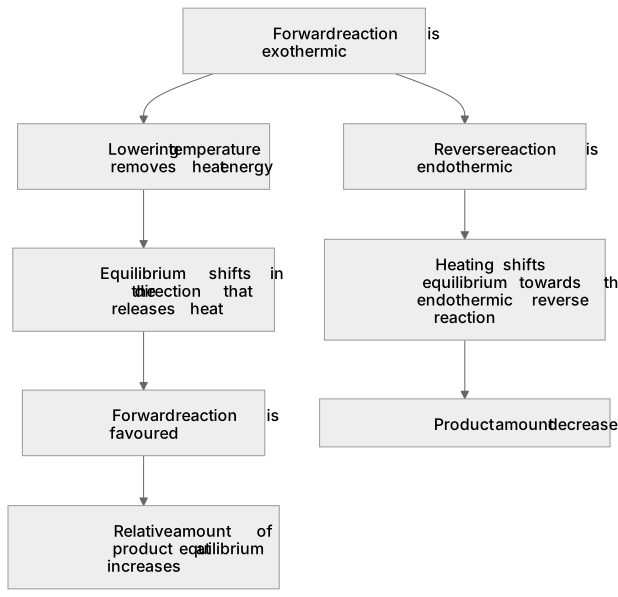
When a reversible reaction reaches dynamic equilibrium, the amounts of reactants and products stay constant. As Higher Tier only content, you must understand how altering temperature changes the equilibrium position. If the forward reaction releases heat, it is exothermic. Raising the temperature adds heat, so the system shifts in the endothermic direction to absorb heat, decreasing the product amount. Lowering the temperature removes heat, so equilibrium shifts in the exothermic forward direction to release heat and oppose the cooling. This increases the relative amount of product.
For example: In N₂(g) + 3H₂(g) ⇌ 2NH₃(g), cooling increases the ammonia yield.
What earns the marks
- State that the forward reaction is exothermic, meaning it releases heat to the surroundings.
- Explain that lowering the temperature removes heat energy from the equilibrium system.
- Apply Le Chatelier's principle: the equilibrium shifts in the direction that releases heat, which is the forward reaction.
- Conclude that the forward reaction is favoured, so the relative amount of product at equilibrium increases.
- Recognise that the reverse reaction must be endothermic because the forward reaction is exothermic.
- Describe the effect of heating as the opposite change, shifting equilibrium towards the endothermic reverse reaction and decreasing the product amount.
Common mistakes and how to put them right
Assuming that cooling always slows the reaction and therefore lowers the product amount.
Put it right by separating rate from equilibrium position, because cooling shifts the position towards the exothermic direction.
Stating that heating an exothermic reaction increases the product amount.
Put it right by explaining that heating favours the endothermic reverse reaction, so product decreases.
Mixing up the labels exothermic and endothermic for the forward and reverse reactions.
Put it right by noting that if the forward reaction is exothermic, the reverse reaction is endothermic.
Exam tips
- Check whether the forward reaction is exothermic or endothermic before deciding the direction of the shift.
- Link the shift to the temperature change by saying the system opposes the change, for example cooling shifts equilibrium to the right for an exothermic forward reaction.
- Remember this is Higher Tier content; you may need to apply Le Chatelier's principle to unfamiliar reactions.
Try the lesson
The start of the The effect of temperature changes on equilibrium (HT only): the relative amount of products at equilibrium increases for an exothermic reaction. lesson, made from checked teaching notes for this specification point.
Have a go first
A reversible reaction reaches equilibrium. The forward reaction is exothermic. What happens to the relative amount of products at equilibrium if the temperature is decreased?
Listen
When a reversible reaction reaches dynamic equilibrium, the amounts of reactants and products stay constant. As Higher Tier only content, you must understand how altering temperature changes the equilibrium position. If the forward reaction releases heat, it is exothermic. Raising the temperature adds heat, so the system shifts in the endothermic direction to absorb heat, decreasing the product amount. Lowering the temperature removes heat, so equilibrium shifts in the exothermic forward direction to release heat and oppose the cooling. This increases the relative amount of product. For example, in N₂(g) + 3H₂(g) ⇌ 2NH₃(g), cooling increases the ammonia yield. A strong answer earns marks for these points. State that the forward reaction is exothermic, meaning it releases heat to the surroundings. Explain that lowering the temperature removes heat energy from the equilibrium system. Apply Le Chatelier's principle: the equilibrium shifts in the direction that releases heat, which is the forward reaction. Conclude that the forward reaction is favoured, so the relative amount of product at equilibrium increases. A common slip: Assuming that cooling always slows the reaction and therefore lowers the product amount. Instead, separating rate from equilibrium position, because cooling shifts the position towards the exothermic direction. Exam tip: Check whether the forward reaction is exothermic or endothermic before deciding the direction of the shift.
See it
Label the diagram
Some boxes have lost their names. Pick the right name for each number.
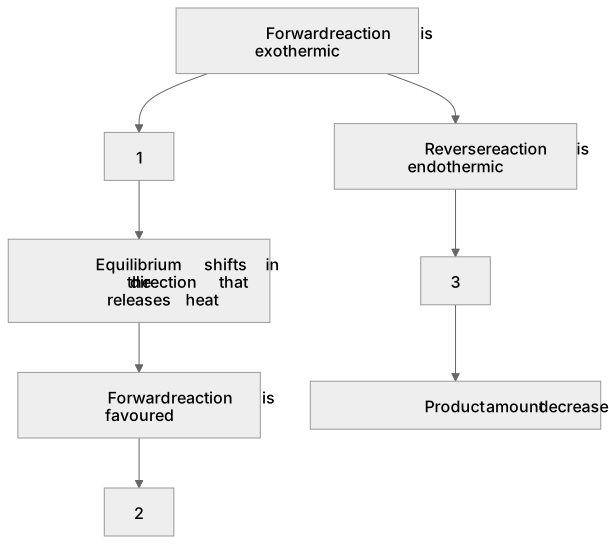
1Box 1
2Box 2
3Box 3
There is more to this lesson
The full lesson goes on to check your understanding and help you earn the marks. Create a free account to carry on, with your progress saved.
A week of Premium from your first lesson · Then the free plan continues · No card, no charge
Test your understanding of The effect of temperature changes on equilibrium (HT only): the relative amount of products at equilibrium increases for an exothermic reaction.
Active recall beats re-reading. Take an instant quiz now to test what you’ve learned and lock it into long-term memory.
A week of Premium from your first lesson · Then the free plan continues · No card, no charge