AQA · GCSE · Combined Science
Course version: 8464 · Version from Sept 2018
The energy change of reactions (HT only): energy must be supplied to break bonds in the reactants
Chemical bonds hold atoms together, so pulling them apart requires work against the attractive forces.
- 3 key terms
Study notes
From the checked teaching notes for this specification point.
The idea
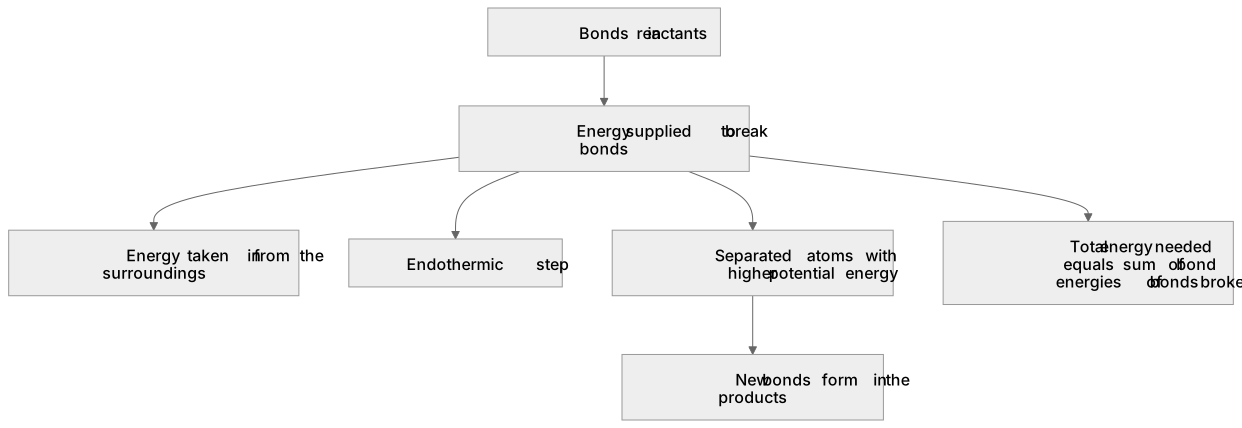
Chemical bonds hold atoms together, so pulling them apart requires work against the attractive forces. In a reaction, the first stage is breaking the bonds in the reactant molecules, and this step is endothermic: energy is taken in from the surroundings. For example, splitting H₂ into two H atoms needs energy input, and breaking O₂ into two O atoms also needs energy input. The total energy needed equals the sum of the bond energies of all bonds broken in the reactants. This energy is not lost; it is stored in the separated atoms. Only after this input can new bonds form in the products. Understanding this clause lets you calculate the overall energy change of a reaction by comparing energy in (breaking) with energy out (forming).
What earns the marks
- Breaking a chemical bond requires an input of energy because work must be done against the electrostatic attraction holding the atoms together.
- The energy supplied to break bonds in the reactants is endothermic and is taken in from the surroundings, so the reactant mixture cools if no other process occurs.
- The total energy required to break all bonds in the reactants equals the sum of the bond energies for every bond broken, using values in kJ mol⁻¹.
- Bond breaking produces separated atoms or fragments with higher potential energy than the bonded reactants, so the process is not spontaneous without an energy source.
- In an overall calculation, energy in from bond breaking is compared with energy out from bond formation to decide whether the reaction is exothermic or endothermic.
Common mistakes and how to put them right
Thinking that breaking bonds releases energy because reactions can feel hot.
Put it right by stating that bond breaking always takes energy in, while bond formation releases energy.
Adding bond energies for bonds in the products when calculating energy supplied to break reactant bonds.
Put it right by summing only the bonds broken in the reactants.
Writing that energy is destroyed or created during bond breaking.
Put it right by saying energy is transferred from the surroundings and stored in the separated atoms.
Exam tips
- Underline the words reactants and supplied in the question so you do not accidentally use product bond energies.
- When calculating, list every bond broken in the reactants and sum their bond energies before doing any subtraction.
- Use the phrase energy is taken in from the surroundings when explaining why bond breaking is endothermic.
- Questions requiring you to use bond energies to calculate energy supplied are only found on Higher Tier papers.
Try the lesson
The start of the The energy change of reactions (HT only): energy must be supplied to break bonds in the reactants lesson, made from checked teaching notes for this specification point.
Have a go first
In a chemical reaction, what must happen to the bonds in the reactant molecules before new bonds can form?
Listen
Chemical bonds hold atoms together, so pulling them apart requires work against the attractive forces. In a reaction, the first stage is breaking the bonds in the reactant molecules, and this step is endothermic: energy is taken in from the surroundings. For example, splitting H₂ into two H atoms needs energy input, and breaking O₂ into two O atoms also needs energy input. The total energy needed equals the sum of the bond energies of all bonds broken in the reactants. This energy is not lost; it is stored in the separated atoms. Only after this input can new bonds form in the products. Understanding this clause lets you calculate the overall energy change of a reaction by comparing energy in (breaking) with energy out (forming). A strong answer earns marks for these points. Breaking a chemical bond requires an input of energy because work must be done against the electrostatic attraction holding the atoms together. The energy supplied to break bonds in the reactants is endothermic and is taken in from the surroundings, so the reactant mixture cools if no other process occurs. The total energy required to break all bonds in the reactants equals the sum of the bond energies for every bond broken, using values in kJ mol⁻¹. Bond breaking produces separated atoms or fragments with higher potential energy than the bonded reactants, so the process is not spontaneous without an energy source. A common slip: Thinking that breaking bonds releases energy because reactions can feel hot. Instead, stating that bond breaking always takes energy in, while bond formation releases energy. Exam tip: Underline the words reactants and supplied in the question so you do not accidentally use product bond energies.
See it
Key words
Say what each word means before you turn the card.
Bond breaking
Try answering aloud or in your head before turning the card.
Energy transfer between surroundings and reacting particles
Try answering aloud or in your head before turning the card.
Conservation of energy in chemical reactions
Try answering aloud or in your head before turning the card.
See every definition
- Bond breaking
- Energy must be supplied to break bonds in the reactants, and this step is endothermic because energy is taken in from the surroundings.
- Energy transfer between surroundings and reacting particles
- Energy is taken in from the surroundings to break bonds, and this energy is not lost but stored in the separated atoms.
- Conservation of energy in chemical reactions
- Energy is not lost when bonds break; it is stored in the separated atoms, and overall change is found by comparing energy in with energy out.
Label the diagram
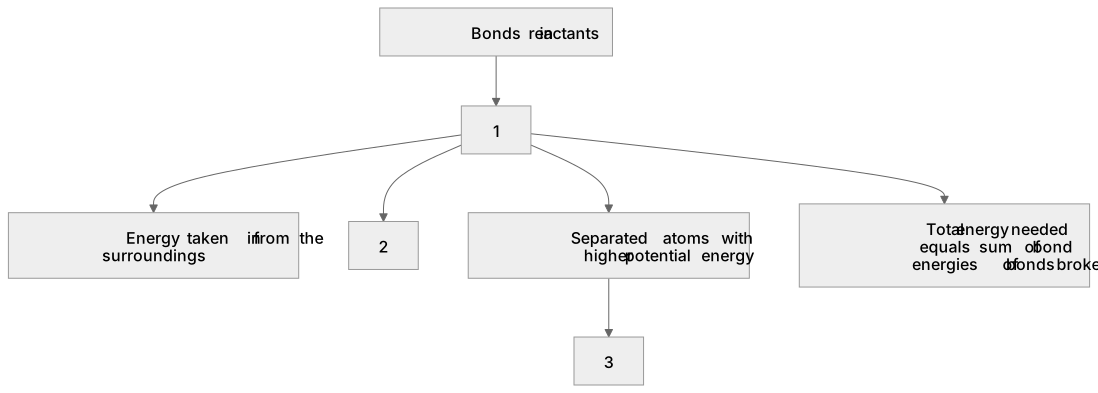
Some boxes have lost their names. Pick the right name for each number.
1Box 1
2Box 2
3Box 3
There is more to this lesson
The full lesson goes on to check your understanding and help you earn the marks. Create a free account to carry on, with your progress saved.
A week of Premium from your first lesson · Then the free plan continues · No card, no charge
Test your understanding of The energy change of reactions (HT only): energy must be supplied to break bonds in the reactants
Active recall beats re-reading. Take an instant quiz now to test what you’ve learned and lock it into long-term memory.
A week of Premium from your first lesson · Then the free plan continues · No card, no charge